D
Deleted member 36735
Guest
800 posts suggest otherwiseI think makes it clear.


800 posts suggest otherwiseI think makes it clear.
But you're saying that the wheels are being prevented from rotating. So zero speed.It's the belt's movement that is preventing the wheels from rotating (this outcome is hardwired by the problem setter). If the belt were stationary, the wheels would be rotating extremely quickly as the plane accelerated along it..
I'm not reading a good book at the moment and I've spent a lot of time this week on trains or sitting with sleeping elderlies. It's been a good distraction.There is a huge irony that we have spent a week talking about wheels. A thread that just goes round and round and round
Remeber these wheels are passive - the jet is accelerating as it pushes against the air behind it. The wheels are simply passive, like a dinky toy. If you break the plane's journey into sections it might make more sense. So if the jet engines engage and plane starts down conveyor at 1mph the conveyor reacts by moving at 1mph in the same direction (wheels therefore do not rotate, but both plane and conveyor are now moving at 1mph). The plane now accelerates to 10mph and conveyor responds, increasing its speed to 10mph - wheels still do not rotate, but both plane and conveyor are now travelling at 10mph. Carry on in this fashion to 20, 30 40......150mph, each increase in speed of the jet matched by the treadmill and you will have the jet and the treadmill reaching the jet's take-off speed. The fact the wheels haven't needed to rotate is interesting but has no impact otherwise.But you're saying that the wheels are being prevented from rotating. So zero speed.
And since, "the conveyer belt is programmed to match the speed of the plane's wheels" the belt is stationary.
So the wheels are not rotating but the belt, which is programmed to exactly match their speed in the opposite direction, is moving at 150mph.Remeber these wheels are passive - the jet is accelerating as it pushes against the air behind it. The wheels are simply passive, like a dinky toy. If you break the plane's journey into sections it might make more sense. So if the jet engines engage and plane starts down conveyor at 1mph the conveyor reacts by moving at 1mph in the same direction (wheels therefore do not rotate, but both plane and conveyor are now moving at 1mph). The plane now accelerates to 10mph and conveyor responds, increasing its speed to 10mph - wheels still do not rotate, but both plane and conveyor are now travelling at 10mph. Carry on in this fashion to 20, 30 40......150mph, each increase in speed of the jet matched by the treadmill and you will have the jet and the treadmill reaching the jet's take-off speed. The fact the wheels haven't needed to rotate is interesting but has no impact otherwise.
It's a very expensive way to reduce tyre wearSo the wheels are not rotating but the belt, which is programmed to exactly match their speed in the opposite direction, is moving at 150mph.
Sack the programmer.
Exactly. Go to a gym. Set the treadmill to 4 mph ( meaning it is coming towards you as you stand on it facing forwards )At that speed, you need to run at 4 mph to stay stationary)Yes there is, it's the same concept. In the Aircraft the jet engines thrust is generating the work to gain forward momentum. In the case of a human walking the work is generated by the pushing motion of the feet powered by the thrust generated through muscles, tendons and bones. You are getting confused by suggesting the engine can create an amount of thrust that will overpower the neutralising effect of the conveyor but the original specification states this won't happen.
Not the same at all. Not even close.Exactly. Go to a gym. Set the treadmill to 4 mph ( meaning it is coming towards you as you stand on it facing forwards )At that speed, you need to run at 4 mph to stay stationary)
Now stop running…………@nd you get thrown back!
Same principle for the jet except the treadmill is going at 180mph, so the jet has to thrust enough to get the wheels turning fast enough for the plane to stay stationary (in respect of the terrain around it). Obviously, the treadmill and the plane get up to 180 mph in a gradual way.
In order to get to that situation the wheels are turning fast enough that if they were on a tarmac runway ( a stationary surface),like the one at Gatwick, the plane would be travelling at 180 mph.
So, on your treadmill the jet is stationary and there is no air travelling over the wing to create enough lift for takeoff.
On the Gatwick tarmac, the plane is displacing the air so that it is travelling over the wings , —. thus lift, thus takeoff
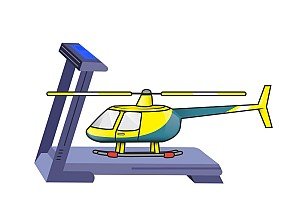
What direction does the rotor turn in?

Either way, it will crash as there is no tail rotor to counter the torque of the the main rotor.What direction does the rotor turn in?


 www.facebook.com
Cool experiment, nothing to do with this, but still cool.21M views · 119K reactions | No relativistic relative motion | Physics teachers and students
No relativistic relative motion
Similar concept
I think I understand the point you were making ,is it because the op says the belt and wheels match then that's all it can be ? Is that right ?The plane's wheels aren't wheel spinning forwards, like an accelerating Fiesta, they are skidding. The thrust forces them to skid because they can't go faster than the conveyor belt
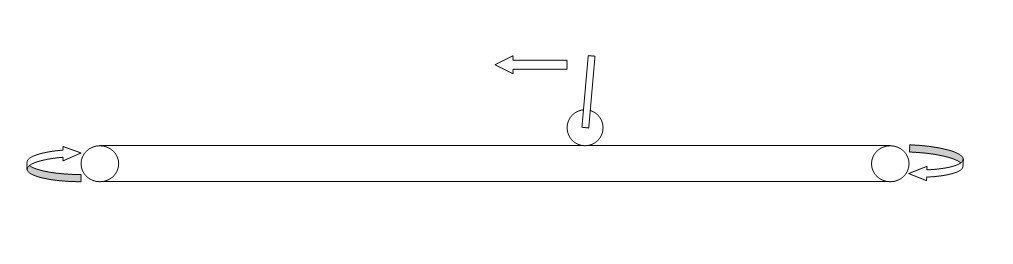
Yes indeed. I understand why he was being so adamant, its just that what was being suggested isn't really possible as the wheels offer minimal friction.View attachment 56999
Wheel and conveyor will be "perfectly matched" (no skidding) even if the conveyor is "speeding up" while the forward motion of the wheel continues.
What you are suggesting can't happen because the wheels have little resistance, Regardless of what you think the op says . There won't be any loss of traction, just the wheels speeding up and the plane taking off.If the conveyer is at x mph (whether that's 0, a constant speed or a variable speed) and the plane is moving in the opposite direction at 100 mph, relative to the Earth and still air, then the plane's wheels have to be rotating at x+100mph.
If there is perfect traction between conveyor and wheels they can't be at the same speed (which is the basic premise of the puzzle).
If the conveyor is moving at 10mph and the plane is moving on freewheels at 100mph then its wheels are rotating at 110 mph. If they're rotating at 10mph, as per the puzzle, then they've lost traction.
I think the freewheel misleads to an equal but opposite extent to how the idea that the thrust wouldn't overcome the friction misled me.
Doesn't help that Mythbusters, as far as I could tell, ignored the whole "same speed" element and just dragged the tarpaulin at a constant 25mph to match the light aircraft's takeoff velocity.


