Plane

  • Thread starter Thread starter Deleted member 35927
  • Start date Start date
Status
Not open for further replies.
If the plane's wheels are rotating faster than the belt, they would have to have some power causing them to do this. The wheels have no power to do this so this does not happen.
If the plane's wheels are rotating faster than the belt, they would be some slipping going on, for this to be occurring.

They wheels can do no more than react passively to the belt passing beneath them. At all times. And the belt and the wheels will be matched at all times with no slipping.

It does not make any difference whether the belt speeds up or not, the wheels rotation will match the belt's speed. The wheels can not do otherwise, because they have no power to do otherwise.

On a normal runway the only thing to be overcome is friction at the start from a stationary position.
Exactly the same on a conveyor.
The post#1 scenario does not include a conveyor that can "think ahead" and "predict" in order to keep the plane stationary.
Once the plane's wheels start to turn the plane will take off as normal.
The plane's wheels aren't wheel spinning forwards, like an accelerating Fiesta, they are skidding. The thrust forces them to skid because they can't go faster than the conveyor belt.
 
I'm mostly confused that anybody can think that "opposite direction" as used in the wording of the puzzle can be interpreted to mean "same direction".
What direction are you thinking off? The direction of the plane, or the direction of the wheels?

If the plane is going right to left, the wheels are going left to right on the surface of the belt.
 
I'm mostly confused that anybody can think that "opposite direction" as used in the wording of the puzzle can be interpreted to mean "same direction".
Here's why.
From the initial problem: “The conveyor belt is programmed to match the speed of the plane’s wheels in the opposite direction, perfectly counteracting their rotation”

Imagine plane is moving right to left. Its wheels will be rotating anti-clockwise i.e. the tyres will be moving from left to right where they contact the ground. To counteract this rotation, the conveyor will move in the opposite diretion right to left, in the same direction as the plane.
 
I'm mostly confused that anybody can think that "opposite direction" as used in the wording of the puzzle can be interpreted to mean "same direction".

I don't think that "opposite direction" can be interpreted as "same direction", however I do think the only way a conveyor can counteract the rotation of a wheel is by moving in the same direction as the wheel is travelling. Unless you can explain another way that can happen?

It's like me stating a bog standard 2p coin is laying on a table tails side up with the image of the monarchs head showing on it's upward facing surface. The interpretation of the words is not at question, everyone can read that the coin is tails side up and the monarchs head is showing, however anyone who knows about coins knows this is impossible a coin cannot be showing heads and tails at the same time. This is how this question is worded.
 
You're getting in a muddle, there is no correlation between walking on an escalator and a jet plane pushing through the air.
Yes there is, it's the same concept. In the Aircraft the jet engines thrust is generating the work to gain forward momentum. In the case of a human walking the work is generated by the pushing motion of the feet powered by the thrust generated through muscles, tendons and bones. You are getting confused by suggesting the engine can create an amount of thrust that will overpower the neutralising effect of the conveyor but the original specification states this won't happen.
 
What direction are you thinking off? The direction of the plane, or the direction of the wheels?

If the plane is going right to left, the wheels are going left to right on the surface of the belt.
The wheels rotate anti-clockwise.
The conveyor belt rotates clockwise; the opposite direction. It's a belt, not just a length of portable runway on rollers.

Here's why.
From the initial problem: “The conveyor belt is programmed to match the speed of the plane’s wheels in the opposite direction, perfectly counteracting their rotation”

Imagine plane is moving right to left. Its wheels will be rotating anti-clockwise i.e. the tyres will be moving from left to right where they contact the ground. To counteract this rotation, the conveyor will move in the opposite diretion right to left, in the same direction as the plane.
The wheels rotate anti-clockwise.
The conveyor belt rotates clockwise; the opposite direction. It's a belt, not just a length of portable runway on rollers.

I don't think that "opposite direction" can be interpreted as "same direction", however I do think the only way a conveyor can counteract the rotation of a wheel is by moving in the same direction as the wheel is travelling. Unless you can explain another way that can happen?

It's like me stating a bog standard 2p coin is laying on a table tails side up with the image of the monarchs head showing on it's upward facing surface. The interpretation of the words is not at question, everyone can read that the coin is tails side up and the monarchs head is showing, however anyone who knows about coins knows this is impossible a coin cannot be showing heads and tails at the same time. This is how this question is worded.
The wheels rotate anti-clockwise.
The conveyor belt rotates clockwise; the opposite direction. It's a belt, not just a length of portable runway on rollers.

Things that rotate are generally described as rotating clockwise or anti-clockwise; not top side left to right or bottom side left to right.
 
The wheels rotate anti-clockwise.
The conveyor belt rotates clockwise; the opposite direction. It's a belt, not just a length of portable runway on rollers.


The wheels rotate anti-clockwise.
The conveyor belt rotates clockwise; the opposite direction. It's a belt, not just a length of portable runway on rollers.


The wheels rotate anti-clockwise.
The conveyor belt rotates clockwise; the opposite direction. It's a belt, not just a length of portable runway on rollers.

Things that rotate are generally described as rotating clockwise or anti-clockwise; not top side left to right or bottom side left to right.
Why does the conveyor have to run clockwise? The problem specifies that the conveyor counteracts the rotation of the wheels - so in the example of the plane moving from right to left with wheels rotating anticlockwise, the conveyor must move in such a way as to make the wheels rotate clockwise. The only way it can do this is if it also moves right to left, in the same direction as the plane. I can't think of a different way to interpret "counteracting their rotation" (if the conveyor moves in the opposite direction to the plane then it will be adding to the wheel's rotation, not counteracting it).
 
Last edited:
Yes there is, it's the same concept. In the Aircraft the jet engines thrust is generating the work to gain forward momentum. In the case of a human walking the work is generated by the pushing motion of the feet powered by the thrust generated through muscles, tendons and bones. You are getting confused by suggesting the engine can create an amount of thrust that will overpower the neutralising effect of the conveyor but the original specification states this won't happen.
When walking you are pushing off the ground (or escalator in this case) to move forward. Thrust from an aeroplane is not using the ground at all to move forward, it is using air.

Imagine a straw on a flat travellator (that you get at airports) it will travel along the travellator in theory it is stationary, but if you apply thrust by the way of blowing on the straw it will move forward on the travellator. The forward movement is not caused by the opposite force of the ground, but by the action of thrust.

The fact that the straw is on the travellator has no bearing on the forward thrust caused by you blowing, it will move forward the same amount regardless if it was on the stationary ground or a travellator moving forward.

So basically when walking you are using the ground to help you move, thrust from a jet engine does not require the ground at, hence why planes keep moving forward in the air!
 
Yes there is, it's the same concept. In the Aircraft the jet engines thrust is generating the work to gain forward momentum. In the case of a human walking the work is generated by the pushing motion of the feet powered by the thrust generated through muscles, tendons and bones. You are getting confused by suggesting the engine can create an amount of thrust that will overpower the neutralising effect of the conveyor but the original specification states this won't happen.
There is no neutralising effect from the belt, plane just keeps on rolling.
 
The wheels rotate anti-clockwise.
The conveyor belt rotates clockwise; the opposite direction. It's a belt, not just a length of portable runway on rollers.


The wheels rotate anti-clockwise.
The conveyor belt rotates clockwise; the opposite direction. It's a belt, not just a length of portable runway on rollers.


The wheels rotate anti-clockwise.
The conveyor belt rotates clockwise; the opposite direction. It's a belt, not just a length of portable runway on rollers.

Things that rotate are generally described as rotating clockwise or anti-clockwise; not top side left to right or bottom side left to right.
The OP doesn't say anything about clockwise or anti-clockwise. When defining "direction" in the OP, you have chosen to define direction as clockwise or anti-clockwise. Yet, when you look at the point of contact between the belt and the wheel, you can simply define the directions as right and left.
 
Another way of thinking of this,

Swap the plane for a rocket which thrusts off the ground to move vertically upwards, If at the side of the rocket was a conveyor belt, moving at the same speed as the rocket moves upwards, would the rocket take off,

Of course it would.

all the plane is doing in this scenario is using thrust to move horizontally along the ground until their is enough lift through the wings to make it airborne.
 
Imagine for a second the plane was just levitating in the air, if the pilot applied thrust it will still move forward,

the ground / wheels have zero bearing on the forward movement of the plane.

Think of a hover craft, it is hovering from downward thrust keeping it in the air and moves forwards from thrust directed backwards, again movement is not created because of the ground but because of thrust of air.

Humans walk by exerting a force on a solid object (ground) which in turns creates an opposite force to move us forward, hence why we cant walk on water as we cant exert enough force on the water.
 
Why does the conveyor have to run clockwise? The problem specifies that the conveyor counteracts the rotation of the wheels - so in the example of the plane moving from right to left with wheels rotating anticlockwise, the conveyor must move in such a way as to make the wheels rotate clockwise. The only way it can do this is if it also moves right to left, in the same direction as the plane. I can't think of a different way to interpret "counteracting their rotation" (if the conveyor moves in the opposite direction to the plane then it will be adding to the wheel's rotation, not counteracting it).
The OP doesn't say anything about clockwise or anti-clockwise. When defining "direction" in the OP, you have chosen to define direction as clockwise or anti-clockwise. Yet, when you look at the point of contact between the belt and the wheel, you can simply define the directions as right and left.
But the problem does say that "the conveyer belt is programmed to match the speed of the plane's wheels in the opposite direction, perfectly counteracting their rotation."
In your scenario the wheel is prevented from ever rotating, so the belt never moves. The problem would be can a jumbo jet take off with locked brakes?
 
But the problem does say that "the conveyer belt is programmed to match the speed of the plane's wheels in the opposite direction, perfectly counteracting their rotation."
In your scenario the wheel is prevented from ever rotating, so the belt never moves. The problem would be can a jumbo jet take off with locked brakes?
Not quite. The belt is moving (it has to in order to counteract the wheel rotation that would otherwise be happening as the plane is accelerating). In fact, the conveyor will be accelerating at exactly the same rate as the plane (this is the only way to ensure the wheel rotation is perfectly counteracted). Once the plane and treadmill get to circa 150mph, the jet will take off.

(The direction the wheels are moving has two possible interpretations 1) the whole structure of the wheel is moving with the plane and in the same direction as the plane 2) the wheel is rotating and at the point of contact with the ground this rotation is in the opposite direction to the movement of the plane. If you go with option 1), the treadmill will be travelling in the opposite direction to the plane but then the requirement “counteracting their rotation” is not met – the conveyor will be increasing wheel rotation not counteracting it. If you go with option 2) then the conveyor will be moving in the same direction as the plane and in this case the requirement to counteract the wheel’s rotation is met.)
 
But the problem does say that "the conveyer belt is programmed to match the speed of the plane's wheels in the opposite direction, perfectly counteracting their rotation."
In your scenario the wheel is prevented from ever rotating, so the belt never moves. The problem would be can a jumbo jet take off with locked brakes?
A jumbo jet could move forward with locked breaks, the question will then be can it generate enough air speed to lift off before the tyres wheels and rest of the fixings under the aircraft disintegrate.
 
But the problem does say that "the conveyer belt is programmed to match the speed of the plane's wheels in the opposite direction, perfectly counteracting their rotation."
In your scenario the wheel is prevented from ever rotating, so the belt never moves. The problem would be can a jumbo jet take off with locked brakes?
Noticed this has already been replied to. Just to break it down:

"In your scenario the wheel is prevented from ever rotating": Yes, hence perfectly counteracting their rotation as per the OP
"so the belt never moves" - No. The belt does move. In the same direction and speed as the plane, and in the opposite direction the wheels are trying to move against the belt
"The problem would be can a jumbo jet take off with locked brakes" - Not sure this bit is relevant, as we've already established the wheel is free-wheeling on take off. But, if brakes were applied (on a static runway), then an extra force is applied against the ground (as the wheels stop turning, and grip on the surface). Yes, that force would try and counter the forward movement of the plane. But, I doubt that would amount to much when the 4 engines of a jumbo-jet are trying to push it forward. Friction would just be exceeded and the wheels would slide along the ground, take a touch more time to get up to speed. I'm not sure I would look forward to landing on those wheels
 
Not quite. The belt is moving (it has to in order to counteract the wheel rotation that would otherwise be happening as the plane is accelerating). In fact, the conveyor will be accelerating at exactly the same rate as the plane (this is the only way to ensure the wheel rotation is perfectly counteracted). Once the plane and treadmill get to circa 150mph, the jet will take off.

(The direction the wheels are moving has two possible interpretations 1) the whole structure of the wheel is moving with the plane and in the same direction as the plane 2) the wheel is rotating and at the point of contact with the ground this rotation is in the opposite direction to the movement of the plane. If you go with option 1), the treadmill will be travelling in the opposite direction to the plane but then the requirement “counteracting their rotation” is not met – the conveyor will be increasing wheel rotation not counteracting it. If you go with option 2) then the conveyor will be moving in the same direction as the plane and in this case the requirement to counteract the wheel’s rotation is met.)
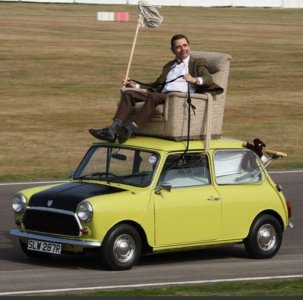
For me, the direction of wheel movement also has two interpretations. Assuming the car in this picture is moving forwards...
IMG_3877 Copy.jpeg
I would say that the wheels are either moving forwards or rotating anti-clockwise.
I can't ever imagine saying that the wheels are moving bottom surface backwards.
 
"so the belt never moves" - No. The belt does move. In the same direction and speed as the plane, and in the opposite direction the wheels are trying to move against the belt
The belt doesn't move unless the wheels are rotating. If the wheels aren't rotating the belt is stationary.
 
For me, the direction of wheel movement also has two interpretations. Assuming the car in this picture is moving forwards...
View attachment 56951
I would say that the wheels are either moving forwards or rotating anti-clockwise.
I can't ever imagine saying that the wheels are moving bottom surface backwards.
Agreed, this isn't terminology that would be used outside of this specific problem. The puzzle writer presumably wanted a way to get across the fact that the conveyor acts to counteract the wheel rotation that would be otherwise occuring. It seems they went with using the direction of the "wheel rotation at point of contact with the ground" option, since this is the only way for the next phrase of the puzzle to make sense ("counteracting their rotation"). The phrasing certainly adds to the confusion, but the counteracting rotation bit I think makes it clear.
 
The belt doesn't move unless the wheels are rotating. If the wheels aren't rotating the belt is stationary.
It's the belt's movement that is preventing the wheels from rotating (this outcome is hardwired by the problem setter). If the belt were stationary, the wheels would be rotating extremely quickly as the plane accelerated along it..
 
Status
Not open for further replies.
Top