• We'd like to take this opportunity to wish you a Happy Holidays and a very Merry Christmas from all at Golf Monthly. Thank you for sharing your 2025 with us!

Plane

  • Thread starter Thread starter Deleted member 35927
  • Start date Start date
Status
Not open for further replies.
Starting how though?
Other folks (not you) just repeating that 250k bhp is unstoppable doesn't enable a freewheel to roll if the body above it is stationary.
The plane has to move forward for the wheel to roll. Even when the thrust breaks through the friction holding it stationary that is the wheel skidding, not rolling.
Would that allow the wheel to start rolling or would it just continue skidding as if locked?
The thrust would push the plane forward, the wheel would begin to rotate in the (impossible) scenario the conveyor would immediately match the wheel rotation, the thrust would continue to accelerate the plane causing the wheel to rotate faster, matched by the conveyor. The wheel and the conveyor would both keep accelerating, the thrust of the engines would then cause the wheel to skid (while still rotating and accelerating).
 
The (logic) problem matching wheel speed to conveyor if they’re travelling in opposite directions is presumably why the OP framed the question how they did, adding a requirement that the conveyor’s movement counters the wheel rotation. As we’ve discussed before, conveyor moving in the opposite direction to plane doesn’t counter, but increases wheel rotation.

I’ve described previously what I think would happen if we ignore the “countering their rotation” phrase, but breaking it down into split seconds may (or may not!) help. So with engines off, plane is stationary and conveyor is stationary. Jet starts engines and begins to move forwards, say at 1 mph. Conveyor, according to the requirements of the problem, starts moving at 1mph in the opposite direction. Immediately this happens the wheels are now spinning at 2mph. (The relative speed difference between plane and conveyor (1 mph) is surely insufficient to lock the wheels/cause wheel spin). So conveyor is 1 mph, wheels are 2 mph and as per the requirement of the problem, the conveyor immediately speeds up to 2mph to match the wheels, which instantaneously increases the wheel speed to 3 mph. You can see where this is going, each time the conveyor speeds up, the wheels are sped up by the same amount, so that when added to the (trivial) initial movement of the plane, they can never match. If the adjustments are happening instantaneously, then within a split second the conveyor (and the plane’s wheels) will be approaching light speed and the physics will start to get really interesting. The relative difference in speed between conveyor and wheels is always 1 mph in this example and insufficient to lock the wheels. You could imagine that there will be some lag in the system and the changes might happen more slowly – in which case the plane will continue to accelerate along and may take off before the conveyor blows up (the plane doesn’t care how fast its wheels are spinng, the wheels have no ability to retard the plane’s progress, they just spin).

Some may argue that the plane can never budge an inch in this scenario, since to do so would require wheel speed which isn’t matched to conveyor speed even if just for a microsecond. This approach is simply taking the question to be “a plane is locked stationary on a treadmill by some mystery force, will it take off?”, which isn’t much of a conundrum. If you write the question as conveyor and plane travel in opposite directions and the conveyor matches the plane’s speed (rather than the wheels), there is no problem – as we’ve previously discussed the plane and the conveyor speed up, the wheels spin twice as fast as both and the plane takes off. I still think the OP in this thread can only really be interpreted as plane and conveyor moving in the same direction.
It is well put, and a problem I tried to demonstrate earlier in this thread. Assuming the software only makes a reaction every 1 second, and based on the planes acceleration as well, I calculated the treadmill would be going over 1300 mph by time plane takes off. In reality, it would be approaching the speed of light, as software will react in very small fractions of a second
 
The body above isn't stationary. It's moving forward rolling on it's wheels no matter what your conveyor is doing rolling not skidding or dragging.
The 250k ref comes from newtons 3rd law and your ability to suggest it can just be vanished away.
Imagine a conveyor belt moving backwards at 10mph and a freewheeling jet or fan propelled vehicle moving forwards (relative to the Earth and air) at 10mph.
It's speed relative to the belt is therefore 20mph.
It's wheels are rotating at 20mph - not the same speed as the belt.

If they're rotating at 10mph like the belt then they are skidding.

Newton would have agreed with me.
 
Imagine a conveyor belt moving backwards at 10mph and a freewheeling jet or fan propelled vehicle moving forwards (relative to the Earth and air) at 10mph.
It's speed relative to the belt is therefore 20mph.
It's wheels are rotating at 20mph - not the same speed as the belt.

If they're rotating at 10mph like the belt then they are skidding.

Newton would have agreed with me.
Your just getting in a muddle, sorry.
 
Having read a lot of replies to this question a lot of answer are questioning the idea that the conveyor belt can't match the speed of the wheels but that's not the question. It says it matches them perfectly. In that case the plane can't take off. It's like a car being stuck in mud with the wheels spinning.
 
Having read a lot of replies to this question a lot of answer are questioning the idea that the conveyor belt can't match the speed of the wheels but that's not the question. It says it matches them perfectly. In that case the plane can't take off. It's like a car being stuck in mud with the wheels spinning.
No it's not, nothing like it.
 
Just googled that and yes.
The plane on a conveyor belt is basically a load of old tosh designed to cause internet forum disagreements. He summarises everything about it perfectly.

Very successful load of old tosh though. It's only when I caught myself arguing that I applied the useful question to ask yourself in a disagreement "why would a reasonable person think this way?" and dug a bit deeper.
 
If the plane is moving forwards then either it's wheels are moving faster than the conveyor or it is skidding.

Lets say the whole length of the conveyor is 10,000 times the circumference of the wheel.
One whole rotation of the conveyor will match 10,000 rotations of the wheel.
The ratio will always be 1 to 10,000 in terms of their rotations.

The observer might perceive the plane to be moving along the conveyor, but it is actually moving through the air above the conveyor.
The conveyor makes no difference to the plane, the plane moves as if the wheels were hovering 1mm above the conveyor.
The fact that it is 1mm lower than this and has contact with the conveyor, causes the wheels to turn. They do not skid in this scenario.
The wheels will match the conveyor at one rotation to 10,000 rotations whatever the conveyor speed and whatever the speed the plane is doing through the air, including being stationary in the air.
Hovering in the air, running along a normal runway or running along a conveyor - plane takes off in the same way.
There is no backward pressure from the wheels as there is with driven wheels or human feet. The wheels are passive.
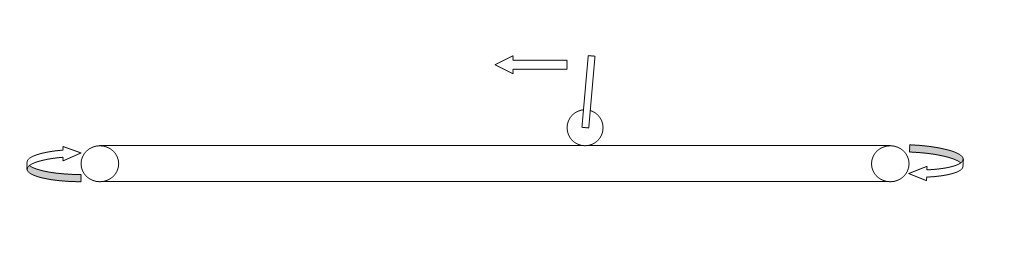
conveyor.jpg
The wheel does 10,000 rotations for every one rotation of the conveyor, if the conveyor belt's whole length is 10,000 times that of the circumference of the wheel.
And this remains the same, whatever the speed of rotation of the conveyor and/or the speed of the plane through the air above the conveyor.

The wheels to not "need" to rotate "faster" than the conveyor in order for it to move through the air above the conveyor.
That is the wrong choice of words to describe what is happening.
The conveyor's rotation and the wheel's rotation will always be the fixed ratio relative to each other.
The wheels can't "do more" they are passive and have no power.
The conveyor altering it's rotation speed will mean that the wheels alter their rotation speed - to match. They do this passively - they can not do otherwise.

The wheels move along a surface. It does not matter whether that surface is a solid static runway or a conveyor, the plane is not hindered.
And the wheels do not skid on the conveyor, it takes off as normal, with wheels' rotation perfectly matching the rotation of the conveyor in a fixed ratio.

Overcoming the perception that the wheels "must rotate faster" than the conveyor for it to move along the conveyor - can be difficult to do.
To do this - forget "moving along the conveyor" and replace with "moving through the air above the conveyor".
This should free the mind from how driven wheels behave.

The wheels are there merely because the plane does not hover.
But the plane behaves just about the same as a hovering one would do, if that hovering one lowered a wheel form itself to just touch the conveyor to make it turn.

Force of jet engine causes plane to move through the air. The wheel below is just a dangly thing of little importance.
(Of course it has some importance, but far less than a lot of people realise, because they perceive how driven wheels behave most of the time)
 
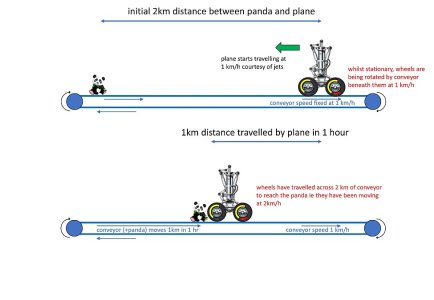
The above isn't quite correct - it is the case that if the plane moves along the conveyor (without skidding /wheels locking) its wheels must have spun faster than the conveyor - that's why the question does not work if plane and conveyor are assumed to be travelling in opposite directions (the plane is constrained by the question to remain at one end of the conveyor by some mystery force that isn't explained). However, solving the problem by having the wheels unilaterally decide to lockup is unsatisfactory - the obvious question being why don't they just spin as they were designed to do. With too much time on my hands there is a diagram below with some unrealistic numbers just to demonstrate wheelspeed greater than conveyor speed when plane moves along conveyor (no pandas were actually injured etc etc .......)

panda and plane.jpg
 
Status
Not open for further replies.
Top