• We'd like to take this opportunity to wish you a Happy Holidays and a very Merry Christmas from all at Golf Monthly. Thank you for sharing your 2025 with us!

Percentage of Single Digit Handicap Players.

You could well be right about the weighting however I was merely responding to a comment about greens difficulty not being taken into account.
There appears from time to time the belief that raters just stroll around a course and randomly make up a number over coffee afterwards. I just always like to point out that a lot goes into it, whether or not you are happy with what comes out of it is of course entirely down to you.
It’s also worth noting that the process has to be the same (or as close to as possible) the world over, so it has to be as objective as possible.
Also just a point re Orikoru’s point on his club’s greens, there is no legislating for stupid/ill advised or downright unplayable pin positions which have been cited on here in the past, you can make any course ridiculously difficult by setting it up wrong.

I wasn't disagreeing with you, just building on your comments.

I understand why length is the key factor. I used to be a member at a short course (Orikoru's old club Haste Hill) and there were single figure golfers there who would be a good 5 or 6 shots higher if they were members at a longer course. People with short or wonky swings who can safely chop it around a short course and make GIR on 300 yard par fours. That approach doesn't work on longer courses. Slab has discussed this several times when talking about his course.
 
There appears from time to time the belief that raters just stroll around a course and randomly make up a number over coffee afterwards. I just always like to point out that a lot goes into it, whether or not you are happy with what comes out of it is of course entirely down to you.
I have no doubt that the course rating process involves a great number of careful measurements, which are then plugged into a formula which calculates the course rating so that it is as objective as possible.

However, the question remains as to whether sufficient weighting is given to the various hazards, green characteristics, etc. If you plot a graph of course length v. course rating you'll get something very close to a straight line (with a very small number of outliers). That suggests to me that length is the overwhelmingly major factor that determines course rating. Which prompts me to wonder just why they go to so much effort measuring all the things they do when it has so little impact on the outcome. You may as well just use the overall length and be done with it.
 
No offence, but Grims Dyke is a short course which appeals to high handicappers. There are loads of courses in the area and Grims Dyke has a role to play as a gentle entry level course for beginners or older golfers. Better players will head to Moor Park, Sandy Lodge or Pinner for a more challenging place to play.
Just a quick question, if I may...
Have you actually played Grims Dyke? And if so, what did you score?
 
I have no doubt that the course rating process involves a great number of careful measurements, which are then plugged into a formula which calculates the course rating so that it is as objective as possible.

However, the question remains as to whether sufficient weighting is given to the various hazards, green characteristics, etc. If you plot a graph of course length v. course rating you'll get something very close to a straight line (with a very small number of outliers). That suggests to me that length is the overwhelmingly major factor that determines course rating. Which prompts me to wonder just why they go to so much effort measuring all the things they do when it has so little impact on the outcome. You may as well just use the overall length and be done with it.
I take your point that length is definitely the overwhelming factor but I have never seen such a graph on length vs CR & BR - do you know if it exists? It would of course be effective length as upslopes and downslopes in landing areas as well as elevation plus forced or choice lay ups also will shorten or lengthen the actual length.
It would be interesting to calculate CR and BR per yard as this would give a different measure of difficulty.
 
No idea, would have to ask our golf manager unless there’s another way of finding out. 635 full m&f members.

But looking at the most recent comp - 91 playing off forward tee - combined men and women comp…and handicaps range looks pretty representative of the club but prob slightly more lower handicappers play in this comp pro rata. 20 off SF out of 91 so 22%. On that basis I’m thinking the club figure might be about 20%. We are a very competitive club, and our excellent practice and teaching facilities encourage improvement.
I asked the question earlier…and it’s something like 12-15% (1/8 to 1/7). Proportionally more higher handicappers don’t play so much competition golf…they are happy just playing socially. Competition fields will find maybe about 20% having HIs of 9.9 or less.

And out of interest I asked about the ‘handicap and winning comps’ question….to which the answer is that at my place the evidence shows SF handicappers do pretty much as well in comps as higher handicappers…maybe the SF players don’t win as many handicap comps as higher handicappers, but that could simply be a statistical ‘numbers playing’ effect as anything.

Certainly it seems that playing off our 2nd longest course (purple) doesn’t seem to give higher handicappers much of an advantage even given they lose ‘just’ 3 or 4 shots.
 
I take your point that length is definitely the overwhelming factor but I have never seen such a graph on length vs CR & BR - do you know if it exists?
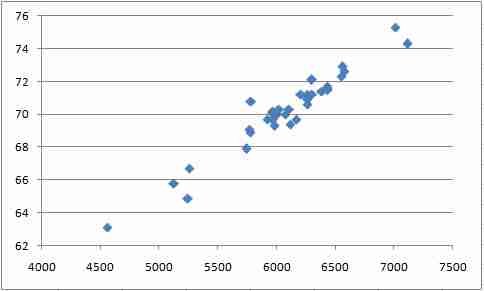
A while back I posted such a graph:
 
A while back I posted such a graph:
Interesting, how many courses were there in the data points, were there different tee sets from the same courses? Also did you do it for bogey ratings or just CR?
 
A while back I posted such a graph:

Of course you are going to see this correlation. A par 72 course is going to be longer than a par 67 course.

I think what you need to plot is the difference between CR and par against length.
 
Of course you are going to see this correlation. A par 72 course is going to be longer than a par 67 course.

I think what you need to plot is the difference between CR and par against length.
Wouldn’t you just need CR & BR per 100 yards. The par is irrelevant. This would give you a measure of difficulty as if it was purely yardage these values would be identical for every course.
 
A while back I posted such a graph:
Even with your small sample size, the variance created by non-yardage factors is clearly significant (2-3 strokes difference in the CR of similar length courses).
I expect the variance in Slope Ratings would be similarly significant.
 
Interesting, how many courses were there in the data points, were there different tee sets from the same courses? Also did you do it for bogey ratings or just CR?
There's only one data point per course; CR off the white tees. I didn't do BR or slope. I can't remember how many courses were involved (feel free to count the number of data points 😅)
They were all courses near to me, so that'll be Devon/Dorset/Somerset.
Of course you are going to see this correlation. A par 72 course is going to be longer than a par 67 course.
The graph is CR against length.
Even with your small sample size, the variance created by non-yardage factors is clearly significant (2-3 strokes difference in the CR of similar length courses).
I expect the variance in Slope Ratings would be similarly significant.
Look closer and you'll see there's only a couple of outliers. One is about 5250 yds with a CR just under 65 (Cricket St Thomas); the other is about 5800 yds with a CR just under 71 (Yeovil). Apart from those two, the correlation is very close.
 
Just had a quick look at ours.
1278 active handicaps including men, ladies and juniors.
19 (1.5%) plus handicap
90 (7%) 0 - 4.9
363 (28%) total. plus - 9.9
Me? Well within top 2/3rds :) although interestingly, according to England Golf, I'm in top 46% in Kent and top 43% in England. Not sure what that proves though :confused:
 
There's only one data point per course; CR off the white tees. I didn't do BR or slope. I can't remember how many courses were involved (feel free to count the number of data points 😅)
They were all courses near to me, so that'll be Devon/Dorset/Somerset.

The graph is CR against length.

Look closer and you'll see there's only a couple of outliers. One is about 5250 yds with a CR just under 65 (Cricket St Thomas); the other is about 5800 yds with a CR just under 71 (Yeovil). Apart from those two, the correlation is very close.

You’ve missed the point here. A course with par 72 / CR 72 is always going to be longer than a course with par 65 / CR 65. Regardless of difficulty
 
You’ve missed the point here. A course with par 72 / CR 72 is always going to be longer than a course with par 65 / CR 65. Regardless of difficulty
So what you're saying is that longer courses have higher CRs.
Or, to put it another way, CR is basically determined by length.
Which is precisely what I've been saying all along.
(Par is irrelevant, BTW)

PS. You still haven't told us what you scored when you played that micky mouse course Grims Dyke.
 
Ours is 25%

I asked Claude.ai to plot as many English courses for length against CR. It found about 20 from the top 100 course list and did some statistical analysis: https://claude.ai/public/artifacts/2d793c79-d1e7-48d5-b938-7b7f7c5a5c3a

Statistical Interpretation:​

  • • The linear regression shows that for every 100 yards of additional length, the course rating increases by approximately 0.41 points
  • • The R² value of 0.9817 indicates that 98.2% of the variation in course rating can be explained by course length
  • • The standard deviation of ±0.236 shows the typical scatter of actual ratings around the predicted regression line
  • • The correlation coefficient of 0.991 suggests a strong positive relationship between length and rating
  • • Course design factors beyond length (hazards, terrain, wind exposure) account for the remaining 1.8% of rating variation
 
Ours is 25%

I asked Claude.ai to plot as many English courses for length against CR. It found about 20 from the top 100 course list and did some statistical analysis: https://claude.ai/public/artifacts/2d793c79-d1e7-48d5-b938-7b7f7c5a5c3a

Statistical Interpretation:​

  • • The linear regression shows that for every 100 yards of additional length, the course rating increases by approximately 0.41 points
  • • The R² value of 0.9817 indicates that 98.2% of the variation in course rating can be explained by course length
  • • The standard deviation of ±0.236 shows the typical scatter of actual ratings around the predicted regression line
  • • The correlation coefficient of 0.991 suggests a strong positive relationship between length and rating
  • • Course design factors beyond length (hazards, terrain, wind exposure) account for the remaining 1.8% of rating variation
And in English? 😂
 
Ours is 25%

I asked Claude.ai to plot as many English courses for length against CR. It found about 20 from the top 100 course list and did some statistical analysis: https://claude.ai/public/artifacts/2d793c79-d1e7-48d5-b938-7b7f7c5a5c3a

Statistical Interpretation:​

  • • The linear regression shows that for every 100 yards of additional length, the course rating increases by approximately 0.41 points
  • • The R² value of 0.9817 indicates that 98.2% of the variation in course rating can be explained by course length
  • • The standard deviation of ±0.236 shows the typical scatter of actual ratings around the predicted regression line
  • • The correlation coefficient of 0.991 suggests a strong positive relationship between length and rating
  • • Course design factors beyond length (hazards, terrain, wind exposure) account for the remaining 1.8% of rating variation
Thanks for this. It's independent verification of what the graph I posted shows. But will it persuade those who deny that course factors other than length are given insufficient consideration when calculating CR? Probably not.
 
We have 350 (248 male) 16 (12 male) under 9.5 listed on PZG (Polish Golf Union) at my club
So I guess 4.8% male, 3.9% female 4.5% overall

NB There are stories that our course is still carrying the ratings from when it was a 9 holer which would make handicaps artificially high as the new 9 is tougher (and longer;)) than the original.
 
Last edited:
Top