
• We'd like to take this opportunity to wish you a Happy Holidays and a very Merry Christmas from all at Golf Monthly. Thank you for sharing your 2025 with us!

Plane

  • Thread starter Thread starter Deleted member 35927
  • Start date Start date
Status
Not open for further replies.
You're getting the scenario round the wrong way in some of your examples, the plane does not respond to the conveyor, the conveyor is programmed to respond and counteract/neutralise/offset the movement of the wheels. The movement of the wheels as we all agree is a direct result of the force of the engines pushing, nobody disputes that.

Let me ask you a question:
If the engines provide enough thrust to force the wheels to move one 360 degree rotation forward, but the conveyor is programmed to respond in an exact equal amount to counteract that, how far has the plane travelled in relation to a fixed point next to it?
Right, we have a sound foundation to extend this line of questioning.

The engines provides enough thrust to force the wheels to do one full rotation. But, as you said, the belt is programmed to counter this. By countering this rotation, it would therefore result in zero rotation of the wheels. How can the belt do this? By moving forwards in the same direction as the plane at the same speed.
 
You're getting the scenario round the wrong way in some of your examples, the plane does not respond to the conveyor, the conveyor is programmed to respond and counteract/neutralise/offset the movement of the wheels. The movement of the wheels as we all agree is a direct result of the force of the engines pushing, nobody disputes that.

Let me ask you a question:
If the engines provide enough thrust to force the wheels to move one 360 degree rotation forward, but the conveyor is programmed to respond in an exact equal amount to counteract that, how far has the plane travelled in relation to a fixed point next to it?
If the engines provide enough thrust to force the wheels to move one 360 degree rotation. then we have some sort of drive mechanism to do this, which a normal jet engine plane does not have.
The wheels of the jet plane respond passively to the forward motion of the plane. Or in this case, respond passively as well to the moving surface beneath them that they are in contact with.
The conveyor might be programmed to increase its speed, but the increased speed does not slow the plane if it is already moving, nor does it prevent the plane form going from stationary with little power to moving with increased power.
How it does this is exactly the same as on a static runway.

"Programmed to counteract" does not include wizardry.
It is not a good choice of words to explain what is occurring in the scenario. The speed of the wheels and the speed of the conveyor remain matched at all times.

No matter how fast the conveyor goes, it only takes a little power from the engines to remain stationary. About the same power that it takes on a normal runway for the plane to go from stationary to slightly moving.
From that stationary position on the conveyor an increase in power from the engines will move the plane forwards even if the conveyor increases its speed, because no opposing force is being applied to push the plane backwards.
 
The wheels of the plane can only move as a direct consequence of the forward push of the engine thrust, they have no power of there own.
You've made the basic error of thinking it's like a car, where the wheels turn and push themselves along the floor.
Not the case with a plane, it's push itself against the air.
Yes, I can assure you we all know this and have always been in agreement, nobody thinks the wheels drive the plane.

Yes, the engines provide a thrust which pushes the plane in the direction of the nose, we're all in agreement.

Newtons' 3rd Law comes into effect then as normally the plane is on free-moving wheels and a solid, fixed runway provides an equal and opposite force to the forward movement of the wheels that the engine thrust provides, the the plane moves forward along the runway. If the plane had no undercarriage and was lying on it's belly, Newton's 3rd Law tells us that the extra force of the runway (added friction over a large surface area that also doesn't roll) would require more power from the engines to move the plane forward but it would be possible.

However, it's interesting that you bring up Newton's 3rd Law because this is also part of it:
" If there is no net force acting on a body, either because there are no forces at all or because all forces are precisely balanced by contrary forces, the body does not accelerate and may be said to be in equilibrium. "
So in this case, the fact that the conveyor is programmed to counteract the movement of the wheels, Newton's 3rd Law specifically tells us that the plane will not indeed move forward as the forces are "precisely balanced by contrary forces".

Newton's Laws
 
But, as you said, the belt is programmed to counter this. By countering this rotation, it would therefore result in zero rotation of the wheels. How can the belt do this? By moving forwards in the same direction as the plane at the same speed.
Here is where we disagree.
"Counteracting" is not stopping the wheels from moving, it is negating the effect that the moving wheels have.
At no point in the puzzle is there any mention of stopping the wheels from moving.
 
Yes, I can assure you we all know this and have always been in agreement, nobody thinks the wheels drive the plane.

Yes, the engines provide a thrust which pushes the plane in the direction of the nose, we're all in agreement.

Newtons' 3rd Law comes into effect then as normally the plane is on free-moving wheels and a solid, fixed runway provides an equal and opposite force to the forward movement of the wheels that the engine thrust provides, the the plane moves forward along the runway. If the plane had no undercarriage and was lying on it's belly, Newton's 3rd Law tells us that the extra force of the runway (added friction over a large surface area that also doesn't roll) would require more power from the engines to move the plane forward but it would be possible.

However, it's interesting that you bring up Newton's 3rd Law because this is also part of it:
" If there is no net force acting on a body, either because there are no forces at all or because all forces are precisely balanced by contrary forces, the body does not accelerate and may be said to be in equilibrium. "
So in this case, the fact that the conveyor is programmed to counteract the movement of the wheels, Newton's 3rd Law specifically tells us that the plane will not indeed move forward as the forces are "precisely balanced by contrary forces".

Newton's Laws
No you are misunderstanding every part of this. Your focus is too narrow
 
You mentioned earlier today a sprinter who runs on to a conveyer being slowed down. Yes, this would happen.
But it would not happen if the sprinter was on free spinning wheels and he was powered by a jet-pack.
As he mounts the conveyor he is not slowed. They conveyor can not counteract the jet-pack.
It doesn't counteract the jet pack but the wheels, if speed matched to the conveyor, won't go anywhere. The dude face plants the ground with whatever force is applied to his back by the jet pack.
 
Here is where we disagree.
"Counteracting" is not stopping the wheels from moving, it is negating the effect that the moving wheels have.
At no point in the puzzle is there any mention of stopping the wheels from moving.
If I asked someone to counteract any wheel rotating, I suspect their response would be to do something to stop it rotating. That's what I think anyway
 
No you are misunderstanding every part of this. Your focus is too narrow
OK, correct me in plain English. You quoted Newton's 3rd Law, I've used it as an example and you say my focus is too narrow...


Let me ask you this:
If I push by bicycle along the road with a force that generates 20 mph, it will freewheel at 20 mph initially (minus a tiny bit that we can't see due to minimal friction).

What if I were to push it with exactly the same force onto a treadmill that was moving towards me at 10mph? What speed would this bicycle travel forward in relation to fixed points to the side of the treadmill?
 
If I asked someone to counteract any wheel rotating, I suspect their response would be to do something to stop it rotating. That's what I think anyway
I can see the logic in that thought process.
But the reason I posted the screenshot of the dictionary definition was to take all thinking and interpretation out of the discussion.
I didn't know exactly what it meant so I looked it up. It wasn't patronising as you said, it was meant to be the opposite, to show that I had to look it up and so we could use it as a factual basis rather than just my opinion on what a word means.
 
OK, correct me in plain English. You quoted Newton's 3rd Law, I've used it as an example and you say my focus is too narrow...


Let me ask you this:
If I push by bicycle along the road with a force that generates 20 mph, it will freewheel at 20 mph initially (minus a tiny bit that we can't see due to minimal friction).

What if I were to push it with exactly the same force onto a treadmill that was moving towards me at 10mph? What speed would this bicycle travel forward in relation to fixed points to the side of the treadmill?
That is easy.

If you were also on the treadmill with the bike, you would be moving at 10mph relative to the air (but 20mph relative to the treadmill)

However, if you were walking alongside the treadmill at 20mph, and pushing the bike alongside you which was on the treadmill, both you and the bike would be travelling at 20mph relative to the air. You are not going to be walking at 20mph, and then suddenly be forced to walk half the speed with the same effort simply because the bike went onto the treadmill
 
OK, correct me in plain English. You quoted Newton's 3rd Law, I've used it as an example and you say my focus is too narrow...


Let me ask you this:
If I push by bicycle along the road with a force that generates 20 mph, it will freewheel at 20 mph initially (minus a tiny bit that we can't see due to minimal friction).

What if I were to push it with exactly the same force onto a treadmill that was moving towards me at 10mph? What speed would this bicycle travel forward in relation to fixed points to the side of the treadmill?
This is irrelevant, youre back to your obsession with ground forces again.
 
This is irrelevant, youre back to your obsession with ground forces again.
By having an agenda that everyone except you has some sort of obsession, it just gives you words to post without actually saying anything.
I specifically said that there is a small amount of friction on the bike tyres, much much less than there would be on the plane tyres.

A freewheeling pushbike that has had a force push it on a treadmill is no different than a freewheeling plane that has had a force push it on a treadmill.

The are indeed initially the same, the only difference in the scenario being that the forces on the plane increase as the engines apply more thrust, however this is dealt with by the conveyor always counteracting the increasing speed of the wheels.
 
By having an agenda that everyone except you has some sort of obsession, it just gives you words to post without actually saying anything.
I specifically said that there is a small amount of friction on the bike tyres, much much less than there would be on the plane tyres.

A freewheeling pushbike that has had a force push it on a treadmill is no different than a freewheeling plane that has had a force push it on a treadmill.

The are indeed initially the same, the only difference in the scenario being that the forces on the plane increase as the engines apply more thrust, however this is dealt with by the conveyor always counteracting the increasing speed of the wheels.
No no no. The plane wheels can only increase in speed by being moved forward by the planes engines, ergo the plane is moving.
The conveyor and wheels cannot apply the force required to halt the jet engines.
The planes takes off as normal
It's that simple.
You need an opposing force to stop the jets , you do not have that anywhere.
This constant waffle about joggers , bikes and the like is just that waffle, you cannot power up a plane and believe for a second it will remain still because you are running a conveyor belt underneath it.
 
We live in a world of wheeled vehicles.
Many of these have something visible to drive the wheels.
Those that have no means of propulsion are trolleys etc. These need something else to propel them, like a human pedalling them, a horse pulling them or they can be to hooked-up to another thing that has powered wheels.
This is our experience that gives us our perception of things moving on wheels.

We have a similar perception of conveyors from our experience of them.
Walking against one requires us to go at a faster walking speed than the conveyor to make any progress at all.
Pedalling a bike or driving a car would give us the same experience and perception of what the conveyor is doing to "counteract" our progress.

A jet propelled vehicle is a different thing. Nothing driving the wheels to make it go.
We need a different experience to change our perception.

You are sitting on a bike with no chain and no pedals. No way to make it move forwards?
It is jet powered. You get on, held steady by two mates, engine turn on and off you go up to a maximum speed of 8mph. Wow, great.
You go to a very long conveyor. You mates are strong chaps and they lift you up and gently lower you down towards the conveyor that is 95mph against your intended direction.
Engines are engaged. Your mates are strong enough to stop you from going forwards through the air. You are (********) very terrified.
Your mates lower you down until the wheels touch the conveyor and start to spin.
They let go and you feel your life might be over.
You move forwards against the conveyor and reach 8mph.
You look down at the conveyor and you feel you are doing 100 or so mph on a bike. You look to the side and see you are doing 8mph. Your mates are jogging along next to you just as they did before and you are all having a great laugh.

Your experience has changed your perception.

My grandmother never was able to change her perception of an escalator.
She spent 60 years walking up and down steep slopes in her village in South Wales.
Then she moved to England and started to experience escalators. Going up wasn't too bad, but she never mastered going down.
She would step onto the escalator and expect to need to lean back or sort of brace-backwards a bit as she did when walking down a steep slope to stop her falling forwards.
Then she would realise she was off balance and wobble forwards and backwards. This was very difficult for her.
With repeated experience her perception might have changed. But 60 years of learned perception was difficult to change.

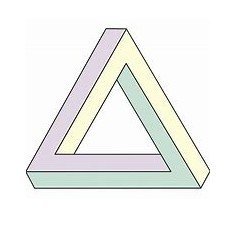
We perceive this object as a 3-dimensional thing. It matches our experience of looking at depictions of 3-dimensional objects.
But it can not be a 3-dimensional thing. It is 3 V-shapes placed together that are 2-dimensional only.
I have never been able to feel that I have fully changed my perception of it. I understand my own explanation above, but the fallibility my human nature has not been fully overcome.

Impossible shape.jpg
I do not feel the need to berate people for how they perceive jet planes on conveyors.
All here have been able to express the sum of their experience, knowledge and perception formed. All very interesting.
But our perceptions can be changed. But are we prepared to think that this is possible?

Have we had the Monty Hall three door problem on this forum before? No point repeating if we have. Or is there?
 
you cannot power up a plane and believe for a second it will remain still because you are running a conveyor belt underneath it.
Did you actually read the meme that you posted? :ROFLMAO:

The whole point of the puzzle is that the conveyor belt counteracts the movement of the wheels, therefore the plane doesn't get pushed forward IN RELATION TO FIXED POINTS like it normally would be. Of course it's rolling forward IN RELATION TO THE CONVEYOR but that's all.

It's obviously a made-up scenario but we can only go on the wording of the question, the conveyor belt counteracting the wheels is the whole central point - the plane is never moving forward.
 
Did you actually read the meme that you posted? :ROFLMAO:

The whole point of the puzzle is that the conveyor belt counteracts the movement of the wheels, therefore the plane doesn't get pushed forward IN RELATION TO FIXED POINTS like it normally would be. Of course it's rolling forward IN RELATION TO THE CONVEYOR but that's all.

It's obviously a made-up scenario but we can only go on the wording of the question, the conveyor belt counteracting the wheels is the whole central point - the plane is never moving forward.
Of course I read it , in your version the answer defies the laws of motion.
 
No no no. The plane wheels can only increase in speed by being moved forward by the planes engines, ergo the plane is moving.
The conveyor and wheels cannot apply the force required to halt the jet engines.
The planes takes off as normal
It's that simple.
You need an opposing force to stop the jets , you do not have that anywhere.
However fast they rotate, the perfectly speed matched conveyor prevents any forward or backward movement of the centre of the wheels. If that plane rolls forward by a millimetre then the one simple rule of the puzzle has been broken.
As the wheels cannot move, the centre of the front wheels becomes a pivot and the forward thrust becomes torque around that pivot.
The thrust from the engines has become a rotational force.
The yes guys are quite right. The force can't go nowhere; it just can't go linearly forward. The planet Earth's surface stops the plane.
 
However fast they rotate, the perfectly speed matched conveyor prevents any forward or backward movement of the centre of the wheels. If that plane rolls forward by a millimetre then the one simple rule of the puzzle has been broken.
As the wheels cannot move, the centre of the front wheels becomes a pivot and the forward thrust becomes torque around that pivot.
The thrust from the engines has become a rotational force.
The yes guys are quite right. The force can't go nowhere; it just can't go linearly forward. The planet Earth's surface stops the plane.

The earth stops it? It just evaporates ?
 
Status
Not open for further replies.
Top