• We'd like to take this opportunity to wish you a Happy Holidays and a very Merry Christmas from all at Golf Monthly. Thank you for sharing your 2025 with us!

Plane

  • Thread starter Thread starter Deleted member 35927
  • Start date Start date
Status
Not open for further replies.
No, the plane moves forward and takes off as it would any other time. It's a straight forward take off, no magic or jiggery pokery.
No what ifs, just simple physics and the laws of motion
Ah. So you both have the conveyor belt propelling the plane to takeoff speed while its wheels are essentially stationary?
 
Ah. So you both have the conveyor belt propelling the plane to takeoff speed while its wheels are essentially stationary?
Jeez . The plane has engines that make it move forward, see newtons 2nd law.
In order to stop it moving forward you'd need some kind of opposing force of equal measure.

A treadmill moving in the opposite direction, no matter what its speed will not stop the plane taking off, how can it?
The wheels aren't driving the plane, they simply offer support and as little rolling resistance as possible.

To the observer it will look like any other take off.
 
Last edited by a moderator:
Interesting. So neither of you are suggesting that this theoretical takeoff is achieved with zero ground speed? It just looks like a normal takeoff with the plane running along the conveyor belt for 2 miles then taking off?
 
plane debate.jpg

I find this to be the best and simplest illustration of the two beliefs expressed on this thread.
And it could be done in a real physical demonstration.

A person moving on rollerskates, forward motion of 5mph powered by a jet-pack, then mounts a travellator moving at 5mph in the opposite direction.
What happens?
1. Person remains motionless relative to the earth.
2. Person continues to move at 5mph relative to the earth as if there were no travellator beneath him.

Answer number 1 would require a direct link between the jet-pack and the wheels of the rollerskates.
ie The jet-pack acts to turn the wheels of the rollerskates at a fixed speed and this speed does not change as the person mounts the travellator.

Answer number 2 would require the wheels of the rollerskates to increase speed of rotation twofold as the person mounts the travellator.
5mph relative to the earth would have to be 10mph relative to the surface of the travellator as far as the rotation speed of the wheels are concerned?
The wheels of the rollerskates are not powered by anything and they are not slowed by anything. They respond passively.

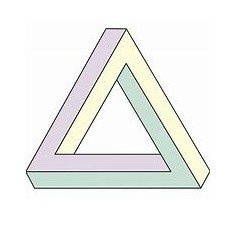
So is it three 2-dimensional V-shapes placed together?
Or is it a 3-dimensional object?
What do you want it to be? What do you see?

Impossible shape.jpg
 
Reddit ?

To be “factually” correct does it not need to be “factually” proven to be correct

So does that mean someone has actually done the experiment
The experiment would be simple. All you would need is a normal treadmill, a programmer to get its speed to respond to wheel speed and a person on roller blades.

The person on roller blades stands on treadmill, and you stand behind them and push them forwards (you are providing thrust). Does the person on roller blades move forwards, or do they remain stationary because the treadmill speeds up in opposite direction?

It hasn't been done, as the answer was, I thought, obvious. But, I didn't realise some would actually believe it true that it would be impossible to push them forwards because of the speed of the treadmill.

To spice things up, strap a small but incredibly powerful jet engine on the Rollerblader. See if that treadmill stops them being thrust straight off the front of the treadmill and through the wall of the building. There seem to be a few in here who would volunteer to be that Rollerblader. Then again, that is why we have the Darwin Awards :ROFLMAO:
 
Ground speed is zero because the conveyer belt perfectly matches the rotation of the wheels.
To anyone standing next to the plane but unable to see the conveyor belt it will appear to take off vertically before flying off.
Contrary to what I thought, the thrust of the engines does actually create movement of air around the plane and across the wings to generate the airspeed required for takeoff, as if it was in a wind tunnel, even though ground speed is zero.
The conveyor belt only needs to be as long as the plane, but needs to be capable of rolling at 200-300mph, which is clearly not practically possible.
 
The experiment would be simple. All you would need is a normal treadmill, a programmer to get its speed to respond to wheel speed and a person on roller blades.

The person on roller blades stands on treadmill, and you stand behind them and push them forwards (you are providing thrust). Does the person on roller blades move forwards, or do they remain stationary because the treadmill speeds up in opposite direction?

It hasn't been done, as the answer was, I thought, obvious. But, I didn't realise some would actually believe it true that it would be impossible to push them forwards because of the speed of the treadmill.

To spice things up, strap a small but incredibly powerful jet engine on the Rollerblader. See if that treadmill stops them being thrust straight off the front of the treadmill and through the wall of the building. There seem to be a few in here who would volunteer to be that Rollerblader. Then again, that is why we have the Darwin Awards :ROFLMAO:

So as I said it’s not been proven to be “factually correct” as there is no practical proof either way

Just theory and opinions 👍
 
I think I've finally got my head round it ...

To make the plane move forward, the thrust of the engine just needs to be greater than the frictional/inertial forces which are holding it stationary on the surface of whatever it is standing. (Sorry if I'm using the wrong names for the forces). Once the thrust exceeds those forces, the plane moves forward. Just because the 'surface' (ie the treadmill) may be moving, the magnitude of those frictional/inertial forces doesn’t change.

So, if treadmill starts before the engines, the plane goes backwards because nothing is countering the frictional/inertial forces.

Turn on the engines and the thrust gradually increases and counters those forces. Once the thrust is greater than the frictional/inertial forces, they no longer hold the plane stationary on the 'surface' - it moves in the opposite direction to the thrust - ie forward relative to the treadmill, to the 'real' ground, and to the air surrounding the wings. As per a 'normal' takeoff, eventually the plane will be moving forward through the surrounding air fast enough for lift to be generated.

So in my mind, no, no matter how fast the 'treadmill' is going the plane does not stay still relative to it, or to the 'real ground'. Once the frictional/inertial forces holding the plane steady on the surface are countered in the plane's favour, it travels forward just as per a normal take-off.

Well, that's my tuppence worth. I'll leave you to it ...

Ps: Anyone thought about the chickens in a lorry problem yet ?
 
Ground speed is zero because the conveyer belt perfectly matches the rotation of the wheels.
To anyone standing next to the plane but unable to see the conveyor belt it will appear to take off vertically before flying off.
Contrary to what I thought, the thrust of the engines does actually create movement of air around the plane and across the wings to generate the airspeed required for takeoff, as if it was in a wind tunnel, even though ground speed is zero.
The conveyor belt only needs to be as long as the plane, but needs to be capable of rolling at 200-300mph, which is clearly not practically possible.
Urm, that's not what we were saying. Regardless of what treadmill is programmed to do, the engines will propel the aircraft forwards. So to anyone standing next to plane, they'd just see a normal take off.

The only way the aircraft would not go forwards would be if the engine drove the wheels, and the wheels were providing the traction to move the aircraft forwards. In that case the treadmill would just act like a treadmill at the gym. No forward movement, no take off
 
Urm, that's not what we were saying. Regardless of what treadmill is programmed to do, the engines will propel the aircraft forwards. So to anyone standing next to plane, they'd just see a normal take off.

The only way the aircraft would not go forwards would be if the engine drove the wheels, and the wheels were providing the traction to move the aircraft forwards. In that case the treadmill would just act like a treadmill at the gym. No forward movement, no take off
Yep. That's why I believe you don't understand it. The wheels are a red herring (we all know they are passive but they are still the plane's reference point to the ground), but the conveyor belt's speed being perfectly matched to them means the plane will not move relative to the ground until it is airborne.
 
I think I've finally got my head round it ...

To make the plane move forward, the thrust of the engine just needs to be greater than the frictional/inertial forces which are holding it stationary on the surface of whatever it is standing. (Sorry if I'm using the wrong names for the forces). Once the thrust exceeds those forces, the plane moves forward. Just because the 'surface' (ie the treadmill) may be moving, the magnitude of those frictional/inertial forces doesn’t change.

So, if treadmill starts before the engines, the plane goes backwards because nothing is countering the frictional/inertial forces.

Turn on the engines and the thrust gradually increases and counters those forces. Once the thrust is greater than the frictional/inertial forces, they no longer hold the plane stationary on the 'surface' - it moves in the opposite direction to the thrust - ie forward relative to the treadmill, to the 'real' ground, and to the air surrounding the wings. As per a 'normal' takeoff, eventually the plane will be moving forward through the surrounding air fast enough for lift to be generated.

So in my mind, no, no matter how fast the 'treadmill' is going the plane does not stay still relative to it, or to the 'real ground'. Once the frictional/inertial forces holding the plane steady on the surface are countered in the plane's favour, it travels forward just as per a normal take-off.

Well, that's my tuppence worth. I'll leave you to it ...

Ps: Anyone thought about the chickens in a lorry problem yet ?
Start another thread about the chickens. See if it can rival this one
 
Yep. That's why I believe you don't understand it. The wheels are a red herring (we all know they are passive but they are still the plane's reference point to the ground), but the conveyor belt's speed being perfectly matched to them means the plane will not move relative to the ground until it is airborne.
No not at all. You can't say the wheels are a red herring and then use them as the force keeping the plane still.
 
Yep. That's why I believe you don't understand it. The wheels are a red herring (we all know they are passive but they are still the plane's reference point to the ground), but the conveyor belt's speed being perfectly matched to them means the plane will not move relative to the ground until it is airborne.
The wheels are a red herring, which is why many seem to think the plane will stay still, like a runner on a normal treadmill. It is why it is a teaser.
 
I think I've finally got my head round it ...

So in my mind, no, no matter how fast the 'treadmill' is going the plane does not stay still relative to it, or to the 'real ground'. Once the frictional/inertial forces holding the plane steady on the surface are countered in the plane's favour, it travels forward just as per a normal take-off.

Well, that's my tuppence worth. I'll leave you to it ...
see the light.jpg
 
Great. You've both misunderstood the puzzle. The wheels and conveyor belt are red herrings. They represent an invisible force that maintains zero ground speed as long as the plane is in contact with the ground.
The thrust of the engines provides enough airspeed washing across the wings to achieve takeoff while stationary relative to the Earth, theoretically. It's that simple.
 
I think I've finally got my head round it ...

To make the plane move forward, the thrust of the engine just needs to be greater than the frictional/inertial forces which are holding it stationary on the surface of whatever it is standing. (Sorry if I'm using the wrong names for the forces). Once the thrust exceeds those forces, the plane moves forward. Just because the 'surface' (ie the treadmill) may be moving, the magnitude of those frictional/inertial forces doesn’t change.

So, if treadmill starts before the engines, the plane goes backwards because nothing is countering the frictional/inertial forces.

Turn on the engines and the thrust gradually increases and counters those forces. Once the thrust is greater than the frictional/inertial forces, they no longer hold the plane stationary on the 'surface' - it moves in the opposite direction to the thrust - ie forward relative to the treadmill, to the 'real' ground, and to the air surrounding the wings. As per a 'normal' takeoff, eventually the plane will be moving forward through the surrounding air fast enough for lift to be generated.

So in my mind, no, no matter how fast the 'treadmill' is going the plane does not stay still relative to it, or to the 'real ground'. Once the frictional/inertial forces holding the plane steady on the surface are countered in the plane's favour, it travels forward just as per a normal take-off.

Well, that's my tuppence worth. I'll leave you to it ...

Ps: Anyone thought about the chickens in a lorry problem yet ?

Surely need to sort out the tree falling in a forest issue first
 
Status
Not open for further replies.
Top