In or Out?

I'm really unsure why it needs defended? If there was any thought that the line could be anything other than straight, then there would be an infinite number of lines that could be drawn between 2 points. They could be drawn 10 miles away from the course so the ball is always in bounds. They could be drawn to cross over Austrailia and back again.

It is obvious that the only definitive line that can be drawn between 2 points is a straight line. The rules generally spoon feed us pretty well so everything is generally black and white. It amazes me that this rule needs even more soon feeding for some.
See post 179!
 
See post 179!
I did, my post directly followed it. I have never ever played with anyone who has ever thought the line between two stakes would be anything other than straight. So I'm finding it odd some think you could assume a curved line, which as I said, would have infinite possibilities.
 
I remember Mathematics is Fun from way back as a useful book despite its highly questionable title and I see it's still around in an online version. It has clear, simple explanations like this

line.svg

In geometry a line:
  • is straight (no bends),
  • has no thickness, and
  • extends in both directions without end (infinitely).

The Encyclopaedia Britannica doesn't pretend that mathematics is fun but it does offer this

line, Basic element of Euclidean geometry. Euclid defined a line as an interval between two points and claimed it could be extended indefinitely in either direction. Such an extension in both directions is now thought of as a line, while Euclid’s original definition is considered a line segment. A ray is part of a line extending indefinitely from a point on the line in only one direction. In a coordinate system on a plane, a line can be represented by the linear equation
ax + by + c = 0.


I especially like the last sentence and will propose to the R&A/USGA that the Definition of Out of Bounds should now, for the avoidance of doubt, read as follows:
When defined by stakes or a fence, the boundary edge is defined by the line ax + by + c= 0 between the course-side points of the stakes or fence posts at ground level.


That would fix it for all who manage to find ambiguity in the clearly unambiguous.. In the meantime I will memorise the equation so that I can quote it at any chancer player who tries to persuade me that his ball is in bounds because of a bight of mown grass outside the boundary stakes. ?
 
I remember Mathematics is Fun from way back as a useful book despite its highly questionable title and I see it's still around in an online version. It has clear, simple explanations like this

line.svg

In geometry a line:
  • is straight (no bends),
  • has no thickness, and
  • extends in both directions without end (infinitely).

The Encyclopaedia Britannica doesn't pretend that mathematics is fun but it does offer this

line, Basic element of Euclidean geometry. Euclid defined a line as an interval between two points and claimed it could be extended indefinitely in either direction. Such an extension in both directions is now thought of as a line, while Euclid’s original definition is considered a line segment. A ray is part of a line extending indefinitely from a point on the line in only one direction. In a coordinate system on a plane, a line can be represented by the linear equation
ax + by + c = 0.


I especially like the last sentence and will propose to the R&A/USGA that the Definition of Out of Bounds should now, for the avoidance of doubt, read as follows:
When defined by stakes or a fence, the boundary edge is defined by the line ax + by + c= 0 between the course-side points of the stakes or fence posts at ground level.


That would fix it for all who manage to find ambiguity in the clearly unambiguous.. In the meantime I will memorise the equation so that I can quote it at any chancer player who tries to persuade me that his ball is in bounds because of a bight of mown grass outside the boundary stakes. ?

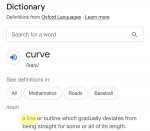
You're using a specific mathematical definition to 'prove' a point that all lines are straight. The problem is, grammatically you are wrong. Just as you are clear that in golf the word line means straight line, I am clear that it doesn't mean that in the real world. The problem with your post is that you are implying that one definition is the only definition. It is literally the equivalent of saying that "pound" can't refer to currency because it means "to hit something."!

In the real world, the actual definition of the word line simply means - a mark on a surface that is longer than it is wide. In some definitions, they even use the borders of a state or country as examples - are they all straight?

Whilst I am happy to have learnt that in golf these things are always straight when it comes to OOB, regardless of any other features, I'm really not sure why people are getting so hot and bothered about the fact that, in my view, it would be better to have the word "straight" in the definition?

Even if 99.9% of golfers understand it, including one word would mean 100% of golfers understand it. Why is 100% not better than 99.9%?
 
Truth is tbh, if it had been my ball in the OP scenario then my instinct would have been that I was not OOB on the basis that the white posts were identifying the edge of the cut grass as the boundary. And I think that I would most probably have played my ball from where it lay.

I fully understand about drawing straight lines (I’m an honours degree in maths so I know one when I see one ?) and how to determine whether a ball is OOB or not, but in this context unless someone playing with me had said ‘woah..hold on just a sec…’, then though I might have been wrong, in play it would have been.

Just being honest about how I most probably would have thought and that it being OOB on basis of straight line between posts might well not have entered my thinking on grounds of it being frankly a bit ludicrous.
 
Top