Gravel path

There was no nearest point about it Phil as the path was still in play... Go read the thread.

I've read every post in the thread - and you clearly still don't get it (this isn't intended to get at you it's a simple conclusion from your last post!)

1. There is only ONE nearest point of relief

2. No point that would have you still standing on the path to play if the ball stayed at that point would be an NPR

3. No point that would be OOB is a valid NPR

4. No point nearer the hole would be an NPR

5. No point in a hazard would be one either (for completeness)

AFTER you have established the NPR you may drop the ball within 1 cl of that point at which point you then have to reconsider the above criteria (and for no 2 this would be for the shot you now propose to play which could be in a different direction if you choose), plus the question of whether the ball rolls more than 2cl from where it first contacts the course.

So, in your situation here the relevant question to the actual NPR will relate to exactly where the OOB is situated - without that it's impossible to state where the NPR is.

In the absence of any OOB within the relevant area the NPR is going to be back in the hedge far enough that you are not standing on the path - you have been quoted the rule relevant to estimating where that would be where it's not possible to physically get there. This is relevant because you may, in some circumstances, choose a free drop in such a situation on the basis that you are then able to take a penalty drop of a further 2CL from that point (or back on line etc) and be in a better position than starting with a penalty drop from where you are - clearly not relevant here but important. It also covers the question 'why would you want to drop a ball where you can't get at it!.

I hope this helps - but after 12 pages I somehow doubt it as nearly everything I'm posting has been stated somewhere before.

For the full and complete guide to dropping you have to read all of rule 20 - this post is not intended as a substitute to that, more a summary of the particular relevant bits.
 
I've read every post in the thread - and you clearly still don't get it (this isn't intended to get at you it's a simple conclusion from your last post!)

1. There is only ONE nearest point of relief

2. No point that would have you still standing on the path to play if the ball stayed at that point would be an NPR

3. No point that would be OOB is a valid NPR

4. No point nearer the hole would be an NPR

5. No point in a hazard would be one either (for completeness)

AFTER you have established the NPR you may drop the ball within 1 cl of that point at which point you then have to reconsider the above criteria (and for no 2 this would be for the shot you now propose to play which could be in a different direction if you choose), plus the question of whether the ball rolls more than 2cl from where it first contacts the course.

So, in your situation here the relevant question to the actual NPR will relate to exactly where the OOB is situated - without that it's impossible to state where the NPR is.

In the absence of any OOB within the relevant area the NPR is going to be back in the hedge far enough that you are not standing on the path - you have been quoted the rule relevant to estimating where that would be where it's not possible to physically get there. This is relevant because you may, in some circumstances, choose a free drop in such a situation on the basis that you are then able to take a penalty drop of a further 2CL from that point (or back on line etc) and be in a better position than starting with a penalty drop from where you are - clearly not relevant here but important. It also covers the question 'why would you want to drop a ball where you can't get at it!.

I hope this helps - but after 12 pages I somehow doubt it as nearly everything I'm posting has been stated somewhere before.

For the full and complete guide to dropping you have to read all of rule 20 - this post is not intended as a substitute to that, more a summary of the particular relevant bits.

I don't get it? This is my understanding of it now...

My nearest point of relief was in the hedge but would have meant me still standing on the path, therefore NPOR was not an option. My opinions are then...

Go back to the tee
Play unplayable
Play it as it lies

Is this right? If so what exactly is it that I'm not getting?
 
Davey you're still not getting it... NPOR is not an option because it would effectively be an unplayable lie in the hedge. The NPOR is not on the small gap between the path and the hedge. It's at the point in the hedge where, if the hedge wasn't there, you would have been able to stand and swing without the path affecting you.
 
Davey you're still not getting it... NPOR is not an option because it would effectively be an unplayable lie in the hedge. The NPOR is not on the small gap between the path and the hedge. It's at the point in the hedge where, if the hedge wasn't there, you would have been able to stand and swing without the path affecting you.

I just said the NPOR is not an option :confused:
 
My nearest point of relief was in the hedge but would have meant me still standing on the path, therefore NPOR was not an option.
Rule people are anal about language. You may have something right but do not express it in the right way, they will call you on it. for that you need a thick skin because it will happen all the time.

If you compute a putative drop area that still has you standing on the obstruction, it is not the npr. It is not a question of npr being an option, the place where you want to drop is not the npr and therefore one of the conditions for relief under the rule does not exist.. The result is the same, the expression of it is more accurate.This not anyone trying to hassle you it is trying to explain how the rules work.

Appreciation and proper use of the language of the rules is an important thing. If you think it is anal or stuffed shirt that is ok. But try to under stand where the others are coming from.
 
Last edited:
I don't get it? This is my understanding of it now...

My nearest point of relief was in the hedge but would have meant me still standing on the path, therefore NPOR was not an option. My opinions are then...

Go back to the tee
Play unplayable
Play it as it lies

Is this right? If so what exactly is it that I'm not getting?

It's wrong because it is not your NPR if you are standing on the path


however, in the example given and with out a definitive position of OOB, your actual NPR will be further into the hedge such that you aren't standing on the path.

If you do not wish to proceed with relief from the path on that basis then your options are
1. play it as it lies
2. declare it unplayable and proceed under your options for that, which include returning to where you played the last shot from.
 
I don't get it? This is my understanding of it now...

My nearest point of relief was in the hedge but would have meant me still standing on the path, therefore NPOR was not an option. My opinions are then...

Go back to the tee
Play unplayable
Play it as it lies

Is this right? If so what exactly is it that I'm not getting?

You still haven't got the concept of NPR. NPR is where you get FULL relief from the path. if you are standing on it then that is not NPR. That said the actually NPR may be a point where a stance can not physically be taken.

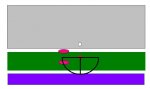
The Pink ovals are a representation of stance. The dark green rectangle is a privet hedge which can't physically be entered. The Purple is a boundary wall and the grey is the path. Direction of play is up. Pink ball is NPR and the semi circle is the club length relief allowed no nearer the hole where radius of the circle = a club length. So the semi circle is the area you can drop.

When working out NPR it's as it the wall and hedge do not exist.

npr.JPG
 
Last edited:
Davey. Just to be anecdotal, a few years ago I really did find that my NPR from a shale path, just as in Decisions 24-2b/3.5 and 24-2b/3.7, was in the middle of a tree. To drop within a club length of the estimated NPR would have left the tree between me and the green. I chose to play from the path and for once nailed a good sand wedge on to the green. (Sorry that last bit was just a gratuitous bit of self-congratulation.) I think that illustrates your position: NPR in the middle of thick hedge; drop from there and you don't have a viable shot; choose to play from the path if you can or deem the ball unplayable. Job done.

It all hinges on understanding that in this curious world of golf rules, the tree (or hedge or whatever) does not exist as far as the NPR is concerned. I think maybe you have difficulty in taking on the apparent nonsense this implies in the real physical world. The words do make it difficult: how can you possibly talk about "relief" in the middle of a tree trunk or a hedge? Think of it as "relief from...." the path or other obstruction, and think, as has been said, of nothing else. As long as the NPR is on the course and not in a hazard, nothing else exists!
 
You still haven't got the concept of NPR. NPR is where you get FULL relief from the path. if you are standing on it then that is not NPR. That said the actually NPR may be a point where a stance can not physically be taken.

The Pink ovals are a representation of stance. The dark green rectangle is a privet hedge which can't physically be entered. The Purple is a boundary wall and the grey is the path. Direction of play is up. Pink ball is NPR and the semi circle is the club length relief allowed no nearer the hole where radius of the circle = a club length. So the semi circle is the area you can drop.

When working out NPR it's as it the wall and hedge do not exist.

View attachment 10178

Yes got it now :thup:

What if the ball rolls into the river you have drawn after I drop it? ;)
 
Davey. Just to be anecdotal, a few years ago I really did find that my NPR from a shale path, just as in Decisions 24-2b/3.5 and 24-2b/3.7, was in the middle of a tree. To drop within a club length of the estimated NPR would have left the tree between me and the green. I chose to play from the path and for once nailed a good sand wedge on to the green. (Sorry that last bit was just a gratuitous bit of self-congratulation.) I think that illustrates your position: NPR in the middle of thick hedge; drop from there and you don't have a viable shot; choose to play from the path if you can or deem the ball unplayable. Job done.

It all hinges on understanding that in this curious world of golf rules, the tree (or hedge or whatever) does not exist as far as the NPR is concerned. I think maybe you have difficulty in taking on the apparent nonsense this implies in the real physical world. The words do make it difficult: how can you possibly talk about "relief" in the middle of a tree trunk or a hedge? Think of it as "relief from...." the path or other obstruction, and think, as has been said, of nothing else. As long as the NPR is on the course and not in a hazard, nothing else exists!

I did have club in hand ready to play the shot and moved a few loose stones by the ball... My Vokey looked at me with a sad face :mad: so I decided against it. I asked my mate what he thought and together we ended up making the wrong decision :(
 
Yes got it now :thup:

What if the ball rolls into the river you have drawn after I drop it? ;)

Considering I said that it is a boundary wall then the answer is nothing ;) But had it been a river you would re drop and if it happens again you would place a ball at the point the ball first struck the course.
 
0 to 100 posts in 4 hours :whoo:

Is this the Le Mans thread? And Davey still showing remarkable stamina as he completes another lap of the circuit at 0332. :thup:
Don't let position on the race course fool you. There are several different classes of car on the course at the same time.:rofl:
 
A tip if you choose to play it off the path rather than take an unplayable.
The individual bits of gravel are loose impediments. If you remove the ones surrounding the ball very carefully without touching or moving your ball (and without unduly delaying play) you can, in effect, engineer your ball onto a sort of 'tee'. But don't move the sand or soil particles.

And destroy your brand new nike irons good idea i would rather get lose the game
 
We had a path on a hole that ran alongside the fairway and on the other side was a small strip of grass with then the OOB fence. So, often the NPR was on the strip nearest the OOB fence where it was usually impossible to swing a club, and caused much debate as to how to give a drop from being on the path. In the end we widened the side of the path right up to the OOB boundary fence which allows for a drop on the fairway side of the path - no more arguments!
 
Brilliant topic, even mods had to get involved :rofl:

And poor old Phillip gets it in the neck even over here in the rules section :whistle:
 
Last edited by a moderator:
We have 2 local rules at my new club that I've nearly become foul of before they were quickly highlighted to me.

The first is I have to take relief from all paths, I cannot choose to play the ball where it lies.

The other is only when the ball is in an actual scrape can I take relief, activity or droppings around the ball is not sufficient and also my stance has no relief either, the ball may be OK but if I'm standing on a deep scrape/burrow and loads of droppings, then tough!

These are both/all opposite to what I had available to me at my last club and has led me to now always ask when going to play other courses what the main local rules are as not everything is printed on score cards at times.
 
We have 2 local rules at my new club that I've nearly become foul of before they were quickly highlighted to me.

The first is I have to take relief from all paths, I cannot choose to play the ball where it lies.

The other is only when the ball is in an actual scrape can I take relief, activity or droppings around the ball is not sufficient and also my stance has no relief either, the ball may be OK but if I'm standing on a deep scrape/burrow and loads of droppings, then tough!

These are both/all opposite to what I had available to me at my last club and has led me to now always ask when going to play other courses what the main local rules are as not everything is printed on score cards at times.

I am certainly no expert but I would have thought that Rules 24.2 & 25.1 covering Immovable Obstructions and Abnormal Ground Conditions would apply.

In the case of Immovable Obstructions (the paths) you may take relief but are not obliged to do so and relief is available if Abnormal Ground Conditions (burrowing animal scrape) interferes with your stance.

As I say I may be wrong but that is my interpretation of those two particular Rules of Golf.
 
Top