
Why Does He get To Choose?

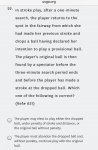
FWIW: From my original post, here are the answers from which to chose:
(1)
A The player may elect to play either the dropped ball, under penalty of stroke and distance, or the original ball without penalty.
B The player must abandon the dropped ball and, without penalty, continue play with the original ball.
C The player must continue play with the dropped ball, under penalty of stroke and distance.
D If the player continues with the original ball, she gets the penalty for playing from a wrong place.

(2)
A. The player must proceed with his original ball
B. The player must proceed with the provisional ball
C. The player may choose whether to proceed with his provisional ball or the original ball
 
I have only just picked up this thread but during its course the wording of at least one of the questions seems to have changed and the answers have become disjointed.
Am I right in thinking that one situation related to a properly announced provisional and the other to a player's announced intent to play under stroke and distance?
 
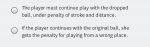
FWIW: From my original post, here are the answers from which to chose:
(1)
A The player may elect to play either the dropped ball, under penalty of stroke and distance, or the original ball without penalty.
B The player must abandon the dropped ball and, without penalty, continue play with the original ball.
C The player must continue play with the dropped ball, under penalty of stroke and distance.
D If the player continues with the original ball, she gets the penalty for playing from a wrong place.

(2)
A. The player must proceed with his original ball
B. The player must proceed with the provisional ball
C. The player may choose whether to proceed with his provisional ball or the original ball
I was writing as you posted. Can you please confirm that in the 2nd case the player actually declared a provisional prior to the original being found.
 
FWIW: From my original post, here are the answers from which to chose:
(1)
A The player may elect to play either the dropped ball, under penalty of stroke and distance, or the original ball without penalty.
B The player must abandon the dropped ball and, without penalty, continue play with the original ball.
C The player must continue play with the dropped ball, under penalty of stroke and distance.
D If the player continues with the original ball, she gets the penalty for playing from a wrong place.

(2)
A. The player must proceed with his original ball
B. The player must proceed with the provisional ball
C. The player may choose whether to proceed with his provisional ball or the original ball
Where were the questions posted, Beginner, intermediate or advanced?
 
I was writing as you posted. Can you please confirm that in the 2nd case the player actually declared a provisional prior to the original being found.
In the original post it’s indicated that, in both questions, a ball was dropped but not played, with the intent that the dropped ball was going to be a provisional.
 
In the original post it’s indicated that, in both questions, a ball was dropped but not played, with the intent that the dropped ball was going to be a provisional.
Were is the quiz?
 
In the original post it’s indicated that, in both questions, a ball was dropped but not played, with the intent that the dropped ball was going to be a provisional.
Were they both from the same quiz or source? Did you copy them exactly?
 
Were they both from the same quiz or source? Did you copy them exactly?
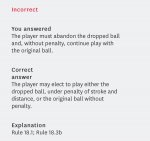
The first is from a USGA "advanced" quiz. I changed "Which one of the following is correct? to "What is the ruling?" (Ref#631) (Explanation 18.1, 18.3b)
Correction: The second question is from the sample exam, Golf Canada Prep Guide for the 2019 Rules Seminar. Copied as written.
 
Last edited:
Just to back up 6Aces, here’s the question and answer as shown on their website.
8B2388C3-00B7-4740-B4F4-D413A88318DE.jpegE4A1AE7F-325D-4F4C-BAB5-B3DAE11F3CED.jpeg91C37868-50DA-40FE-B88C-E25340C00900.jpeg
 
I'm simply pointing out how the answers could be different.
No more loose or misleading than the wording to many of the questions designed to draw out the nuances of some rules.
It's a somewhat mute point as to whether your earlier statement that the player should never have a choice as to which ball to play, or mine that the player always has a choice because he can proceed under stroke and distance, is the misleading ststement.
Without the actual wordings you can only deal in what could be, or when 2 similar questions are quoted (#13), highlight what they are trying to draw out.

I trust that we can agree that where you have played 2 different balls the rules will not permit you choice as to which one to proceed with...after which 5he question of which one, and what choices, will depend on the variables of any situation.

I think we are certainly in agreement! And the subsequent clarification of what the multiple choice answers were takes away my suspicion that this might have been another slip-up in the Rules Quizzes.

Edit: I didn't get time to complete this. There are always these basic choices of how you want to proceed with your ball in play - play it as it lies, unplayable ball, stroke and distance. The decisions are based on not knowing the outcome of taking the relief procedure. Not choice between two balls on the ground. In the case in point we have the unusual situation that a ball has already been dropped and if the player decides to proceed under stroke and distance, he is allowed to use that ball as the outcome of the procedure he would have to carry out. Nothing gained and not a matter of choosing which of two balls would be the more advantageous to play.
 
Last edited:
nothing gained and not a matter of choosing which of two balls would be the more advantageous to play.

Unless I'm missing something I see it as exactly a choice between the 2 balls.
According to the answer given the player can choose between which ball they want to play.
So you look at the first ball when it's found and decide if you can get it into a better position in another 2 shots against where the provisional is.
That's a straight choice as to which is most advantageous isn't it..?

And where did the change to the provisional rule pop up from?
I've missed this one and I'm surprised it's not been mentioned previously.
Mind you, I'm begining my cramming tomorrow.....
 
Unless I'm missing something I see it as exactly a choice between the 2 balls.
According to the answer given the player can choose between which ball they want to play.
So you look at the first ball when it's found and decide if you can get it into a better position in another 2 shots against where the provisional is.
That's a straight choice as to which is most advantageous isn't it..?

And where did the change to the provisional rule pop up from?
I've missed this one and I'm surprised it's not been mentioned previously.
Mind you, I'm begining my cramming tomorrow.....

What you have missed is that the player in the question is not choosing between her original and a provisional ball. She has dropped a ball with the intention of playing a provisional but when her original ball is found in time, she can no longer play the second ball as a provisional. Her original ball is in play and she must continue with it. She has the option of playing the original ball as it lies or playing it under stroke and distance which are the choices any of us has anytime, anywhere. The answer tells you that if she decides to play under stroke and distance she can use the ball already dropped - she doesn't have to drop again. There's no gain from her knowing where the dropped ball is when deciding what to do: whenever we are deciding whether to play our ball as it lies or take stroke and distance relief, we know where we will be playing from if we opt for S&D.

This does not indicate a change in the rules about provisionals: as soon as your original ball is found, there isn't one.
 
I think the change has to do with consistency in the Rules. In 2018, if you returned to the spot of your second shot and dropped a ball, but the original was found within five minutes, you must continue with the dropped ball. But, again in 2018, if you had played from the teeing ground and returned to the teeing ground to play again, had teed a ball and then the original was found within the five minutes, you must continue with the original ball.
In 2019, both scenarios are the same, you can play either the dropped or teed ball under stroke and distance, or continue with the original.
 
I think what was confusing me was the use of the term Provisional.
Because it's not really is it.....
She's gone forward to look and then decided to return to take S&D not a Provisional....
 
Forgive me if this is highjacking the thread, but what is the point of now/soon being able to go back to drop & play a provisional? I'd always believed the whole point of a provisional was to speed up play by ovbviating the need to go back to get another ball into play if an original turned out to be lost or OOB?

Walking back to put a new ball into play, fair enough - but i don't get it in respect of it being a provisional? The appropriate time to do that has surely long past - in that time isn't saved unless you do it before you walk away in first place?
 
I think what was confusing me was the use of the term Provisional.
Because it's not really is it.....
She's gone forward to look and then decided to return to take S&D not a Provisional....
The constraint on walking forward changes from Jan 1
 
Forgive me if this is highjacking the thread, but what is the point of now/soon being able to go back to drop & play a provisional? I'd always believed the whole point of a provisional was to speed up play by ovbviating the need to go back to get another ball into play if an original turned out to be lost or OOB?

Walking back to put a new ball into play, fair enough - but i don't get it in respect of it being a provisional? The appropriate time to do that has surely long past - in that time isn't saved unless you do it before you walk away in first place?
The difficulty has always been 'how far is too far?'
From 2019 the player will have 3 minutes worth to go forward and go back while others continue searching
 
Forgive me if this is highjacking the thread, but what is the point of now/soon being able to go back to drop & play a provisional? I'd always believed the whole point of a provisional was to speed up play by ovbviating the need to go back to get another ball into play if an original turned out to be lost or OOB?

Walking back to put a new ball into play, fair enough - but i don't get it in respect of it being a provisional? The appropriate time to do that has surely long past - in that time isn't saved unless you do it before you walk away in first place?

It's a timesaver compared with not playihg a provisional in the first instance, not finding your ball in the 3 minutes and then haing to walk back to put another ball into play.

You go forward, think it unlikely that your ball will be found and realise you should have played a provisional. You leave others searcing and go back and play a provisional withint the 3 minutes. You return to the search with a little search time remaining but your ball isn't found. You carry on with your provisional. Had you not gone back to play the provisional, you would only now be trudging back to put that other ball into play. Instead, you have taken up no more time than the search - which you would have done anyway. Even if your search time is up before you get back, there is sitll some saving of time.
 
The difficulty has always been 'how far is too far?'
From 2019 the player will have 3 minutes worth to go forward and go back while others continue searching

I sort of get that bit - especially the how far is too far bit. And appreciate that there is now an absolute limit on "too far"

But just dont get where the time saving element of a provisional comes in when someone has walked forward, looked around for, say, a minute, then starts walking back. ? After all, if the ball was only topped a few yards before you start looking, then you're not really saving any time by going back to play a provisional; and if you'd gone forward 200 yards, you're certainly not saving any time. I can't get past the notion that time saving only comes in if the prov is played before you go forward.

Sincerely yours, Confused of SE13.
 
It's a timesaver compared with not playihg a provisional in the first instance, not finding your ball in the 3 minutes and then haing to walk back to put another ball into play.

You go forward, think it unlikely that your ball will be found and realise you should have played a provisional. You leave others searcing and go back and play a provisional withint the 3 minutes. You return to the search with a little search time remaining but your ball isn't found. You carry on with your provisional. Had you not gone back to play the provisional, you would only now be trudging back to put that other ball into play. Instead, you have taken up no more time than the search - which you would have done anyway. Even if your search time is up before you get back, there is sitll some saving of time.

Colin, I see that rationale might (and only just might) have worked if there was still 5 mins worth of search time. But I cant see the actuality of it with only 3 mins? I just think that by the time one has looked for a bit, gone back, and dropped a ball, one is going to be out of time for it to be a provisional anyway?

Still Confused of SE13
 
Top