Why can't slope ratings be more fluid?

Given your ball striking, you'd be in with a shot at that!
Possibly, but more likely that I would be able shoot 2 over par at my course off the whites for 40 points and a Score Differential of 1.0

I would tend to agree with Ori that I would see my HI going up a bit, if I were to play regularly at Grimsdyke. But I've never payed there so my opinion is weak.
But I have played Painswick which has low CR and SR below 113. I found it to be a quite treacherous course, not merely short and tricky.
 
I think once you get to the point you are needing to shoot several shots under par to play to scratch it becomes difficult. At this point it relies on hitting approaches very close and/or holing long putts for birdie.

There’s quite a big difference in score from having 5 tap in putts for par versus holing those for 5 birdies, whereas not being quite as accurate off the tee/into the green isn’t as punished
 
This to me suggests the slope rating should be higher then, because a bogey golfer doesn't have the ability to play that way. Slope is meant to be the difference in difficulty between scratch and bogey, right? The tightness of fairways, the fact it's out of bounds/dead right on about five or six holes*, and those hellish greens you speak of, make it difficult for the bogey golfers, to my mind.

*I say this because the most common miss for your bogey golfer would be a slice, that's what makes it tough off the tee. But we've learned earlier in this thread that apparently bogey golfers are considered straight hitters in the ratings!? 🙄🙄

This I completely agree with. Easy for a scratch golfer but a nightmare for a high hc with a slice.
 
I get the point you’re making but it’s simply not true that a scratch golfer will find every Green in regulation just because it’s a shorter course.

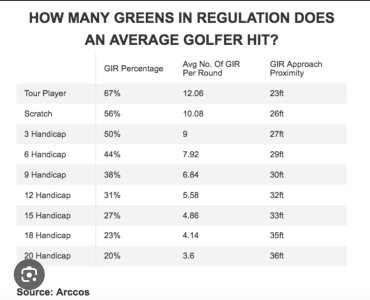
The average scratch player is only expected to hit 56% of GIR. Whilst they will find the course easier they will not hit every fairway or green regardless of where they play.

Yes agree, I was exaggerating a little, but I've seen really low players on these types of courses a few times. 5 iron off the tee then a flick with a wedge. It's very easy for them. I was a member at a short course, some of the juniors got down to scratch and they all moved on to a different course which challenged them more.

Your stat about 56% of GIR applies across all courses. It would be lower playing Carnoustie off the tips, and higher at a short easy course.
 
I’ve thought similar about stroke index for each hole. Everyone I play with at my course is adamant our SI18 is one of the hardest holes on the course, and if you walk off with a bogey you’re happy, even a double isn’t terrible. It’s a 250 yard par 4, an upside down bowl for a green which is approx 15 yards deep, very well placed front bunker and OOB 5 yards off the back. When you get on the green, due to the slope, it’s really hard to lag a putt, give it a little bit too much and the ball trickles on, too tentative and you’ve got the same putt again.

I would think if they could use data to work out the hardest holes based on average scoring, it would be much lower (or is it higher?).

Problem is you have the thing about each 9 holes having an even share of the hardest and easiest holes.

Stroke Index is not a ranking of difficulty. Maybe it would help to understand the guidance for stroke index allocation: https://www.randa.org/en/roh/appendices/appendix-e

The recommended methodology and procedures for determining a stroke index allocation within the six-triad structure, designed to accommodate both stroke play and match play formats, is as follows:
  • Apply odd stroke index allocations over the front nine and even stroke index allocations over the back nine. If, however, the back nine is significantly more difficult than the front nine, as determined by the Course Rating, the even stroke index allocations can be switched to the front nine and the odd stroke index allocations to the back nine.
  • Spread stroke index allocations evenly over the 18 holes so that players receiving strokes will have the opportunity to use a high proportion of these strokes before a match result has been decided.
  • Apply the lowest stroke index hole (1 or 2) on each nine in the middle triad.If no hole within the middle triad is ranked within the lowest 6 holes relative to par, then it can be moved into an adjacent hole at the end of the first triad or the beginning of the third triad on each nine.
  • Apply the second lowest stroke index hole (3 or 4) on each nine in either the first or third triad, unless the lowest stroke index hole has been allocated in that same triad.
  • If possible, avoid low stroke indexes (6 or less) on consecutive holes.
 
As we all know, there are definite flaws in the course rating procedure. Too much weighting given to course length has lead to many short but tight and tricky courses being too low-rated, leading to situations where handicaps either travel well or badly from home courses - which I thought was the exact scenario they wanted to avoid when they devised the system of different course handicaps. And the governing bodies stubbornly refuse to re-rate courses even when it's desperately needed.

I was just wondering, is there any reason we can't have a more fluid system to this involving algorithms? Perhaps similar to the PCC algorithm - which I presume automatically or semi-automatically reacts to the level of scoring submitted on the course that day and adjusts accordingly? Why can't we have a system that, over time, reviews all of the scores submitted at a course, and the handicaps of those submitting them, and if there's a course where players are routinely not beating their course handicaps, then the slope rating could automatically be notched up 2 or 3 points? After a while with this process in place, all courses should end up with completely accurate slope ratings, and everyone will then receive a fairer amount of shots on their course handicap.

Is there a reason this can't be implemented?
Is this "as we all know in our expert opinion", or "as we all know based on our ignorant, subjective opinion? :ROFLMAO:

Length will always have to play a huge factor. Sure, a short course may be very tight and tricky to play on an average day, and this is accounted for to a degree. However, given that handicaps are based more on your better days, then it has to be assumed you will be good enough or lucky enough not to get caught out by those tight obstacles on those good days. But you can never avoid the length of the course. If I play a wide open course that is 6500 yards long, it is going to take me many more shots to go round that course on my good days than it would to go round a tight 5500 yards course, also on my good days.

My last course was a prime example. Very tight, with jungle either side of most fairways. I could have car crash holes many times. On my average round, I would still have a few horror moments. But, on my good days on that Par 70 course, I could easily shoot low 70's and even broke 70 a handful of times. Stick me on a wide open course that is a few hundred yards longer, my lowest score there would be a shot or two higher than I could shoot at my short course. Simply by the fact that I've to knock the ball around a longer distance.
 
As we all know, there are definite flaws in the course rating procedure. Too much weighting given to course length has lead to many short but tight and tricky courses being too low-rated, leading to situations where handicaps either travel well or badly from home courses - which I thought was the exact scenario they wanted to avoid when they devised the system of different course handicaps. And the governing bodies stubbornly refuse to re-rate courses even when it's desperately needed.

I was just wondering, is there any reason we can't have a more fluid system to this involving algorithms? Perhaps similar to the PCC algorithm - which I presume automatically or semi-automatically reacts to the level of scoring submitted on the course that day and adjusts accordingly? Why can't we have a system that, over time, reviews all of the scores submitted at a course, and the handicaps of those submitting them, and if there's a course where players are routinely not beating their course handicaps, then the slope rating could automatically be notched up 2 or 3 points? After a while with this process in place, all courses should end up with completely accurate slope ratings, and everyone will then receive a fairer amount of shots on their course handicap.

Is there a reason this can't be implemented?
No reason why it can't be. However, it shouldn't because it's mathematically unsound in almost every possible way.

Incidentally, WHS does already provide a variance report (to those with a high enough level of access) that can highlight any glaring problems with the accuracy of any ratings.
 
I get the point you’re making but it’s simply not true that a scratch golfer will find every Green in regulation just because it’s a shorter course.
When he encounters an obstacle the 'difficulty factor' in getting to a better place is far lower for scratch than bogey.

The average scratch player is only expected to hit 56% of GIR.
Incidentally what is it for a bogey player?
 
When he encounters an obstacle the 'difficulty factor' in getting to a better place is far lower for scratch than bogey.

The average scratch player is only expected to hit 56% of GIR.
Incidentally what is it for a bogey player?
According to google stats a bogey golfer (20 handicap) is expected to hit 3.42 GIR or 19% on average.
 
Yes agree, I was exaggerating a little, but I've seen really low players on these types of courses a few times. 5 iron off the tee then a flick with a wedge. It's very easy for them. I was a member at a short course, some of the juniors got down to scratch and they all moved on to a different course which challenged them more.

Your stat about 56% of GIR applies across all courses. It would be lower playing Carnoustie off the tips, and higher at a short easy course.
That’s why it’s classed as an average 🤔

Of course there will be more in some places and less in others.

Course I play near me, I can play the whole course with using Driver once as it’s a short course with fairly open fairways. But even with hitting mid to long irons off the tee and short irons to greens, I can’t hit and hold every green. Law of averages simply applies across this at all levels. So your point doesn’t really apply at all they simply won’t hit every green it’s a pure exaggeration to prove a point.
 
Surely four of your best eight score differentials will be lower than your index, so 4 of your last 20 rounds which is 1 in 5 rounds you beat your handicap. (Ok that's SD and index rather than course handicap, but I'm not doing the maths now to see if holds the same, it's late. 😅)
Not necessarily, it depends on the spread of those 8 scores. My index is 9.1...only 3 of my differentials are lower than this figure. I wouldn't call 3 rounds in 20 "routinely" beating handicap. I wouldnt even describe 1 in 5 rounds as "routinely" beating your handicap.
 
Our white course is 5500 yards, blue 5000 doing a bit of rounding, at that short a course I don’t think it being shorter makes it easier. We have a few driveable par 4’s off the whites, off the winter course driver is too long so you have to drop down a club….that to me doesn’t make the course easier.

There are also no forced carries to reach a fairway. The defence of the course is for me its condition and the small size of the green.

When you said blues I assumed they were the harder tees.

I do not play away these days but used to see blues as the championship tees at some courses.
 
Have you ever seen a genuine scratch golfer playing a short and tight course? Mid iron off the tee, wedge into the green, they find it ridiculously easy and don’t need to hit driver and bring any trouble into play.

When it comes to scratch or plus hc golfers, the only defence this type of course has is pin positions. The green keeper can trick up the course by hiding the flags on slopes, because these golfers will find every green in regulation.

In counter argument to this we are a shortish narrow fairway course and our holes are difficulty rated. The difficulty was set by comparing the score in comps off the whites
3 of the par 3s are SIs 3 (150 Yard) , 5 (156 Yards) and 7 (230 downhill Yards). I bet most our scratch or near scratch players are that because of the birdies/ eagles they make on other holes rather than GIR on the par 3s.
 
Top