Master Telephone Socket

Crazyface

Tour Winner
Joined
Feb 27, 2010
Messages
8,004
Location
Cheshire
Visit site
After a trawl around the net it appears that to move this socket you must get Open Reach in to do it (£150 thanks for comin') as it is their property!!!! Two wires! A child of 10 could do it. What a con! Yet again. Unless..........?
 
After a trawl around the net it appears that to move this socket you must get Open Reach in to do it (£150 thanks for comin') as it is their property!!!! Two wires! A child of 10 could do it. What a con! Yet again. Unless..........?

Person Telephone Socket please.

:eek:
 
Extension phone cable from BTs socket not suffice?

Whats the punishment if you're caught moving their hardware?

Two good words for you.......Plausible deniability.:whistle:
 
If you do move it, make sure you copy the wires onto the right terminals. It isn't just 2 wires in the primary socket - think its terminals 2,3 & 5. Get it wrong and your phone won't ring, and they will know you've buggered about with it.
 
The master socket normally has all terminals connected in case you want a second line in to the house.
Long time since I opened mine so it may be just 4 or 5.
 
Sorry I realised I am not thinking straight. The cable has 6 wires. 3 go in to one socket and 3 in to another. From memory the wires are distinguished by one set are solid colour and the other set are duo colour eg green and white, red and white
 
easy job to move the socket if the cable is long to go where you want it and you have a krone tool or other press down tool. A quick photo before you pull the wires and your good to go. I moved the mother in laws a while back with no issues.
 
easy job to move the socket if the cable is long to go where you want it and you have a krone tool or other press down tool. A quick photo before you pull the wires and your good to go. I moved the mother in laws a while back with no issues.

You wanna talk me though it? There's only two wires coming in to the house and they are connected to the internal wires using some sort of gel thing and only two internal wires are then connected to the "Master Socket". Can I just pull out the external wires, drill a hole to new location, push wire though and reconnect using this gel connector?
 
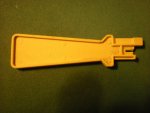
Oh and "Krone tool"?

Punch_down_tool

"Krone" tool. Sometimes called an IDC tool, insulation displacement connector tool. Basically, you push the wire inc its insulation onto the connector. The "blades" on the connector split the insulation. A posh version of the tool, the one issued to BT engineers, will also cut the spare length of wire off. Not rocket science, and fairly obvious to use. It is possible to use a thin bladed screwdriver to push the wires onto the IDC, and it achieves the same outcome.
 
As a further thought the question is - why are you moving it?

If it is just because you want it more accessible then simply wire the new socket as an extension (the extension cable simply plugs in to the master box if the master box is not gong to be used) or add an extension cable without a box.
 
Another why are you moving it? question ... whatever happened to wireless/cordless phones.. I know where my base unit is but never know where the handset is.. either way does not matter as no one calls that number anyways

On a related question.. I have a cable trailing from the tall BT lamp post outside the house to mine. The last time a BT phone was used in the household was about 20 years ago.. since then it has been Virgin. Other than being used by the odd bird, is there a way to cut it off?
 
Another why are you moving it? question ... whatever happened to wireless/cordless phones.. I know where my base unit is but never know where the handset is.. either way does not matter as no one calls that number anyways

On a related question.. I have a cable trailing from the tall BT lamp post outside the house to mine. The last time a BT phone was used in the household was about 20 years ago.. since then it has been Virgin. Other than being used by the odd bird, is there a way to cut it off?
Simply get BT to remove it.
 
You have 2 wires only incoming from outside on terminals 2 & 5 or A & B depending on which version of socket (NTE) you have. On the internal cabling which can be varying number of wires, you only need 2 wires connected on terminals 2 & 5. You do not
need any wires on terminal 3 unless you have a really old phone. The wire on terminal 3 was used as a BELL wire and phones for a long time don’t require it. If you have broadband it can badly affect you broadband speed due to capacitance.
 
Another why are you moving it? question ... whatever happened to wireless/cordless phones.. I know where my base unit is but never know where the handset is.. either way does not matter as no one calls that number anyways

On a related question.. I have a cable trailing from the tall BT lamp post outside the house to mine. The last time a BT phone was used in the household was about 20 years ago.. since then it has been Virgin. Other than being used by the odd bird, is there a way to cut it off?

I assume that 'now with Virgin' means you have a cable connection. Personally I would not remove it in case you ever sell and the person finds you do not have a landline.
 
A bit of an urban myth that one. It is possible if the other wire is faulty e.g. high resistance, but the speed will be down.

This was a note the BT Engineer left me when I had a fault that left me with broadband and no phone. I was told there was a disconnected wire in the green box further along the road.


Broadband uses a high frequency carrier mixed in with the voice band signal that carries the phone call. There is also a DC voltage on the line. All three need both wires to be intact to provide a complete electrical circuit between exchange and home.

The only reason broadband can keep on working if one wire of the pair is broken is due to induction across the break. The two ends of the cable break behave like a capacitor or transformer, albeit very inefficiently. But obviously the DC voltage on the line cannot easily bridge the gap so the phone ceases to work. But even so a break in one wire of the pair will still degrade broadband performance even if it does manage to struggle through.
 
This was a note the BT Engineer left me when I had a fault that left me with broadband and no phone. I was told there was a disconnected wire in the green box further along the road.


Broadband uses a high frequency carrier mixed in with the voice band signal that carries the phone call. There is also a DC voltage on the line. All three need both wires to be intact to provide a complete electrical circuit between exchange and home.

The only reason broadband can keep on working if one wire of the pair is broken is due to induction across the break. The two ends of the cable break behave like a capacitor or transformer, albeit very inefficiently. But obviously the DC voltage on the line cannot easily bridge the gap so the phone ceases to work. But even so a break in one wire of the pair will still degrade broadband performance even if it does manage to struggle through.

Yes that is what I was saying. Although it appears it is working on one wire it still needs the 2nd wire to have to an inductive connection of some kind, commonly known as an “HR DIS” to engineers. (HR DIS is short for High Resistance DISconnection)

Re the wire from the “lamppost” if it is actually a wooden telegraph pole it would need an engineer to climb the pole to disconnect the “drop wire”. If it is a metal pole that the drop wires disappear inside the pole then it would need an engineer to open the pole at the base to disconnect it.
 
Top