Hazard with a road through and across it/them?!

AmandaJR

Money List Winner
Joined
Oct 26, 2011
Messages
14,158
Location
Cambs
Visit site
A question arose at our committee meeting last night about the hazard (s) we have running across our 6th/8th and 17th holes.

On the 6th the ditches are lateral and on the 8th and 17th water hazards as they cross the holes. The hazard is a ditch, road and further ditch. The road runs through rather than over the hazard if that makes sense apart from the 6th where it only runs through. The 8th and 17th both have a section where the road area is extended to allow golfers to cross the hazards. Currently they are considered as one hazard BUT if your ball comes to rest anywhere on the road (including the cross sections) it is treated as a free drop to be taken on the nearside of the hazard and one club length from its boundary.

Should it really be treated as 2 hazards (each ditch) and the road a separate part of the course as such and therefore a drop allowable? Is marking it as a single hazard making it so that in fact balls should be played off the road or a penalty drop taken? Or should that only apply where the road is extended to cross over the hazard?

Makes sense?? Any help??

PS. The positioning of the stakes and how precise they MUST be came to light and as that had been covered here I was able to firmly state the rule despite MrHeWhoKnowsEverythingAndMustBeObeyed initially questioning me on it :thup:
 
I'm finding it slightly difficult to visualise the set-up but hope these thoughts might cover some or even all of the possibilities.

1) If the ditch is marked as a single continuous later water hazard and water hazard, any part of your roads which lie within the margins of the hazard are obstructions in the hazard from which you do not get relief. See Rule 24-2b
It does not matter whether the roadway is at ground level or bridges the ditch. The margins of a water hazard extend vertically up and down. On that basis, giving free relief from that part of a roadway that is within the margins is not permissible. You can play the ball as it lies and ground your club on the obstruction or proceed under Rule 26-1. You get relief from interference from any part of the road outside the hazard so it is a good idea for you to have stakes on either side of the road or even better a red or yellow line to show where the margin is.

2. If your roadway runs through the ditch without any form of bridging ie it is on ground level, then you could mark off the hazard into separate hazards on either side of the road, which means the road is not in a hazard and so is an obstruction from which you can get relief.

3. If a roadway crosses an open ditch by a bridge, then you could not separate it out as not being in the hazard. By definition the open ditch is a water hazard and equally by definition the bridge is in it.

4. If the roadway crosses above the bottom of the ditch but the ditch is in an enclosed pipe ie what you have is a roadway with a conduit under it, the bit of the ditch in the pipe would not in my view be a water hazard since it does not meet the definition of "surface drainage ditch or open water course". In which case, the roadway would not be in a hazard and again you could take relief from interference.
 
I'm finding it slightly difficult to visualise the set-up but hope these thoughts might cover some or even all of the possibilities.

1) If the ditch is marked as a single continuous later water hazard and water hazard, any part of your roads which lie within the margins of the hazard are obstructions in the hazard from which you do not get relief. See Rule 24-2b
It does not matter whether the roadway is at ground level or bridges the ditch. The margins of a water hazard extend vertically up and down. On that basis, giving free relief from that part of a roadway that is within the margins is not permissible. You can play the ball as it lies and ground your club on the obstruction or proceed under Rule 26-1. You get relief from interference from any part of the road outside the hazard so it is a good idea for you to have stakes on either side of the road or even better a red or yellow line to show where the margin is.

2. If your roadway runs through the ditch without any form of bridging ie it is on ground level, then you could mark off the hazard into separate hazards on either side of the road, which means the road is not in a hazard and so is an obstruction from which you can get relief.

3. If a roadway crosses an open ditch by a bridge, then you could not separate it out as not being in the hazard. By definition the open ditch is a water hazard and equally by definition the bridge is in it.

4. If the roadway crosses above the bottom of the ditch but the ditch is in an enclosed pipe ie what you have is a roadway with a conduit under it, the bit of the ditch in the pipe would not in my view be a water hazard since it does not meet the definition of "surface drainage ditch or open water course". In which case, the roadway would not be in a hazard and again you could take relief from interference.

Thanks Colin that is very helpful. Point 1 is the situation so we need to act on Point 2 and separately stake each ditch as two hazards in order to gain relief from the road. The road does slightly extend past the hazards on the cross paths so will take note of where the marker stakes are placed.

Our club/course has a weird set up and are 2 separate entities entirely and the course manager states it's "our problem" so a trip to B&Q for some timber and paint is being organised!
 
Amanda, I have just had a doubt about what I said in 2) so don't rush off to B&Q yet.

When there is water in the ditch, where does it go when it reaches the roadway? If it just flows over the roadway then I think we must be talking of a continuous hazard by definition and I was wrong to suggest it is ok to separate it. If the water is piped under the road, then I think 2) and 4) are right. Otherwise all you have is a ditch, a short section of which happens to have a different surface from the rest. That surface will be an obstruction but within the hazard.

Sorry my visualisation was faulty I think.
 
Amanda, I have just had a doubt about what I said in 2) so don't rush off to B&Q yet.

When there is water in the ditch, where does it go when it reaches the roadway? If it just flows over the roadway then I think we must be talking of a continuous hazard by definition and I was wrong to suggest it is ok to separate it. If the water is piped under the road, then I think 2) and 4) are right. Otherwise all you have is a ditch, a short section of which happens to have a different surface from the rest. That surface will be an obstruction but within the hazard.

Sorry my visualisation was faulty I think.

Hi Colin. The ditches are usually dry and at most ankle deep in water and leaves. I doubt it has ever been anywhere close to the road surface. The road itself is access to the local marina/boat club. Not even sure what role the ditches play in terms of water transportation.
 
Ok, if the water doesn't normally go over the road and there is not a bridge then it looks as if you have never had a continuous water hazard in the first place. You have had two ditches, ie two separate hazards on either side of a small causeway. If there is a pipe somewhere under it, it doesn't matter.

As to marking, I think Duncan will know better than I, but I think what you need to do is stake each margin of the hazard up to the edge of the roadway and then place another stake at right angles to the line of the margin close to the last one in order to show where the hazard ends. Like this

. . . . : roadway : . . . .
 
whaz.jpg
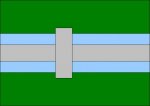
My take on your description is as per this image? Two ditches. a road between, and the crossing point. If both ditches flow under the crossing point to keep them as two continuous water courses, then my view is that you can have one or two hazards - at your own choice. The single hazard has the road within it and therefore no relief - except the bit that encroaches into the fairway outside the hazard.. Or two separately marked hazards with the road between. In this scenario, the road is not in the hazard and you get relief. But the bit of the crossing point that crosses the water, I think you'd have to regard as in the hazard.

If the ditches don't flow under the crossing point, you could regard, and mark, them as four separate hazards, and the total hard surface of road & crossing point gets free relief.

Because there is no "usable" playing surface between the two outer edges of the hazard(s) I think it would be justifiable, and fair to regard the whole as a single hazard with no relief - and put it down to skill to avoid it.
 
View attachment 3157
My take on your description is as per this image? Two ditches. a road between, and the crossing point. If both ditches flow under the crossing point to keep them as two continuous water courses, then my view is that you can have one or two hazards - at your own choice. The single hazard has the road within it and therefore no relief - except the bit that encroaches into the fairway outside the hazard.. Or two separately marked hazards with the road between. In this scenario, the road is not in the hazard and you get relief. But the bit of the crossing point that crosses the water, I think you'd have to regard as in the hazard.

If the ditches don't flow under the crossing point, you could regard, and mark, them as four separate hazards, and the total hard surface of road & crossing point gets free relief.

Because there is no "usable" playing surface between the two outer edges of the hazard(s) I think it would be justifiable, and fair to regard the whole as a single hazard with no relief - and put it down to skill to avoid it.

That is pretty much accurate although I don't think the hazard "flows" under the 1st smaller ditch at the crossing point. Will double check that later. There is "usable" playing surface on the far side of the 1st ditch and the near side of the 2nd as the banks/top are grassy. I'm thinking 2 separate hazards and relief from the road EXCEPT on the crossing point is sounding the likely truest option?
 
Amanda,

I agree with Colin's assessment of what the hazard 'naturally' appears to be,

But what I believe you should really do is...

1. Decide whether you want to give free relief from roads in general - I strongly believe you should.
2. Decide whether you want to give free relief from the road within/between the ditch area - I'm inclined to think you shouldn't, but it's up to your club.
3. Design and record the appropriate markings. Agree that the design complies with what you decided.
4. Purchase and install the stakes.
5. Update the Local Rules. There may need to be cross-references added to remove ambiguity (relief from roads, except where in hazards (or particular hazards).
6. Make sure the card reflects what you have decided/installed.

Hope that helps.
 
View attachment 3157
My take on your description is as per this image? Two ditches. a road between, and the crossing point. .

Now it's clear! I just couldn't get my head round the description and come up with this: basically a road with a ditch on either side. Which is why I was generalising so much. Thanks for that backwoodsman!

On that basis, I would put up for debate that you cannot designate this as a single water hazard as each ditch will have distinct natural margins and would therefore by definition be separate hazards. It isn't a hazard with a road in it (which perception gave me the trouble in understanding the set-up :o), but a road with separate ditches alongside it.

The first consequence of that argument is that the roadway is not in a hazard and relief is available provided the surface is artificial. The nearest point of relief cannot be in a hazard so if you land on the roadway, your NPR will likely be on the other side of the ditch from the roadway (unless there is a wide shoulder between edge of road and margin of ditch). If you feel it is unfair that the player who lands in one of the ditches is penalised but the one who lands on the road in between gets free relief you would need a local rule deeming the road to be an integral part of the course.

The second consequence regards the the bits that cross over the ditches. If these are of a solid "causeway" type or if there is an underground pipe to drain water from one side to the other, you have separate hazards which stop and start on either side of the crossover and if the surface of the crossover is artificial, you have relief from interference by any part of it.

If the crossover is some form of bridge with the ditch open and continuous below it, then, I agree, the whole length of the ditch is a single hazard and that part of the bridge within its margins is an obstruction in the hazard with no relief. But the bit of the crossover between the inner margins of the two ditches, is part of the roadway obstruction from which you get relief. Be sure to buy plenty paint.

I think I said all that already in a roundabout sort of way, but it is good to make it more specific to the situation as backswoodman has done. Thanks again for that helpful diagram ( I must find out how to embed an image in a posting)

Thanks Amanda. Thinking about this sure beats reading my morning paper and contemplating the depressing state of the economy and the Scottish football team.
 
Last edited:
The second consequence regards the the bits that cross over the ditches. If these are of a solid "causeway" type or if there is an underground pipe to drain water from one side to the other, you have separate hazards which stop and start on either side of the crossover and if the surface of the crossover is artificial, you have relief from interference by any part of it.

Perfect! Checked today and both ditches "stop" and at that point a pipe only travels under the cross-over part of the road.

Soooooo....when these hazards are lateral (as on the 6th) and assuming the road is deemed free relief the next debate is where to drop and where is NPOR. Dropping on the far side is very unpopular (!!) as it is over a hedge and on the 4th hole - tough shot from there. I assume that it would be simply a matter of what half of the road the ball comes to rest at although the nearside ditch is about half the width of the far one!

No time yet to contemplate depressing news stories Colin :o
 
Perfect! Checked today and both ditches "stop" and at that point a pipe only travels under the cross-over part of the road.

Soooooo....when these hazards are lateral (as on the 6th) and assuming the road is deemed free relief the next debate is where to drop and where is NPOR. Dropping on the far side is very unpopular (!!) as it is over a hedge and on the 4th hole - tough shot from there. I assume that it would be simply a matter of what half of the road the ball comes to rest at although the nearside ditch is about half the width of the far one!

No time yet to contemplate depressing news stories Colin :o

For free relief, it's Nearest Point of Relief, not Nicest PoR! And it's from the obstruction irrespective of what is beside it! So it's quite possible that NPoR is actually IN the hedge!

It is, however, quite acceptable to have a permanent Drop Zone, in a convenient position, to cover such 'slightly unfair' situations and this is available in addition to other option within The Rules.
 
For free relief, it's Nearest Point of Relief, not Nicest PoR! And it's from the obstruction irrespective of what is beside it! So it's quite possible that NPoR is actually IN the hedge!

.

Had this recently. NPOR for a fellow competitor was narrow strip of grass adjacent path. One small bounce after the drop & he was in real cr*p and he proceeded to take a 12 on a par three. Two weeks later I put my tee shot in exactly same spot. So I used a putter to putt out of trouble onto the "nice" side of the path instead of a free drop.

Back to OP: Isn't it up to the club to decide whether they want it to be one or two hazards? If they want the whole job lot to be a single hazard, is there anything to stop them? Is there anything to say that two separate, but close, ditches must be two separate hazards?

Colin: The image was done as follows. Create the picture however you choose. (I used the OpenOffice equivalent to Powerpoint) I save it as a .png file. Then use the "Go Advanced" method of creating a reply to a post and there's an "Image" button on the toolbar which allows you to browse and attached an image file
 
Thanks for the info on posting an image. I'm sure it will come in useful in the future for clarifying questions like Amanda's.

The reason for my argument that you cannot make the whole thing a single water hazard is that the ditch on each side of the roadway is a separate water hazard because each is defined by its natural margins - one margin bordering the fairway and the other bordering the roadway. The road lies between the inner margins of the two ditches and it does not form part of a water course of any kind. It does not meet the definition of a water hazard.

If we think, for a moment of a situation where you have a road with one ditch on one side of it. If you saw yellow stakes along the fairway side of the ditch and along the other side of the road, would you not think that strange - wrong in fact?

In short, to answer the question, what says to my mind that you cannot incorporate the two ditches and the road into one hazard is the Definition of a water hazard.

 
I feel a spot of pedantry coming on...

Given that the definition of water hazard contains the phrase "All ground and water within the margin of a water hazard are part of the water hazard" does this not presuppose that not everything within the margin has to be water? Why isn't the road just a bit more of the "not everything"? And in any case, a hazard doesn't have to be defined by its natural margin - it can be defined (as opposed to identified) by stakes.

Or a different tack: Is the roadway materially different to an island in a pond.

I'd suggest either argument good enough to make it not "wrong" to include the road in the hazard if so desired.
 
It's not pedantry at all to tease out the precise meanings of the Rules. It's what we have to do. And here's more of the same. ;)

I think you are mistaken in saying that it is not the natural margins which define the hazard but the stakes. The stakes or lines should be set to mark the natural margins. See Decision 33-2a/4
http://www.usga.org/Rule-Books/Rules-of-Golf/Decision-33/#d33-2a-4

If they do not then the Committee has got it wrong and where stakes are incorrectly placed, the natural margin takes precedence in defining the hazard. See Decision 26/2
http://www.usga.org/Rule-Books/Rules-of-Golf/Decision-26/#26/2

The difference with an island in a pond is that the island is completely surrounded by the water ie it lies completely within the margins of the water hazard.
 
I think you are mistaken in saying that it is not the natural margins which define the hazard but the stakes. The stakes or lines should be set to mark the natural margins. See Decision 33-2a/4
http://www.usga.org/Rule-Books/Rules-of-Golf/Decision-33/#d33-2a-4

If they do not then the Committee has got it wrong and where stakes are incorrectly placed, the natural margin takes precedence in defining the hazard. See Decision 26/2
http://www.usga.org/Rule-Books/Rules-of-Golf/Decision-26/#26/2

Hmmm, sorry Colin, I'm not convinced by this. The first decision says the committee SHOULD place stakes along the natural margins as near as possible. So if a committee choose not to do so then they are breaking no rule (ie it does not say MUST). Using stakes or lines is a clear option under the definition and all good courses mark between them with lines that are outside the natural boundary but nevertheless are the margin under the rules. The second is very specific and covers where the ball is clearly in a hazard (ie within the natural boundary but is outwith the staked area due to the committee putting the stakes inside the hazard which I don't think covers the situation described in this thread.

To me, I'm probably OK with the whole area being staked and I've seen it on many courses where whole areas of trees/bushes in boggy ground with little in the way of fixed natural boundaries have been marked like this, but once that is done I don't think it's correct to have a local rule allowing a free drop from the road that is within that area. As mentioned above, there is no relief from an obstruction within a hazard. Local rules are not supposed to overule the rules of golf, so I'd say they are still wrong, but for different reasons.
 
agree with Fyldewhite's first paragraph.

agree Amanda's got the right issues in hand with regard to the LWH element, and as Foxholer suggests a DZ may be the most equitable situation unless playing from the 'road' is a realistic option ie a lot depends on the road surface and the relative position of the road and LWH to the hole in play. On balance it's probably a good option, but you may have issues if the road runs a long way up the hole - how many DZ's needed an how will people easily establish which to play from? There's also the issue of what happens if someone is in the LWH nearest the hedge (going this route you have 2 separate hazards (or more) ) so they can take their 26-1 relief to the road and thence to the DZ...needs to be considered. In fact everyone could drop on the road if the DZ is an attractive option! Really need to see the area (name the course and Google Earth will provide the rest....) to understand the area better.

For the WH situations it really makes the most sense just to have the ditches as WH - the argument that the player on the road then gets 'too lucky' is pretty poor; what about the player who comes up ft short of the first, or 3ft past the second??? It's also the simplest to explain and simplicity is good. I agree with Colin that it sounds as if the road really isn't 'in the hazard', or passing over one, so it's also the better rules solution. Mark it clearly an cover in the LRs for completeness.

Committee's don't always do what they should (rules wise) and who's really to say what they should do for the particular course other than the members. It is good to see the issues debated (within clubs) from a position of understanding - rules and implications.
 
Hmmm, sorry Colin, I'm not convinced by this. The first decision says the committee SHOULD place stakes along the natural margins as near as possible. So if a committee choose not to do so then they are breaking no rule (ie it does not say MUST).

Yes, but isn't the alternative offered by "should" that either you mark with stakes/lines or you don't mark at all? If an area is not marked in any way but meets the definition of a water hazard, it is a water hazard and its natural margins define its limits. What I can't see in "should" is any sort of sanction to stake out an area in contradiction of these natural margins, which is what I believe marking the two ditches and the roadway as a single hazard would do. Say there were no markings in this case, what would you see and how would you interpret it? You would reach a ditch crossing the fairway and recognise it as a water hazard and easily see it started at one edge and finished at the other. You would then walk over a piece of ground, grass, earth or road it doesn't matter, before reaching another metre-wide ditch similarly recognisable as a water hazard by definition. Three distinct features, three separate events: ditch, fairway/roadway then another ditch. Where in the Rules do you find anything that would sanction combining three separate features of a hole into a single hazard? Would there be any limit to how far apart the ditches could be? If they were 50/100 metres apart, could we still have everything between the near edge of one ditch and the far edge of the other marked as a water hazard?

I'm not shifting .........

.........yet. ;)
 
Top