• We'd like to take this opportunity to wish you a Happy Holidays and a very Merry Christmas from all at Golf Monthly. Thank you for sharing your 2025 with us!

Drop from path - Nearest Point of relief - please help


Before you follow the advice above, you should remember not to pick up your ball until you have determined just what all the possible outcomes you may have by dropping the ball elsewhere.
If you decide the potential outcomes are worse than just chipping the ball from the path and you wish you had chosen to do that, it will cost you a penalty stroke to put it back again.
 
I think you are misunderstanding the nature of the nearest point of relief. It does not matter whether you can physically take a stance or make a stroke because of something else like a tree or a bush (see the answer to the Decision rulefan reference above). Imagine there is nothing else on the course other than the obstruction or abnormal condition you are taking relief from - no tree, no bush, no rock, no immovable obstruction, no slope so steep you couldn't hope to stand on it etc. The NPR is literally the nearest point on that empty landscape at which there would be complete relief and you must drop within a club length of it. Blink twice and restore all the reality of trees, bushes, park benches etc. etc. It makes no difference if there is something that makes the NPR is unreachable or, for that matter, that there is nowhere within a club length you can drop or play from.

In your situation, the hedge and whether you could play a shot from it are irrelevant to establishing your NPR. You imagine the shot you would have played had there been no path and, using the same club and stance, establish the point where that shot would be free from interference by the path.

OK - in which case I got it wrong as my NPR in my situation is then NOT immediately adjacent to the track with my back jammed into the out of bounds hedge) - but has my NPR at a distance which places my ball half way (let's say) in my stance - with me standing fully off the track as if I was going to chip over the track and over the greenside bunker.

Now I could have taken that stance but I would have had no backswing due to the proximity of the boundary hedge - but I assume that that is just tough.
 
Last edited:
OK - in which case I got it wrong as my NPR in my situation is then NOT immediately adjacent to the track with my back jammed into the out of bounds hedge) - but has my NPR at a distance which places my ball half way (let's say) in my stance - with me standing fully off the track as if I was going to chip over the track and over the greenside bunker.

Now I could have taken that stance but I would have had no backswing due to the proximity of the boundary hedge - but I assume that that is just tough.

As posted above, the nearest point of relief is for the stroke you would play if the track was not there. The nearest point of relief must provide complete relief from the track for the lie of the ball, area of intended stance and swing. The Rules guarantee that free relief; they do not guarantee that you can make a stroke from that place.
 
As posted above, the nearest point of relief is for the stroke you would play if the track was not there. The nearest point of relief must provide complete relief from the track for the lie of the ball, area of intended stance and swing. The Rules guarantee that free relief; they do not guarantee that you can make a stroke from that place.

I am abs clear now. Many thanks for that. Many players will end up on that track - I wonder how many play the NPR rule properly. As it happened as I never took relief I didn't get it wrong:)
 
Many players will end up on that track - I wonder how many play the NPR rule properly.

My ball was a couple of feet from the LHS of the track and maybe 4 ft from the RHS of it. So my NPR will be the LHS. Problem is that left of the track there is an overgrown bank about three or four foot deep running to the out of bounds hedge. Very Long grass and weeds cover the bank.

It might be worth suggesting that the committee mark the area to the left of the path as OOB. Saves any arguments and will probably improve pace of play.
 
It might be worth suggesting that the committee mark the area to the left of the path as OOB. Saves any arguments and will probably improve pace of play.

By coincidence, I've just done that very thing - marked off a border between a gravelled area and the boundary fence as OOB so that no-one's NPR can be in it. It's a jungle full of large chunks of sawn off tree trunks. Impossible to play from.
 
By coincidence, I've just done that very thing - marked off a border between a gravelled area and the boundary fence as OOB so that no-one's NPR can be in it. It's a jungle full of large chunks of sawn off tree trunks. Impossible to play from.

We should do that. I'd leave the track in bounds but as the bank between the track and the OOB hedge is only 3 ft at its widest - and it is covered in deep, jaggy and stingy stuff - it might as well be out of bounds.
 
Seems like our greens committee has been reading the board.

On the track that runs for 150 yds down the side of our 2nd fairway subject of earlier posts I've made here.

We are in the process of planting a hedge near-side of the track and so through the hedge (and hence also on the track) will be out of bounds, not yet sure if we are putting white posts in the hedge or near-side of hedge to further define the OoB. Part reason is to sort out the difficulties re the track; playing options and OoB, and also part to protect people walking up the track to our chipping ground.

Also from the fairway to the track was about 30yds - narrowing to less than 10yds by the green. We are going to have half width of rough adjacent to hedge as deeper than second cut rough (so longer than first cut but not free growing rough) to hold up balls bouncing and rolling towards the hedge, track and OoB. The remainder of the rough will remain second cut length, with a narrow band of first cut rough adjacent to the fairway. The whole track issue arose because we play a long blind second shot and the line is difficult to judge and misdirected shots would bounce and roll quite quickly towards and onto the track.
 
Hopefully they will put in white stakes as knowing just when a ball is through or in a hedge can cause all sorts of arguments.

Bur otherwise, good news.
 
Hopefully they will put in white stakes as knowing just when a ball is through or in a hedge can cause all sorts of arguments.

Bur otherwise, good news.

Yes indeed, will save a lot of faffing about and uncertainty - and will protect folk walking the path. And yes - hope they do put white OoB stakes in the hedge - and make clear whether or not any 'hedge stakes' are part of the course boundary (is that the same under the rules as an OoB?) so clear whether a drop can be taken from any such stake (if interfering with swing) - or not.
 
Yes indeed, will save a lot of faffing about and uncertainty - and will protect folk walking the path. And yes - hope they do put white OoB stakes in the hedge - and make clear whether or not any 'hedge stakes' are part of the course boundary (is that the same under the rules as an OoB?) so clear whether a drop can be taken from any such stake (if interfering with swing) - or not.
The white stakes define the OOB and therefore are not obstructions (Movable or Immovable). They may not be moved and relief is not available (unless taken under rule 28).
Try to make sure they are on the fairway side of the hedge, not in the hedge.
 
The white stakes define the OOB and therefore are not obstructions (Movable or Immovable). They may not be moved and relief is not available (unless taken under rule 28).
Try to make sure they are on the fairway side of the hedge, not in the hedge.

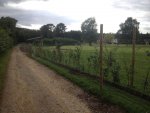
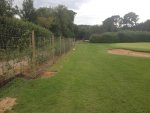
And here's a couple of snaps to show what we've done. The track is now out of bounds and the white posts define the out of bounds track-side of the new hedge. Previously the track and the little bank up to the hedge were in bounds. The hedge was the course boundary so out of bounds in respect to a course boundary applied.

Picture1.jpgPicture2.jpg

We are going to let the rough grow deeper from half way between the fairway and the hedge - to stop rolling and most bouncing balls flying into and through the hedge and onto the track (which is well used). The new hedge will be in bounds. The white stakes clearly define 'out of bounds' track-side of the hedge.
 
Last edited:
On the subject of NPOR but slightly off topic, we were playing a foursomes comp yesterday and were on the fifth tee when a group playing a mixed foursomes game were approaching the second green that was adjacent. One of the ladies had been left next to a molehill by her partner and was asking if she could get relief and was told yes. She was shown the NPOR but then said 'i'm not dropping there, i'll be in the rough so i'll drop it here'.
 
And here's a couple of snaps to show what we've done. The track is now out of bounds and the white posts define the out of bounds track-side of the new hedge. Previously the track and the little bank up to the hedge were in bounds. The hedge was the course boundary so out of bounds in respect to a course boundary applied.

View attachment 23498View attachment 23499

We are going to let the rough grow deeper from half way between the fairway and the hedge - to stop rolling and most bouncing balls flying into and through the hedge and onto the track (which is well used). The new hedge will be in bounds. The white stakes clearly define 'out of bounds' track-side of the hedge.

Why isn't the fence used to define the OOB?
Presumably is is not deemed an integral part of the course and free relief will be available for a ball between the fence and the OOB line.
I'm a bit concerned about determining the exact line if the player cannot get through the fence to get a line of site betwe
wen stakes
 
Why isn't the fence used to define the OOB?
Presumably is is not deemed an integral part of the course and free relief will be available for a ball between the fence and the OOB line.
I'm a bit concerned about determining the exact line if the player cannot get through the fence to get a line of site betwe
wen stakes

The fence is temporary while the hedge grows. There is a LR about the fence - can't recall what it is - but I think it is free relief - as we'd get if each of the new hedge shrubs were staked. I don't think they are at the moment. We use the track to get from the green you see (the 2nd) to the 3rd tee - walking back up the rise we've just played over. There is an exit through the fence to the track down by the green and you can get on to the track by the 3rd tee. You can see where the exit from the 2nd green to the track is in the 1st picture (between the two white OoB posts) and you see the notice in the ground telling us to exit from the green to the track in the 2nd.
 
Last edited:
And remember its always the nearest not Nicest - So if you drop in the rough you dropping in the rough or trees or bush lol So sometimes it better to play it as it lies. Also remember if you're in a puddle on the path - you must take relief from the puddle first (drop on the path) ;-P
 
And remember its always the nearest not Nicest - So if you drop in the rough you dropping in the rough or trees or bush lol So sometimes it better to play it as it lies. Also remember if you're in a puddle on the path - you must take relief from the puddle first (drop on the path) ;-P

No, you can choose which condition you take relief from first.
 
No, you can choose which condition you take relief from first.

Indeed. Previously on the hole in question - if you were on the track but closer to the LHS i.e closer to the bank up to the OoB hedge, you had to work out best place to take relief from the track. The nearest point of relief was always the bank - but on the vast majority of situations you wouldn't want to drop there - into deep rough with no relief from the boundary hedge and so no swing. And so unless you decide to play off the track, taking relief from the track at cost of one shot was what you were left with.

1) Going back from the ball position as far as you want keeping ball position on track and the hole in line with each other, would take you out of bounds or dropping on the bank in deep rough and with no back swing. So not an option you'd choose. Might as well take free drop and end up in the same trouble.
2) Taking stroke and distance would usually mean a long walk back down the fairway to have another go at a long blind and difficult second shot. Not ideal.
3) Two club lengths not nearer the hole almost always meant that you were dropping on the track (due to the alignment of the track) - so nothing to be gained there.

Last time I was on the track I just played it from there. I suspect that many in the same situation would have felt that there MUST be an option that gives 'fair' free drop relief from the track, or a decent outcome from taking a penalty drop, and they would have convinced their PPs that there was one, but in most cases there just isn't.

What we have done now makes the situation much clearer and much easier to decide what to do.
 
Last edited:
Top