Can I guess where a hazard line runs?

Bellante

Hacker
Joined
Feb 21, 2013
Messages
15
Visit site
Hi All,

A friend has recently started considering himself as something of a rules expert while he apparently study’s to become a referee. His latest missive seems to be that a player can take it upon himself to “guess” where a hazard line should be. Is he right?

A curving stream crosses the fairway and is defined as a water hazard by yellow stakes some distance apart. However, the usual painted line on the ground following the natural curvature of the stream and connecting the stakes has worn out.

Although I’m fairly certain I know where the line should be, in order to determine if my ball is within the hazard do I now have any other option than taking a straight line between 2 stakes, and which as a result does not follow the natural curvature of the hazard?
 
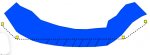
In the diagram below, the shaded part of the water hazard lies outside the line from stake to stake and would appear therefore not to part of the hazard. Decision 26/2 , which Rulefan refers us to, tells us however, that we must regard an area like that which is created by faulty marking, as part of the hazard. We have to go by the natural margin of the ditch/burn/pond - not really a matter of guesswork but of looking, for example, for the line where the ground drops down into the water.

(Click on the image to get its full size)

water hazard.jpg
 
Last edited:
Thanks for your help guys but I probably should have explained my querie in more detail.

In order to protect the liner of this stream under our local rules if your ball falls anywhere within the hazard area you must take a compulsory penalty drop.
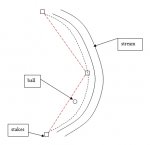
A painted line on the ground normally defines the hazard (Black dotted line in the picture below), but has gradually disappeared. My ball comes to rest quite clearly outside where the painted hazard line would normally be, but in its absence my understanding is that I now have no choice but to take a straight line between the marker posts which then places me within the hazard and therefore I must take a compulsory penalty drop. Am I correct, or do I have any other option?

Hazard defined.jpg
 
I take it that the line has completely disappeared in which case the margin of the hazard is defined by the line from stake to stake as you say. See from the Definition:

When the margin of a water hazard is defined by stakes, the stakes are inside the water hazard, and the margin of the hazard is defined by the nearest outside points of the stakes at ground level. When both stakes and lines are used to indicate a water hazard, the stakes identify the hazard and the lines define the hazard margin.

Your ball is clearly in the hazard. In the days when the line was there, it would not have been because the line defined the margin, but you cannot go by markings that no longer exist. How, for instance, would a guest on your course know there used to be a line? Or a senior member like me, remember :)
 
In order to protect the liner of this stream under our local rules if your ball falls anywhere within the hazard area you must take a compulsory penalty drop.View attachment 4786

Compulsory penalty drop???

Even if the ball is in the hazard you may still play it, but as with bunkers you cannot touch the surface with the club or hands prior to making your stroke - so can't remove loose impediments, can't take practice swings that touch the ground or grass and can't ground the club nor touch the grass or any other impediment when addressing the ball.
 
Sorry Cooklad but our local rule is quite clear and you don’t have choice, it is a compulsory penalty drop which means you cannot play the ball under any curcumstances from within the hazard.
 
Thanks very much for clarifying the situation Colin.

I didn’t think there was any other option but as I’m no expert I just wanted to be sure. Of course this now means that in the bar after our round next weekend I will be giving my rules friend some serious stick for his adamant insistence that there was. Cheers.
 
Compulsory penalty drop???

Even if the ball is in the hazard you may still play it, but as with bunkers you cannot touch the surface with the club or hands prior to making your stroke - so can't remove loose impediments, can't take practice swings that touch the ground or grass and can't ground the club nor touch the grass or any other impediment when addressing the ball.

Indeed, I don't think that LR would be enforceable if there was a (serious) tournament there.

However, I don't believe anything in The Rules specifies the margins as straight line between the stakes. I have certainly seen, but cannot locate, ruling/decision about using the 'natural boundary' of the hazard - though the stakes still provide an additional margin allowance and are in the hazard. So if the stakes are 9 inches from the drop into the stream, I believe that the boundary is a curved line 9" from that drop rather than a straight line between the 2 stakes. Same would apply on the other side of the stream where a ball down the slope into the stream (so in the hazard) might be considered outside the hazard if straight line interpretation was applied.
 
Unless there are lines, this is how the margin of a water hazard is defined.
When the margin of a water hazard
is defined by stakes, the stakes are inside the water hazard, and the margin of the water hazard is defined by the nearest outside points of the stakes at ground level.
This means a straight line between the course side edges of the stakes.

If these lines cross the natural margin (as in the blue diagram) then 26/2 applies. As the lines do not cross the natural margin in the second diagram, the margin is the dotted red line.


Last edited:
Top