
MegaSteve
Tour Winner
If we are to base our vote on the quality of a party's leader then I suggest no votes would be cast... Ain't a decent one out there currently...

Yet we already have trade deals outside EU 🙄
We didn’t elect Boris Johnson as our leader


neither of thise leaders are PM though are theyDid 'we' vote for the Labour leader or Liberal leader ?
Barneir reportedly states he will not remove/change the backstop and the UK must sign the WA.
Has he not registered that Parliament rejected the WA on 3 occasions and the Speaker refused its 4th presentation.
Labour joins in the fun :
Why is it not a good idea ? We can then sort out our own deals with countries outside the EU which at the moment we cannot do. This could lead to cheaper products for UK consumers and also open up potential new markets for UK companies. There all all sorts of other things of course like getting back control of our fishing waters, control of our laws and not having to answer to European courts. At the minute, because of the mess Theresa May left us in, a clean brexit is the only true form of brexit as the existing deal, even being amended, is just not acceptable

Twaddle!Have you not registered that the EU have already struck a deal with this government.
There's are huge downside to No Deal! But it seems to be the only way to actually Leave. So, for that reason alone, I'm content to lrsvr eith 'No Deal'.Why do some of you think leaving on no deal is a good idea?

Well we genuinely don't know how bad no deal will be, but do you think it will go better or worse than their own official analysis in Operation Yellowhamer - https://www.thetimes.co.uk/article/...ked-operation-yellowhammer-document-797qxkrcm, which was produced in August, that is clearly marked as a base scenario (not worst case), despite Gove, Cummings and Boris lies?
I'm still confused by the whole "taking back control". I'm still not sure what laws we were forced to take that adversely affect us. Of the 1000s of laws passed, I'm pretty sure there was something like 70 odd we were forced to implement and all of them are actual improvements to us such as clean beaches etc and the reason we voted against them was due to costs etc.
With regards to getting deals outside of the the EU, well again that remains to be seen, but due to economies of scale I fail to see how they will be better deals? I'd be interested to hear your theories on that. We are also going to need to deal with our closest neighbours. Do people honestly think that we will be able to get a better deal than the one we already have whilst being a member? I just don't see how that is possible.
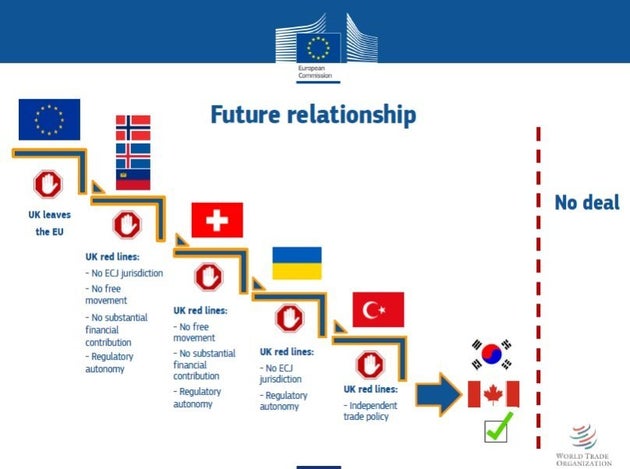
My final point i just want to add is the WA negotiated by May simply comes down to the red lines as outlined by the UK Government. I am sure you have seen the graphic, but I'll paste it in again. By choosing to leave both the CU and the SM were government decisions. I assume to placate the hard brexiteers of the Tory party. That decision does not have a majority in Parliament or with the public.
The agreement relating to agriculture as part of the WA is because during the transition period the UK is bound by the obligations from all EU international agreements (as EU international agreements are part of the EU acquis). This guarantees integrity and homogeneity of the single market and the customs union and we want to leave them. Why should we expect the EU to be ok with the UK setting lower tariffs with a nation that currently has an agreement with the EU?Some good points but you really, really, really spoilt it with your comment about the WA simply comes down to the UK’s own red lines.
First of all, go and read it. Seriously, if you want your comments to be taken seriously, go and read it.
I have, and some of it several times.
The first half of it is very fair and equitable. The rest, especially the bit around agriculture, is appalling. The short version on agri; the U.K. will not be able to set it’s own tariffs and quotas without reference to an “independent†(hahahaha) monitoring group that reports back to the EU. If the tariffs and quotas offered to a non-EU country are better than those offered to the EU, the U.K. is fined. And the final adjudicator will be the ECJ..... that doesn’t come close to a red line the U.K. has insisted on does it?

Gordon Brown was and was never voted as prime minister. Its a silly argument though, we all know that the public doesn't vote for a prime minister so why even bother to say it.neither of thise leaders are PM though are they
No1. The UK is free to set its own laws and the ECJ will have no jurisdiction over them.Once we've taken back control what are everyone's top 10 laws that the EU foisted upon us that they want to see repealed?

Gordon Brown was and was never voted as prime minister. Its a silly argument though, we all know that the public doesn't vote for a prime minister so why even bother to say it.
The agreement relating to agriculture as part of the WA is because during the transition period the UK is bound by the obligations from all EU international agreements (as EU international agreements are part of the EU acquis). This guarantees integrity and homogeneity of the single market and the customs union and we want to leave them. Why should we expect the EU to be ok with the UK setting lower tariffs with a nation that currently has an agreement with the EU?
No1. The UK is free to set its own laws and the ECJ will have no jurisdiction over them.


