Anyone Learned Aimpoint? Your Thoughts?

ok. Think of the green as a clock, the green slopes back to front (12-6), hole is in the centre, and your ball is pin high at 3 o'clock. Now you need to know the stimp of the greens, let's say UK AVE is 9, and you now need to find % of the slope, which lets say is 3%. This express read at the moment is for across the slope or 90* which is our example here! you would stand 2 paces behind the ball facing the hole (this accounts for the speed as in if it was 7 on stimp, you'd stand on right behind the ball, every step back from the ball accounts for 1ft of increase in speed) so stimp of 9 is 2 paces behind the ball. We know the slope as we face the hole from behind the ball will be right to left, Raise your arm stick 3 fingers in the air close your non dominant eye, the left side of your fore finger should cover the right half of the hole leaving the left half visible, once you cover half the hole with your fore finger look at the outside edge of your 3rd finger and this will be your break or Aimpoint for that putt.

Sounds complex but once you know how to calculate the slope plus speed it takes 5 secs to do.

now I can't wait for the barrage of critics saying, WT......

As for it taking over the main Aimpoint read, the Express is a quick reference just like plumb bobbing, but not as accurate as the chart.

Thank you for listening and I'm happy to take your sceptic remarks Dragons!!!!!!

as there is still a lot of guestimate numbers in there, isn't this what us 'normal' putters do once we get a 'feel' for the greens?
 
as there is still a lot of guestimate numbers in there, isn't this what us 'normal' putters do once we get a 'feel' for the greens?

The guestimate is for an example purposely to highlight how the express read works. Once you learn the system it relatively quick and gives a good indication of break. Now, I showed a 75yr old on our putting green that has a 4% slope on a stimp of 8 from 15ft in both directions, and we put a tee peg in the ground where his express read said to aim at, he canned both putts first time........ His face said it all really.
 
The guestimate is for an example purposely to highlight how the express read works. Once you learn the system it relatively quick and gives a good indication of break. Now, I showed a 75yr old on our putting green that has a 4% slope on a stimp of 8 from 15ft in both directions, and we put a tee peg in the ground where his express read said to aim at, he canned both putts first time........ His face said it all really.

but how do you know these figures, they are as rough as mine when I roughly read a line, then how do you know where to aim (put the T peg in your example?) except you put it approximately where you think it should be...............which all boils down to what the rest of us do..............

However, I can see how this affirmation can help if you have trouble reading that a ball will run 'down' a slope, by how much will come from practice and getting a feel for the greens of that day.........

As much as it looks like I'm belittling aimpoint I'm not, just trying to see how different it is compared to a normal read based on normal physics and experience.
 
but how do you know these figures, they are as rough as mine when I roughly read a line, then how do you know where to aim (put the T peg in your example?) except you put it approximately where you think it should be...............which all boils down to what the rest of us do..............

There is a bit in me that says RTFM... but the mods wont have it.. so wont say it :)

As much as it looks like I'm belittling aimpoint I'm not, just trying to see how different it is compared to a normal read based on normal physics and experience.

Agree with it.. If you have the experience, then fabulous. However, for a relative beginner it gave me a jump start. The numbers that 3665 talks about come from reading a guide book that you carry around and takes 2 second to read. I dont use the numbers but read the break by standing near the line. I think my putting is now less worse than before.

Having said that, even for the experienced lot, I think it gives them a boot of confidence that they are reading it correctly. My friend was surprised at some amount of break that we read from the book, but when we followed the instruction, it did break by that much.. Think of it like a refresher green reading course.
 
There is a bit in me that says RTFM... but the mods wont have it.. so wont say it :)


Agree with it.. If you have the experience, then fabulous. However, for a relative beginner it gave me a jump start. The numbers that 3665 talks about come from reading a guide book that you carry around and takes 2 second to read. I dont use the numbers but read the break by standing near the line. I think my putting is now less worse than before.

Having said that, even for the experienced lot, I think it gives them a boot of confidence that they are reading it correctly. My friend was surprised at some amount of break that we read from the book, but when we followed the instruction, it did break by that much.. Think of it like a refresher green reading course.

which defeats the point of a forum and discussion, might as well say the same with any rules query you've had :rolleyes:

I didnt realise the guide book gave you all these figures, wonder where they get it from as each course and green are different.

As for having experience, you have the same experience of gravity that I have, didnt take me long when a putt falls below a hole to aim a bit higher.

On saying that there must be something in it as you are all forking out a min £40 for the experience, so I will duly find a club member and RTFM- maybe I'll be converted as my putting is one of my weakest areas:mmm:
 
Last edited:
which defeats the point of a forum and discussion, might as well say the same with any rules query you've had :rolleyes:

cmac.. the rtfm was attempt at humour, so apologies if offended. I am sure this will come to bite me at some point.

I was very skeptical of it before I went on the course. It was 90 quid which could have found better use elsewhere. But then I got an offer to do it for £50 and then play the Brocket Hall/Melbourne course for another 40. No one on the course and we had a 2 ball millionaire golf that day!!! We put it into practice and both struggled, but that is part of the learning and unlearning process

I didnt realise the guide book gave you all these figures, wonder where they get it from as each course and green are different.

As for having experience, you have the same experience of gravity that I have, didnt take me long when a putt falls below a hole to aim a bit higher.

On saying that there must be something in it as you are all forking out a min £40 for the experience, so I will duly find a club member and RTFM- maybe I'll be converted as my putting is one of my weakest areas:mmm:

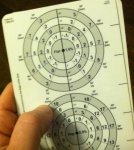
The chart book is not specific to any green or course but provides a template. You then make ur calculation and use the appropriate page. Here is a pic that I got from the net.. chart-300x336.jpg

As you see from the pic, there is no mention of any greens or courses.
1) There is a page for stimp reading from 7 - 10. For
2) For each stimp they have a reading for slopes 1% to 4%
3) Once you have determined your stimp and your slope, you look up the book and see how much will it break.
4) The book then tells u where to aim i.e. 1 inch to the right or -1 to the left (which are the numbers in the pic)
I will try and upload a pic of my book when i get near my bag.

If ur at KoK or H4H, I am sure one of us can show the book.
 
I haven't RTFM but I still cant get m head around the fact the line is dictated largely by pace! you might see the line, the chart might tell you where to aim. if you don't hit it hard enough / too hard, it wont go in!
 
I didnt realise the guide book gave you all these figures, wonder where they get it from as each course and green are different.
It all comes down to physics!

Greens may be 'different' but (on non-grained greens like we have in UK) you only need to know (estimate) the speed and slope and you have everything you need.

Their PGA 'version' - which is not about green reading - demonstrates that!
 
It still boils down to those that have never tried it or never want to being sceptical. My suggestion is to see it in action somewhere and understand how quickly and easily you can get an accurate read. Before I went on the course I would never have believed some of the reads it was giving me, but putt the ball on the right line (it doesn't help the mechanics) and it really is amazing how good it is.
 
It still boils down to those that have never tried it or never want to being sceptical. My suggestion is to see it in action somewhere and understand how quickly and easily you can get an accurate read. Before I went on the course I would never have believed some of the reads it was giving me, but putt the ball on the right line (it doesn't help the mechanics) and it really is amazing how good it is.

Scepticism, well mine anyway, comes from the inability of the users to quantify how Aimpoint helps to hole more putts.

Assessing green speed is a guess? If the guess is incorrect, the charts are pointless?

Assessing %slope is a guess? Again, the charts are pointless if you have it wrong?

It's hard to see how the Aimpoint guessing game is any different to a "normal" guessing game. Except that one costs £90 more than the other.

I'm never going to criticise anyone using it or any other method though.
 
Scepticism, well mine anyway, comes from the inability of the users to quantify how Aimpoint helps to hole more putts.

Assessing green speed is a guess? If the guess is incorrect, the charts are pointless?

Assessing %slope is a guess? Again, the charts are pointless if you have it wrong?

It's hard to see how the Aimpoint guessing game is any different to a "normal" guessing game. Except that one costs £90 more than the other.

I'm never going to criticise anyone using it or any other method though.

Indeed.

I seem to remember stating that it was a 'quite scientific method of guessing'. If that helps, and I've seen several cases where it seems to have, then that's great. It certainly seems to give users more confidence, always a good thing imo.
 
Scepticism, well mine anyway, comes from the inability of the users to quantify how Aimpoint helps to hole more putts.

Assessing green speed is a guess? If the guess is incorrect, the charts are pointless?

Assessing %slope is a guess? Again, the charts are pointless if you have it wrong?

It's hard to see how the Aimpoint guessing game is any different to a "normal" guessing game. Except that one costs £90 more than the other.

I'm never going to criticise anyone using it or any other method though.

I look at it slightly differently in that I'm not that bothered by others results one way or the other.

The basic elements for putting as I see them are pace, line and green reading. Even if we do these things well we can still miss due to surface irregularities.

If I was missing or making putts and wanted to know why it could be due to any 1 of the factors or a combination of them (I might misread, start it wrong and make it).

If I was making loads I might not be that interested in doing it, if I was missing some then it would become an option.

So if I was going to assess my putting I'd try and assess myself on aim (test to see if I can start it on line), on pace (test to see if I can hit at the pace I want for different distances) and on green reading (take aim out by using tee pegs as a gate, I know if I hit it at the correct pace when I see it finish) individually. Then if I found green reading an issue I'd consider it.

I see aimpoint as a feel system, you're just collecting as much information as you can and using that to make a best guess, similar to a like a laser or GPS.

Most people who putt well will have practiced a fair bit to get experience of this, with aimpoint I don't see any reason why you couldn't take a complete beginner and get them to a pretty good level of green reading within a couple of hours. They'd still have to learn to putt.

One advantage of green speed guess is that after your first putt on a green, if you feel you missed because the pace was wrong then just flip the chart to the appropriate speed for your next putt (green keepers shouldn't be producing greens of vastly different speeds on the same course).

Slope's a guess, though they give you a way to feel it or assess it. However, on a home course or any if you're that bothered you could map the course beforehand (or just the main pin positions)and it wouldn't be some much of a guess then.

I've done the course to see what it's about and found it very interesting, the 2 hours with the guy who knew what they were doing both in green reading and other areas of putting was time and money well spent for me. I don't see the system taking that much time to get a read.

I think it's nice to have confirmation, I can remember hearing either Stepen Ames, Robert Allenby or Stuart Appelby making a comment along the lines of they'd had their best year after committing fully to shots from the fairway, not second guessing themselves after they had to come to accept that if they were half a club out so what, they'd still be close.
 
I look at it slightly differently in that I'm not that bothered by others results one way or the other.

The basic elements for putting as I see them are pace, line and green reading. Even if we do these things well we can still miss due to surface irregularities.

If I was missing or making putts and wanted to know why it could be due to any 1 of the factors or a combination of them (I might misread, start it wrong and make it).

If I was making loads I might not be that interested in doing it, if I was missing some then it would become an option.

So if I was going to assess my putting I'd try and assess myself on aim (test to see if I can start it on line), on pace (test to see if I can hit at the pace I want for different distances) and on green reading (take aim out by using tee pegs as a gate, I know if I hit it at the correct pace when I see it finish) individually. Then if I found green reading an issue I'd consider it.

I see aimpoint as a feel system, you're just collecting as much information as you can and using that to make a best guess, similar to a like a laser or GPS.

Most people who putt well will have practiced a fair bit to get experience of this, with aimpoint I don't see any reason why you couldn't take a complete beginner and get them to a pretty good level of green reading within a couple of hours. They'd still have to learn to putt.

One advantage of green speed guess is that after your first putt on a green, if you feel you missed because the pace was wrong then just flip the chart to the appropriate speed for your next putt (green keepers shouldn't be producing greens of vastly different speeds on the same course).

Slope's a guess, though they give you a way to feel it or assess it. However, on a home course or any if you're that bothered you could map the course beforehand (or just the main pin positions)and it wouldn't be some much of a guess then.

I've done the course to see what it's about and found it very interesting, the 2 hours with the guy who knew what they were doing both in green reading and other areas of putting was time and money well spent for me. I don't see the system taking that much time to get a read.

I think it's nice to have confirmation, I can remember hearing either Stepen Ames, Robert Allenby or Stuart Appelby making a comment along the lines of they'd had their best year after committing fully to shots from the fairway, not second guessing themselves after they had to come to accept that if they were half a club out so what, they'd still be close.

Good post, agree with that.

That is my point there - everyone misses putts due to misreads, so Aimpoint is very interesting to me if it will help me hole more putts. But, there has to be something tangible for the advocates to remain with the method surely? When I asked the question of how many putts were being holed, there was no answer - then the defensive comments came.

Feeling more confident over putts is too wishy washy for me, You can be the most confident 3 putter in the world, but it doesn't help the scores any.

I'm still searching for the green reading laser grid from Caddyshack to go into production!! :)
 
but how do you know these figures, they are as rough as mine when I roughly read a line, then how do you know where to aim (put the T peg in your example?) except you put it approximately where you think it should be...............which all boils down to what the rest of us do..............

There is no guessing about these figures in Aimpoint. You get to LEARN (like most things in golf) what to do to attain these figures.
A putt is affected by numerous parameters but the main 4 are Distance, Speed, Slope and Angle. Distance is down to pacing the putt off (easily done), speed, you can ask, stimp yourself (if you have one) OR use the chart on a 5ft putt to get a speed reading. Slope is judge by the weight placement on your feet, no different to walking down length of a putt to gauge which way slope is going. Angle is obtained from the ball to the hole from the midpoint of the putt, the chart will tell you if it's uphill or downhill and this will eventually give the amount of break for that putt.

Sounds complex but it's no different to you working out, a downhill lie that flies left to right out of a flying lie into a 15mph wind, with pin cut 4ft left of the green from 163yds out, how far left do I aim? ..... What club do I use? You'll have maybe one of those in a round, Aimpoint, if we hit the green in reg, will be used 18 times at least. The more you do it the easier it becomes to a point that I can stand to the side and have a good idea before I get to the ball what it's going to do.

I will say this, normally in UK greens are generally about 9-10 on a stimp, if we had a weeks golf on various course and the speeds were similar day to day, then I'd say, if comparable in putting technique, there not be much between us in number of putts. But if we played a course that had a stimp of 12, then potentially, I'd be able to adapt quicker to the huge amount of breaks required on a green that fast then you. Aimpoint gives me that.
 
There is no guessing about these figures in Aimpoint. You get to LEARN (like most things in golf) what to do to attain these figures.
That's codswallop!

You are just learning to guess better. Though that's a good thing!

The fact that it comes up with a precise number should not detract from the fact that everything about the process to get there was a guess - albeit an educated one!

To quantify the benefit, somewhat...What were your putts-per-GIR before learning Aimpoint? What are they now?
 
Good post, agree with that.

That is my point there - everyone misses putts due to misreads, so Aimpoint is very interesting to me if it will help me hole more putts. But, there has to be something tangible for the advocates to remain with the method surely? When I asked the question of how many putts were being holed, there was no answer - then the defensive comments came.

Feeling more confident over putts is too wishy washy for me, You can be the most confident 3 putter in the world, but it doesn't help the scores any.

I'm still searching for the green reading laser grid from Caddyshack to go into production!! :)

Think asking that question, how many putts were being holed, doesn't justify if Aimpoint is viable or not. It tells you the amount of break needed for that putt, but can't work out if your putting action is a figure of 8, or you open/close the head by a degree or 2, and if it deflects off a spike/pitch mark/stone, or the hole is crowned...... Just cos I use Aimpoint doesn't mean I'm immune to all the vagaries of outside influences, but it gives me a great OPPORTUNITY to hole more putts and I have holed a fair share of putts including more 20ft plus putts.

Let me ask you this, if your Pro had been on the European tour and gave a 2-3 hr seminar on short game shots that he gained from Seve whilst on tour and charged £100, would it be foolish to disregard paying that and learn how he approached and played certain shots that could potentially improve you in getting the ball into the hole?
 
That's codswallop!

You are just learning to guess better. Though that's a good thing!

The fact that it comes up with a precise number should not detract from the fact that everything about the process to get there was a guess - albeit an educated one!

To quantify the benefit, somewhat...What were your putts-per-GIR before learning Aimpoint? What are they now?

ok codswallop stands corrected. I suppose everything we do in golf is a guess then.

All I can give you is my stats right now thru golfshot, I had stats on computer but lost them before Aimpoint, I can't remember what they were.

GIR is 64.7%. Putts per hole 1.78. Per GIR 1.84
 
Think asking that question, how many putts were being holed, doesn't justify if Aimpoint is viable or not. It tells you the amount of break needed for that putt, but can't work out if your putting action is a figure of 8, or you open/close the head by a degree or 2, and if it deflects off a spike/pitch mark/stone, or the hole is crowned...... Just cos I use Aimpoint doesn't mean I'm immune to all the vagaries of outside influences, but it gives me a great OPPORTUNITY to hole more putts and I have holed a fair share of putts including more 20ft plus putts.

Let me ask you this, if your Pro had been on the European tour and gave a 2-3 hr seminar on short game shots that he gained from Seve whilst on tour and charged £100, would it be foolish to disregard paying that and learn how he approached and played certain shots that could potentially improve you in getting the ball into the hole?

We have exactly the same amount of opportunities, whether Aimpoint increases chance of taking those opportunities is the point no-one has demonstrated...............as of yet.

He'd be teaching me a technique which I could execute physically rather than an elaborate guessing system though
 
We have exactly the same amount of opportunities, whether Aimpoint increases chance of taking those opportunities is the point no-one has demonstrated...............as of yet.

He'd be teaching me a technique which I could execute physically rather than an elaborate guessing system though

and I'm executing an elaborate system that has seen me have more putts go online and hole a few more putts then I did before, do I hole everyone, no, do I 3 putt, yes, do I have off days putting, yes, but that's not the systems fault, that's physical, like you executing a short game technique well one day physically but next day it doesn't........ Is that Seve's fault?

At the end of the day it's a learning skill that helps players whether it's Aimpoint, Trackman, Peltz short game bible, the linear method, Seve's/Mickelsons short game, Leadbetter/harmon/Foley/Golfing Machine teachings, Dr Karl Morris/Joseph Parent/Golf 54/Rotella psychology, they are there to help. Not to everyone's liking, but at least I've TRIED these out over the years and gained a little bit from each. You will go and pay good money for a fitting to the latest TM advertising claim of Loft up, if the numbers crunch then you'll buy it, if it doesn't and you've already got the right club, then the doubt is taken away. I didn't pay but I tried it out and made no difference for me.

Call me a nutter, I don't rightly care, but I'd rather be that and try then be a sceptic and not open minded to these advances.
 
Top