Alterations to WHS?

I see no ambiguity there. It clearly states "...full Course Handicap maintained to machine precision".
In the briefing document issued by England Golf (section 6), it is very clearly referred to as 'Unrounded Course Handicap'. The term Full Course Handicap isn't used anywhere in the document.
Indeed when I asked several players what their full course handicap was, to a man they all said the number of shots received from the tee without any reduction. But then to be fair, hardly any are aware of the introduction of 'unrounded' calculations that is heading towards them.
Old habits die hard with golfers and I think many will still assume 'full course handicap' is a whole figure. Gonna be a big learning curve, again.......
 
I do like the look of the Australian system. I did not at first, but now that we are adopting CR-Par, I do.

They have no such thing as Course Handicap.

To Australians, this debate we are having must seem such a pointless waste of time.
 
I do like the look of the Australian system. I did not at first, but now that we are adopting CR-Par, I do.

They have no such thing as Course Handicap.

To Australians, this debate we are having must seem such a pointless waste of time.
Yes they do. They just call it Daily Handicap.
 
Yes they do. They just call it Daily Handicap.
Daily Handicap is what we call Playing Handicap for individual strokeplay.

This is also the handicap they use to determine nett double bogey limit.
It is 93% of what we call Course Handicap.

What we call Course Handicap the Australians have no name for.
 
Daily Handicap is what we call Playing Handicap for individual strokeplay.

This is also the handicap they use to determine nett double bogey limit.
It is 93% of what we call Course Handicap.

What we call Course Handicap the Australians have no name for.
I assumed their Course Handicap was called Daily Handicap. It was a Playing Handicap the Australians effectively didn't have, as they used the Daily Handicap more directly.
 
I assumed their Course Handicap was called Daily Handicap. It was a Playing Handicap the Australians effectively didn't have, as they used the Daily Handicap more directly.
Daily Handicap has had 93% applied.
Before the 93% is applied (what we call Course Handicap) they have no name for.
 
Daily Handicap has had 93% applied.
Before the 93% is applied (what we call Course Handicap) they have no name for.
They don't have a name for it, surely, because they don't use it. It is just a fragment of their entire formula, the result being Daily Handicap (Course Handicap).

So the Austraians get one Handicap for each course, but I unlike us, don't worry about applying different allowances for different formats (I assume)
 
I would like to comment but I have made my feelings known about this supposed WORLD HS, good luck with your version,
when I visit in May not sure if my Aussie Handicap will be recognized.
 
They don't have a name for it, surely, because they don't use it. It is just a fragment of their entire formula, the result being Daily Handicap (Course Handicap).

So the Austraians get one Handicap for each course, but I unlike us, don't worry about applying different allowances for different formats (I assume)
They still use allowances (multipliers) in the various formats. These are applied instead of the standard 0.93 multiplier that is included in the Daily Handicap.
 
They still use allowances (multipliers) in the various formats. These are applied instead of the standard 0.93 multiplier that is included in the Daily Handicap.
Cheers. So, would it be fairer to say, if we are trying to compare their system to ours that Daily Handicap is effectively Course Handicap. And once they apply any further multipliers, the result would effectively be Playing Handicap?
 
Cheers. So, would it be fairer to say, if we are trying to compare their system to ours that Daily Handicap is effectively Course Handicap. And once they apply any further multipliers, the result would effectively be Playing Handicap?
I don't think so. It is wrong to say Daily Handicap is equivalent to our Course Handicap

Daily Handicap is what they use to play individual strokeplay. It is the equivalent of our Playing Handicap for individual strokeplay. They apply 93%, we apply 95%.

Ozzie Playing Handicap.jpg

Before the 93% is applied, that is equivalent to our Course Handicap, but they don't give it a name.
 
I don't think so. It is wrong to say Daily Handicap is equivalent to our Course Handicap

Daily Handicap is what they use to play individual strokeplay. It is the equivalent of our Playing Handicap for individual strokeplay. They apply 93%, we apply 95%.

View attachment 51483

Before the 93% is applied, that is equivalent to our Course Handicap, but they don't give it a name.
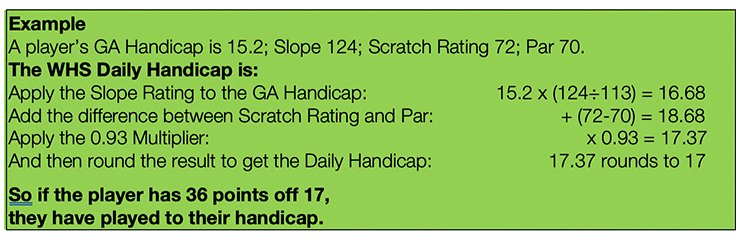
But aren’t EG saying if we play to our Course Handicap then 36 points is playing to your handicap. So in the case above, in CONGU, 36 points off 19 (18.68 rounded to 19) is playing to handicap.
Obviously I have missed something but can’t spot it.
 
I don't think so. It is wrong to say Daily Handicap is equivalent to our Course Handicap

Daily Handicap is what they use to play individual strokeplay. It is the equivalent of our Playing Handicap for individual strokeplay. They apply 93%, we apply 95%.

View attachment 51483

Before the 93% is applied, that is equivalent to our Course Handicap, but they don't give it a name.
Yes, but it is surely their Daily Handicap that is used as the number that needs to be adjusted for any other formats. Which for us, is what we do with our Course Handicap. I don't know what their playing allowances are for all formats, but effectively for singles strokeplay, their playing allowance is essentially 100%.

Regardless, all we are doing is trying to compare different terms in different applications of the system. So, it is probably futile trying to get a like for like comparison, because they are essentially different.

But I agree with your initial point, I prefer the Australian implementation of it. Anything to avoid applying a playing allowance every time you play singles stroke play (which for me is the most common format when playing competitive golf) feels a lot more straight forward.
 
Yes, but it is surely their Daily Handicap that is used as the number that needs to be adjusted for any other formats. Which for us, is what we do with our Course Handicap. I don't know what their playing allowances are for all formats, but effectively for singles strokeplay, their playing allowance is essentially 100%.

Regardless, all we are doing is trying to compare different terms in different applications of the system. So, it is probably futile trying to get a like for like comparison, because they are essentially different.

But I agree with your initial point, I prefer the Australian implementation of it. Anything to avoid applying a playing allowance every time you play singles stroke play (which for me is the most common format when playing competitive golf) feels a lot more straight forward.
This is the key. In practice, most golf for the vast majority of people is not individual strokeplay competition golf.
 
But aren’t EG saying if we play to our Course Handicap then 36 points is playing to your handicap. So in the case above, in CONGU, 36 points off 19 (18.68 rounded to 19) is playing to handicap.
Obviously I have missed something but can’t spot it.
Because the notion of "playing to handicap" is interpretable and not a globally fixed concept.

I view playing to handicap as being the Score Differential that is closest to Handicap Index.
This will not change with CR-Par or unrounded Course Handicap.

Sometimes my HI could be halfway between two potential Score Differentials.
Half a shot above or half a shot below handicap.
After CR-Par is introduced, this could be 35 or 36 points, or it could be 36 or 37 points.
That is why I have not considered stableford points scored as a good or reliable indicator of playing to handicap. Score Differential is a better indicator.
 
Last edited:
Yes, but it is surely their Daily Handicap that is used as the number that needs to be adjusted for any other formats. Which for us, is what we do with our Course Handicap. I don't know what their playing allowances are for all formats, but effectively for singles strokeplay, their playing allowance is essentially 100%.

Regardless, all we are doing is trying to compare different terms in different applications of the system. So, it is probably futile trying to get a like for like comparison, because they are essentially different.

But I agree with your initial point, I prefer the Australian implementation of it. Anything to avoid applying a playing allowance every time you play singles stroke play (which for me is the most common format when playing competitive golf) feels a lot more straight forward.
They call 93%, or rather 0.93 as "The Multiplier".
So what we call a 95% allowance for individual strokeplay, they use a 0.93 multiplier for individual strokeplay. This is quite definitely not 100%.

They change the 0.93 multiplier to the appropriate other multiplier for the other formats.
 
This is the key. In practice, most golf for the vast majority of people is not individual strokeplay competition golf.
If most people don't play individual strokeplay golf most of the time, I guess that severely limits what scores they can submit for handicap in the UK?

It is a pity we have a handicap system that says acceptable scores can only be submitted for formats most people don't even play?
 
Round where we are casual golf is the most common format but as many groups have their own handicapping system I'm not sure why a different system is needed.
In formal golf singles strokeplay in either medal or Stableford format is probably next . Matchplay competitions are not uncommon but are played over months with half the field being removed in the first round.
 
Top