
Which course is better for reducing handicap?

My current HI is 5.0

Course A
A score of 81 would give me a 6.2

Course B
A score of 78 would give me a 6.1

Either of these would give me cut.
I would be inclined to go for Course A to give me the best chance.

Without further info or experience of these two notional courses, I fall back on my experience of my own course which is
Par 70 either tee
White 70.8/132
Yellow 69.1/127

I believe white tees at my club give me the better chance of desirable score differentials.
Yellow tees are "harder" for me.
It niggles me a bit at my club when we have a seniors comp, they put us on the yellow tees, which I find harder. But very few, if any, think like me it seems.

In a real world case, each player will vary from the "standard" by which courses are rated. A personal choice has to be made with regard to one's own strengths and weaknesses.
I do !
Off yellows all the bunkers are reachable for me.
Off whites there not.
There’s not much difference between the tees but I lose two shots off the yellows.

As to the op it depends on the shape of the holes as well.!
Anyone who plays a draw will struggle on a predominantly left to right course and vice versa.
We all have certain courses we just don’t play well.
 
Hi, I can help you with the correct answer to your question. TLDR - it doesn't matter, WHS works, just play better to reduce your handicap.

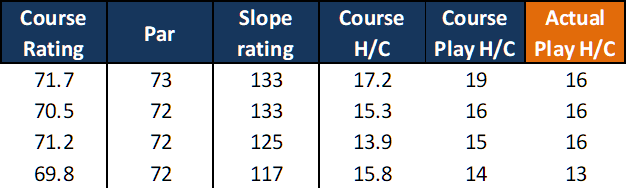
I am a member of 2 clubs, both clubs have 2 courses. The details are as below. My handicap index is 14.9. Should I use only rounds played on each course to calculate my handicap for that course I would have the index labelled "course h/c" on each of those courses. On all courses I have over 20 rounds. All the data is from the "yellow" (or equivalent tee). But where I have played off the longer tee in only 1 instance (on the top course) would this score have counted anyway.

So the way to read this would be - taking the top row. If I only ever played this course my index would be 17.2. So my playing handicap would be 19. In reality, cause my index is 14.9, my actual playing handicap is 16.

1775573681098.png

As it happens today I have 3 rounds from the top course and 2 each from the bottom two as counting scores for my H/C. (the 8th score is from elsewhere). My perception would be that the top course is only just the toughest of the 4 - the bottom is by some margin the easiest. As I say this is just my feeling but one way the data would show this is that among my 20 scores on each course the spread between highest and lowest on this course is the largest. This is likely cause it has 3 par 5's where the 2nd shot it over water. This would mean you need to hit a good drive or you'd need to lay up followed a good 2nd to avoid the water.

On any course - assuming par from each tee is the same - you are almost always better off going from the shorter tee. My average fairway drive goes 272yds. From longer tee's my no. of fairways hit drops by a third and my greens in regulation by more than half. The number of putts is about the same. So for me - the issue from the "whites" or "blues" isn't the distance in and of itself. It is that my approach shots are taken with longer irons and this results in more missed greens. You could probably work this out for yourself if you just think of your course - on the par 3's that are 130-160 yds how often are you hitting the green vs the par 3's that are 160yds+
 
Hi, I can help you with the correct answer to your question. TLDR - it doesn't matter, WHS works, just play better to reduce your handicap.

I am a member of 2 clubs, both clubs have 2 courses. The details are as below. My handicap index is 14.9. Should I use only rounds played on each course to calculate my handicap for that course I would have the index labelled "course h/c" on each of those courses. On all courses I have over 20 rounds. All the data is from the "yellow" (or equivalent tee). But where I have played off the longer tee in only 1 instance (on the top course) would this score have counted anyway.

So the way to read this would be - taking the top row. If I only ever played this course my index would be 17.2. So my playing handicap would be 19. In reality, cause my index is 14.9, my actual playing handicap is 16.

View attachment 61441

As it happens today I have 3 rounds from the top course and 2 each from the bottom two as counting scores for my H/C. (the 8th score is from elsewhere). My perception would be that the top course is only just the toughest of the 4 - the bottom is by some margin the easiest. As I say this is just my feeling but one way the data would show this is that among my 20 scores on each course the spread between highest and lowest on this course is the largest. This is likely cause it has 3 par 5's where the 2nd shot it over water. This would mean you need to hit a good drive or you'd need to lay up followed a good 2nd to avoid the water.

On any course - assuming par from each tee is the same - you are almost always better off going from the shorter tee. My average fairway drive goes 272yds. From longer tee's my no. of fairways hit drops by a third and my greens in regulation by more than half. The number of putts is about the same. So for me - the issue from the "whites" or "blues" isn't the distance in and of itself. It is that my approach shots are taken with longer irons and this results in more missed greens. You could probably work this out for yourself if you just think of your course - on the par 3's that are 130-160 yds how often are you hitting the green vs the par 3's that are 160yds+
272 yard average drive on fairway and 14.9 index? Wow.
 
The answer is that, if the system worked correctly, it wouldn't matter. However the WHS doesn't allow enough latitude between easy & hard courses. Nor does it add enough to the standard scratch score for bad weather conditions or take enough off for playing off yellows instead of whites. At my club, anyone wanting to maintain an artificially low handicap will only play in calm, dry conditions off the yellow tees.
You get calm days at South Shields? Well, I didn't know that.
 
My course is short, narrow and with hellish greens but because it's short it has very low course ratings. Consequently it's very difficult to get your handicap down there, since even a very good score for me will have a higher score differential. If you really want to get your handicap down you need to join a club with very high course and slope ratings.

This really only applies to a certain type of golfer.

I see a lot of regular golfers who are short hitters but very straight. They do well at short and tight courses but then struggle at longer courses with higher slope and course ratings because they just can’t hit it far enough to reach GIR.

Conversely a big hitter who is a bit wild off the tee will struggle on a short tight course.
 
I'm with you on this. I'm thinking about the harder courses that I play. My h/c would go up, not down. No question about it.
Yeah I was trying to fathom how that would work! Maybe I’m thick but I can’t see the logic that a hard course would help lower your handicap. 🤔

Maybe it’s just me but I’d have thought playing somewhere that’s more of an average to easy course would be more suited to getting low. Say a Par 72 with a CR of 68-70, Slope of 110(ish) possibly lower, fairly and short and not to much danger off the tee. Rather than a hard course that would just see handicaps go up and up surely.
 
How do you work that out?

Go and play Carnoustie off the Open championship tees. I bet most handicap golfers would get nowhere near their handicap.
The answer is in score differentials and the fact you only need to put in an average round in order to have a comparatively low score differential appear on your record.
 
Yeah I was trying to fathom how that would work! Maybe I’m thick but I can’t see the logic that a hard course would help lower your handicap. 🤔

Maybe it’s just me but I’d have thought playing somewhere that’s more of an average to easy course would be more suited to getting low. Say a Par 72 with a CR of 68-70, Slope of 110(ish) possibly lower, fairly and short and not to much danger off the tee. Rather than a hard course that would just see handicaps go up and up surely.
Doesn't work because your score differential ends up being about 4 shots lower than what you thought you scored so you don't get cut. Know this from experience at my place - I need to shoot 77 or better now just to match my current handicap, and I haven't got it in me to shoot much lower than that. On a harder course I can go and shoot 81 and get a SD of 9 and get a decent cut. 🤷🏻
 
Doesn't work because your score differential ends up being about 4 shots lower than what you thought you scored so you don't get cut. Know this from experience at my place - I need to shoot 77 or better now just to match my current handicap, and I haven't got it in me to shoot much lower than that. On a harder course I can go and shoot 81 and get a SD of 9 and get a decent cut. 🤷🏻
To play to my handicap I need to shoot 72 off our shortest tees or 79 off our longest (75, 77 and 78 off the others).
This doesn’t mean that I will automatically play the longest just because I can shoot a relatively high number and still get a cut.
In fact I, as well as the rest of the club, think those tees are the worst for trying to get a cut despite being able to shoot a higher number.
 
Doesn't work because your score differential ends up being about 4 shots lower than what you thought you scored so you don't get cut. Know this from experience at my place - I need to shoot 77 or better now just to match my current handicap, and I haven't got it in me to shoot much lower than that. On a harder course I can go and shoot 81 and get a SD of 9 and get a decent cut. 🤷🏻
I think a lot of the thought behind this is on either course you hit driver on most holes and it then leaves either a short or long iron depending on course/hole length.
The average golfer is going to hit the green more often with a shorter iron.
This to me makes sense.

It does not allow for how difficult the green may be (imagine how long it would take to measure green differences and difficulty on every course).

I’m not a long hitter but fairly straight and a decent putter.
I always score lower on a shorter course than a longer one.
I have a mate off a similar handicap who is a big hitter but can carve a few and he always scores better on longer courses.

You need to stop playing a pitch and putt and get yourself off the blacks at the Grove 🤣🤣
 
I think a lot of the thought behind this is on either course you hit driver on most holes and it then leaves either a short or long iron depending on course/hole length.
The average golfer is going to hit the green more often with a shorter iron.
This to me makes sense.

It does not allow for how difficult the green may be (imagine how long it would take to measure green differences and difficulty on every course).

I’m not a long hitter but fairly straight and a decent putter.

I always score lower on a shorter course than a longer one.
I have a mate off a similar handicap who is a big hitter but can carve a few and he always scores better on longer courses.

You need to stop playing a pitch and putt and get yourself off the blacks at the Grove 🤣🤣
Green difficulty is big annoyance for me, as ours are all lethal but this isn't accounted for in ratings at all.

I would also class myself as a medium hitter who hits a relatively good number of fairways. But I still find it easier at longer, wider courses with flatter greens. Maybe because my short game isn't great and short game is trickier and more important at my course. For example I could miss a green at my course and have a fiddly chip onto a downslope - versus being 40 yards short of the green on a longer course and having an easy pitch shot. For the most part though, the issue is that my most likely score will be the same on both courses - low 80s. However on my home track that could be an SD of 14-15 whereas on the away track it could be 10-11.

There's another course near me that's even more silly - it's called Rickmansworth. Par 65 but it has some of the hardest par 3s you'll ever see and some ridiculous slopes on fairways etc. Again, my scores there are much the same as there are on other longer courses, despite the low par. So putting cards in there would be a total waste of time, absolutely zero chance of getting cut. My mate scored 74 there in February and it gave him an SD of 15.2. :LOL: Would've needed to shoot about 5 over to get cut I think (his index is 12).
 
Green difficulty is big annoyance for me, as ours are all lethal but this isn't accounted for in ratings at all.

I would also class myself as a medium hitter who hits a relatively good number of fairways. But I still find it easier at longer, wider courses with flatter greens. Maybe because my short game isn't great and short game is trickier and more important at my course. For example I could miss a green at my course and have a fiddly chip onto a downslope - versus being 40 yards short of the green on a longer course and having an easy pitch shot. For the most part though, the issue is that my most likely score will be the same on both courses - low 80s. However on my home track that could be an SD of 14-15 whereas on the away track it could be 10-11.

There's another course near me that's even more silly - it's called Rickmansworth. Par 65 but it has some of the hardest par 3s you'll ever see and some ridiculous slopes on fairways etc. Again, my scores there are much the same as there are on other longer courses, despite the low par. So putting cards in there would be a total waste of time, absolutely zero chance of getting cut. My mate scored 74 there in February and it gave him an SD of 15.2. :LOL: Would've needed to shoot about 5 over to get cut I think (his index is 12).
The handicap system is set up for the average golfer.
The trouble is none of us is average 🤣.

I used to play quite a long course (10 par 4s over 420 yards).
That can be hard work when your game is slightly off and you never seem to have a putt for birdie on some days or every par putt you have is 30 foot downhill.

A lot of the time it’s about getting used to it and then it’s just second nature
 
The handicap system is set up for the average golfer.
The trouble is none of us is average 🤣.

I used to play quite a long course (10 par 4s over 420 yards).
That can be hard work when your game is slightly off and you never seem to have a putt for birdie on some days or every par putt you have is 30 foot downhill.

A lot of the time it’s about getting used to it and then it’s just second nature
To be fair when I talk about long courses they're not actually long long. I'm talking about tracks that are 6000-ish yards. I can reach most of the greens still, they're so much wider than my home track, the greens are easier, and yet I receive 3 more shots on my course handicap there. Go figure.
 
The handicap system is set up for the average golfer.
The trouble is none of us is average 🤣.

I used to play quite a long course (10 par 4s over 420 yards).
That can be hard work when your game is slightly off and you never seem to have a putt for birdie on some days or every par putt you have is 30 foot downhill.

A lot of the time it’s about getting used to it and then it’s just second nature
The system is based on model golfers, not average golfers.
Model golfers are consistent, real golfers (average or otherwise) are not - and their level of inconsistency is also inconsistent.
 
To be fair when I talk about long courses they're not actually long long. I'm talking about tracks that are 6000-ish yards. I can reach most of the greens still, they're so much wider than my home track, the greens are easier, and yet I receive 3 more shots on my course handicap there. Go figure.
The one I used to play was 7000 off the back tees.
At time it was just a slog rather the interesting.
I was just hoping to hit the start of the fairway and the hazards were out of reach.
Off the shorter tees it was around 6400 yards which for me made it more interesting and more fun.
 
Top