Point of nearest relief question

I'm not quite visualising the set-up, Mark. Everything you describe makes sense if it were a water hazard but I can't picture any of it as a lateral water hazard. Are you sure the stakes were red and not yellow?

And can you clarify where the stakes were - ie was this bank within the margins of the hazard or not?

Hi Colin
I checked on Saturday - the stakes were yellow and above the bank so the ball didn't clear the hazard, so I presume i'm right in playing from the fairway in front of the pond.
 
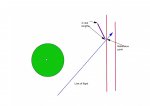
That's as in my first diagram, then, with your drop being behind the hazard anywhere back along the line from the hole through the point at which your ball crossed the margin.

You also had other options at the time under penalty of one stroke:
drop and play from where your previous stroke was made in the hazard and have another go at clearing the bank*;
drop and play from where you played your last stroke outside the hazard.

*You would need to be very careful with this one in case your dropped ball rolled into an unplayable position as it would cost you an additional penalty stroke to escape from that.

See Rule 26-2
 
Last edited:
Thanks for clarifying this Colin, you've certainly made me think about it! Like I said it was a pretty unusual event I don't normally experience my ball going back over my shoulder!
 
Not trying to hijack the thread but this has got me thinking about a hole on our course.

It is a par three with wide deep ditch all the way down the right, if you were to hit the ball green high and past the pin but go into the hazard which has red stakes where would you drop (assuming the ball was unplayable). There is no chance of crossing the ditch to drop on the opposite side and two club lengths from the point you crossed the hazard in line with the path you ball was traveling would likely put you nearer the hole.

Would you have to go back to the tee or could you take your two clublenghts parallel to the hazard either back or foward from the tee so you are further from the hole from where you crossed the hazard line, my only thought with this is you could end up dropping further from the tee so you would not be dropping on the true line of your shot.

Hope this makes sence, I would like to do a diagram but i'm not that clever.
 
The line of your shot is not relevant to taking relief.
The significant reference is simply where the ball last crossed the margin of the hazard.

In your case the 2 cl may be back towards the tee or further away.
Depending on the exact 'route' of the water hazard you may or may not be able to find a spot which is not nearer the hole.

If you can't, then it's back to the tee I'm afraid.
View attachment 5678
 

Attachments

  • 2cl.jpg
    2cl.jpg
    52.1 KB · Views: 22
Last edited:
Shaun

"Not nearer the hole" than the point where the ball crossed the margin will be an arc of a circle the radius of which is the distance from the hole to the point. This will leave an area in which you can drop. It might be very small -even impractically small - but it will be there! I've tried to illustrate this - click on the diagram for the full size image. AX (the distance from the hole of the point of entry) is the same length as AX1 and AX2 which as you see leaves this small area on either side of X in which you can drop. The yellow is meant to show the 2 club length area in which you can drop and the green shows the further area into which your ball can roll without requiring a redrop.

I think however this is really a situation in which your Committee should consider establishing a dropping zone.

View attachment 5680
 
Thats great, thanks guys.

I do think a drop zone may be a good idea in this case due to the nature of the hazard and location to the green. Any point two club lengths from the point of entry to the hazard is going to leave a very small area to drop.

I guess the real answer is to stay out of the hazard.
 
"Not nearer the hole" than the point where the ball crossed the margin will be an arc of a circle the radius of which is the distance from the hole to the point.
View attachment 5680

A pedantic clarification that allows me to use my favourite 'Scottish' word...

"Not nearer the hole" than the point where the ball crossed the margin will be an area outwith that of a circle the radius of which is the distance from the hole to the point.
 
Last edited:
That's an interesting reference - I didn't know of that meaning - but the anent I know and love means concerning, with regard to, about

This source http://oxforddictionaries.com/definition/english/anent gives the origin as Old English on efen 'in line with, in company with'. It also says it is archaic or Scottish: in my case there isn't much difference.:)

From water hazards to etymology in one thread!
 
I once got pulled up by a smart alec manager for writing in a report 'this is outwith the scope of this study' he said there is no such word - I was adamant there was - he wasn't having it - bawheid!
 
So what did you say him? "It's such a pity that the word is outwith your limited vocabulary," might not have done your promotion prospects much good. :)
 
A pedantic clarification that allows me to use my favourite 'Scottish' word...

"Not nearer the hole" than the point where the ball crossed the margin will be an area outwith that of a circle the radius of which is the distance from the hole to the point.

"Not nearer the hole" includes a point equidistant from the hole, so it's not necessarily outwith such a circle.
 
So what if I revise my original description to this?

"Not nearer the hole" than the point where the ball crossed the margin is defined by the circumference of a circle the radius of which is the distance from the hole to the point. This will leave an area in which you can drop.
 
So what if I revise my original description to this?

"Not nearer the hole" than the point where the ball crossed the margin is defined by the circumference of a circle the radius of which is the distance from the hole to the point. This will leave an area in which you can drop.

The highlighted words could cause confusion because of other limitations which may apply eg 1cl.

In fact they are unnecessary as the rest of your definition of 'not nearer the hole' is perfectly adequate.


Edited: Just realised the last sentence may just have been a comment rather than part of the definition.
 
Top