
bobmac
Major Champion
To give an accurate answer to the original question, the position of the embedded ball has to be established, in the bunker or not. Do we all agree on that?

Why include me in that reference? I haven't attacked anyone.Yourself, rulesfan and rulie have contributed 8 posts to the thread to date. Precisely 2 of those related to the substance of the OP. 6 are simply attacking my contribution and this continues to appear to be your preoccupation. Thank you for that fine welcome to this forum.

To give an accurate answer to the original question, the position of the embedded ball has to be established, in the bunker or not. Do we all agree on that?
It's bit messy, really, and here we have the usual case of having to see it to make a judgment, I'd say.
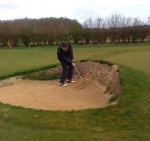
Yes, I shouldn't have, that was an error on my part.Why include me in that reference? I haven't attacked anyone.
Post #8 only indicates there was unprepared sand in the face of the 'bunker', so while more likely than not, we are not in a definitive position to say the ball is or is not in the bunker. Without seeing it, there are two possibilities. One is it is like the photo above, the face not being part of the bunker. The other is the face is part of the bunker and normally contains sand but is in a state of disrepair - ie it is "ground where sand normally would be" as discussed in rule 12.1. I agree that seeing it would be helpful (as I noted earlier) and if mashleyR7 is back in the area a photo would be useful.I certainly hope so and since the OP has confirmed that the ball wasn't in the bunker [post #8] the applicable rule is for an embedded ball in the general area [16.3]. Relief is not, however, allowed for a ball embedded in sand in a part of the general area that is not closely mown and so judging by the OP's description of the face, you'd have to take account of whether the ball was embedded in sand and if so whether the face of the bunker was closely mown or not. It's bit messy, really, and here we have the usual case of having to see it to make a judgment, I'd say.

 after 2 drops, placed.
I don't share your confidence that mashleyR7's post (#8) was "quite clear" that the ball was not in the bunker. My reason is #8 appeared to focus on rulefan's quoted bunker definition that starts "a bunker is a specially prepared area of sand....", with post #8 noting that the area the ball was in contained "unprepared sand". That is, mashleyR7 may have understood the bunker definition to mean that any "unprepared sand" in the face means that area cannot be part of a bunker. My subsequent posts sought to draw out that an area of unprepared sand may or may not be part of the bunker, as clearly affirmed in rule 12.1.The OP who alone has actually seen this bunker was quite clear after considering the part of the Definition rulefan quoted that the ball was not in the bunker. That seems enough to me to give a clear answer.
My understanding is there is an official ruling to this effect and it is a significant change from pre-2019, when D13/4 used to apply - that old Decision, now rescinded, said an embedded ball is considered lying in the part of the course where it entered the ground.There was an old post here somewhere, referring to a ball embedded so far into the bunker face, that it was actually outside the confines of the bunker.
I think the drop was outside the bunker.

My understanding is there is an official ruling to this effect and it is a significant change from pre-2019, when D13/4 used to apply - that old Decision, now rescinded, said an embedded ball is considered lying in the part of the course where it entered the ground.
This clarification is a different issue. Old world - ball embedding into a bunker but passing entirely through a bunker lip to be outside the bunker (the edges were measured vertically downwards) was considered to be lying in the part of the course where it landed. Now that same ball is considered outside the bunker.Have you missed this later clarification?
Rule 16.3b:
1. Player Not Always Allowed to Take Embedded Ball Relief:
If a player’s ball is embedded in the general area but neither the reference point nor any part of the course within one club-length of the reference point is in the general area, the player is not allowed to take free relief under Rule 16.3b.
For example, free relief is not allowed if:
- a ball is embedded at the very base of the lip, wall or face above a bunker,
- the spot right behind the ball is in the bunker and
- within one club-length of and not nearer the hole from that reference point, there is no part of the relief area that is in the general area. (Added 12/2018)


