Loft insulation

matt611

Head Pro
Joined
May 22, 2010
Messages
390
Visit site
Given the current gas issues I’m thinking it might be worth adding to the loft insulation. It’s still early days but has anyone got any advice on websites I could read up on this or videos worth watching? Any thoughts welcome.

Thanks
 
Given the current gas issues I’m thinking it might be worth adding to the loft insulation. It’s still early days but has anyone got any advice on websites I could read up on this or videos worth watching? Any thoughts welcome.

Thanks

It's always worth adding insulation, it's cheap and affective

If you wait until April the gov are on verge of launching a scheme to help pay for it

Or you can do yourself if you are able

If you really want to be fancy, insulation.. then loft legs and then loft boards on top to give storage without squashing the insulation
 
Given the current gas issues I’m thinking it might be worth adding to the loft insulation. It’s still early days but has anyone got any advice on websites I could read up on this or videos worth watching? Any thoughts welcome.

Thanks
Building regs now require 11"/270mm minimum but I would recommend 15 - 18". Any more will probably not pay for itself even with energy prices going through the roof (literally).

Make sure all pipes are lagged and if possible, below the insulation
 
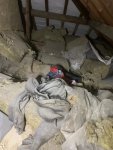
I researched it a lot recently. When we got the house I had a look through the hatch and there is some nasty looking insulation stuff around the hatch. Now we got a slightly larger ladder I had a deeper look around, wanted to see how deep we are. It turns out that further away from the hatch we have zero insulation, at least towards rge bedroom side, the other is too messy to see properly
Unfortunately the ladder isn’t long enough for me to actually get up there.
Next weekend I will get one, go up and check out what we need in terms of down lighting protection and then put down an initial 100 mm between the joists. Better than null for now. Going to go to Whicks as it is the most convenient. Depending on how that goes I might get another 170 on top of it, or we look at loft boards and get someone to do it together.
 
If you are going to do it yourself make sure you read up fully.

When I did mine some things that were pointed out is the electric cables need to be on top of the insulation (this can be hard as there may not be enough slack in the cables to achieve this), other not to have insulation above light fittings, not to close off air gaps designed to give airflow through the loft to stop condensation and if you have a water tank in the loft there should not be insulation below it.

I was lucky I got mine under the old scheme of £1 per roll and I noticed the benefits.

Make sure you wear full protective gear the fibres can get very itchy.

It is not a job I would ever like to have to do again.
 
If you are going to do it yourself make sure you read up fully.

When I did mine some things that were pointed out is the electric cables need to be on top of the insulation (this can be hard as there may not be enough slack in the cables to achieve this), other not to have insulation above light fittings, not to close off air gaps designed to give airflow through the loft to stop condensation and if you have a water tank in the loft there should not be insulation below it.

I was lucky I got mine under the old scheme of £1 per roll and I noticed the benefits.

Make sure you wear full protective gear the fibres can get very itchy.

It is not a job I would ever like to have to do again.
My understanding is that power shower cables have to be above the insulation, the rest can be below it. The downlighting are protected by those buckets that go above it, and the light travo can be under the insulation as well. And I leave 10cm free at each end for ventilation.

Got the protective gear and was all ready to look up last weekend until it turned out the ladder is too short. But got a battery light installed on a beam I could just reach.
 
My understanding is that power shower cables have to be above the insulation, the rest can be below it. The downlighting are protected by those buckets that go above it, and the light travo can be under the insulation as well. And I leave 10cm free at each end for ventilation.

Got the protective gear and was all ready to look up last weekend until it turned out the ladder is too short. But got a battery light installed on a beam I could just reach.

from the nhbc standards

8.1.7Electrical services and installations

Electrical installations shall be provided in accordance with relevant regulations, codes and standards. The installation shall ensure safe and satisfactory operation and be protected from chemical attack.
Electrical services and installations should:

    • ensure cables are not placed under, against or within thermal insulation, unless they have been appropriately sized and derated
    • ensure PVC covered cables are not in contact with polystyrene insulation.

The derated bit is important. From what I understand the basis for rating is 30 degree C (think of temps in lofts this summer)
 
from the nhbc standards

8.1.7Electrical services and installations

Electrical installations shall be provided in accordance with relevant regulations, codes and standards. The installation shall ensure safe and satisfactory operation and be protected from chemical attack.
Electrical services and installations should:


    • ensure cables are not placed under, against or within thermal insulation, unless they have been appropriately sized and derated
    • ensure PVC covered cables are not in contact with polystyrene insulation.

The derated bit is important. From what I understand the basis for rating is 30 degree C (think of temps in lofts this summer)

Tbh in nearly 40 years as an installation Electrician I’ve never seen cables damaged by loft insulation or any sign of cables being overloaded due to thermal insulation, most cables are run way below there maximum current carrying capacity so even when you derate the cable you will not overload it.
My advice would be, do not pull cables about at all. Gently lay your insulation between the joists then lay another level cross ways and leave a space around any spotlight fittings.
 
D8AC4899-50AD-469C-8F18-816AFCC0F4D5.jpegF83BD5DB-6E91-47CF-944B-454C97480645.jpegDE77BFD1-2329-47FB-A95B-C9D2934E6B32.jpegAE14E133-DB1A-402B-A8A1-B4B76C7F197D.jpegE8AFDA29-448C-448B-816E-E9D55BB44B03.jpeg4676DF3D-60A9-4526-ADD6-E8703DA732BE.jpegE141A965-FD29-482A-8630-0920054563E8.jpeg
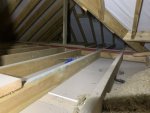
Ok, I got myself a ladder and went up there.
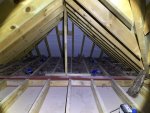
The extension looks straight forward. Get downlight protectors and insulate. I have 8 uniform gaps between the joists, 3 of them contain light.
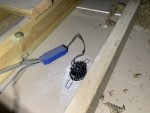
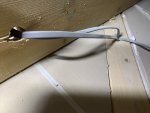
There is no power shower, I guess the cables are fine to remain? Trafounder the hood?

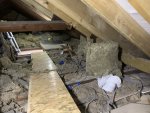
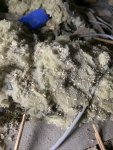
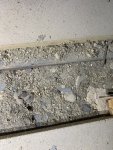
The old bit is more confusing. Is that old stuff any good? Dangerous? Removing and replacing, or sorting and adding?
 
C7524D28-BDDC-4951-9B54-17169C813339.jpeg
I pot 100mm down in the extension like above. The empty bit is filled as well, but my light gave up and I had to finish with my mobile and a torch.
Turns out, our roof is really low and all this crouching and only stepping on joists and boards isn’t really that comfortable.
It took me 3 hours to roll out 2 rolls and install the pods, that is without clearing old rubbish, but in the least accessible area. The next bits should be more ,easy, but easier. I also think we have 600mm joists in the old bit which helps in separating the rolls.
 
Has anyone had experience with the expanding foam insulation you spray on the inside of a roof?
 
Has anyone had experience with the expanding foam insulation you spray on the inside of a roof?
Why? Just why?

Surely you should put the insulation as low as possible so that you aren't heating the roof space. The foam will probably be impervious to the transmission of warm moist air that is created by activities below (you and your's breathing/bathing/cooking/laundry etc) so all that moisture will remain in the roof space potentially causing problems long term. And, if you ever needer to replace the roof covering, I would expect the bill to be somewhat more than normal. I would also guess that it would be far more expensive than insulating at joist level - that's a smaller area to insulate to start with.

Disclosure - I've not had it done nor even considered it.
 
View attachment 45536
I pot 100mm down in the extension like above. The empty bit is filled as well, but my light gave up and I had to finish with my mobile and a torch.
Turns out, our roof is really low and all this crouching and only stepping on joists and boards isn’t really that comfortable.
It took me 3 hours to roll out 2 rolls and install the pods, that is without clearing old rubbish, but in the least accessible area. The next bits should be more ,easy, but easier. I also think we have 600mm joists in the old bit which helps in separating the rolls.

I did a lot of research in to insulation when I was building my new workshop (types, u and r values, install methods etc) and 100mm in a roof/loft space is the very minimum that you should be going for in rockwool or any fibreglass type insulation. 100mm is only really recommended where PIR (solid foam type) is being used. For a domestic attic I'd be putting at least another 150mm layer laid perpendicular to the current lot.
 
Top