help require regarding taking relief

That explains it, Louise.

Now, returning in more wakeful mode to what I said above, the Exception clearly has to be referring to the obstruction from which relief is being taken in the first instance. It could, however, because of the use of an, also refer to another immovable obstruction. Thus, for instance, if your ball is on an artificially surfaced path where a gatepost makes a shot impracticable, it does look as as if you could take relief from the pathway in one move rather than take relief from the gatepost and then, if there is still interference by it, from the path.
 
How wide is the hazard. If narrow and right beside the path and ball was on the left side of the path the NPR may have been across the hazard.


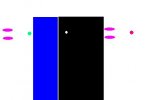
White where ball lies.
Green = NPR

npr.JPG
 
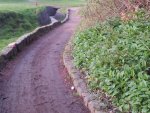
That looks like a beaten down earth path, not artificially surfaced.

[h=2]24/9[/h][h=4]Artificially-Surfaced Road or Path[/h]Q.An artificially-surfaced road or path is an obstruction. What constitutes artificial surfacing?
A.A road or path to which any foreign material, e.g., concrete, tar, gravel, wood chips, etc. has been applied is artificially surfaced and thus an obstruction.
 
I'd call those 'walls' edging. If they are considered part of the path, then your NPR is in the jungle on the right. If separate entities, then relief from the 'wall', an IO, onto (a nicer part of) the path would reasonable. I would have expected the LR to have specified whether the 'wall' was part of the path or not.

And as AF posts, if the surfacing is artificial, it is an obstruction - so doesn't need an LR.

So it really all depends on how the LR(s) is/are worded.
 
Last edited:
I guess it's worth remembering that NPR for free relief does not always result in a good lie. With the cabbage on the right, this looks like one of those. And in any case, it certainly looks like the cabbage is where you'd be, regardless of whether you took relief in two goes rather than one.

I know that you have take rules word for word, but given that the underlying principal of the rules is fairness, it's not a giant leap to the conclusion that for the situation in the photo, free relief with a decent lie would not be fair. It does not look like a place where a 'proper golf shot' should end up - ie it's your own fault you're there - so it is most likely the 'rules' would expect you to take your chances or take a penalty. Hence I'd be surprised if the combination of RoG and LR give the option of a penalty free decent lie.
 
That looks like a beaten down earth path, not artificially surfaced.

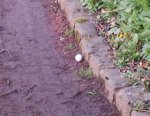
It is almost certainly 'crushed' red sandstone. Usually described as 'self binding red gravel'. You can see some gravel adjacent by the ball. A common path surfacing over here.

That appears to be the case. But twigs on the surface and weeds growing thru make it worth investigating.

002a.jpg
 
That looks like a beaten down earth path, not artificially surfaced.

[h=2]24/9[/h][h=4]Artificially-Surfaced Road or Path[/h]Q.An artificially-surfaced road or path is an obstruction. What constitutes artificial surfacing?
A.A road or path to which any foreign material, e.g., concrete, tar, gravel, wood chips, etc. has been applied is artificially surfaced and thus an obstruction.

It s actually red shale, it is just very dirty at the moment due to the mud still around the course.
 
All becomes clear. A picture is definitely worth a thousand words.

I'd have taken a putter and played me some crazy golf. :fore::whistle:

Looks to me like that's the best option there :rofl:

Putter down the path or drop in that jungle? Only one winner there :D
 
Louise,

It would help if you provided any wording of the LRs - if there is one.

As it's an artificial path, there's no need to have an LR - except for 'clarification'. If that's the case, I believe the wall is part of the path. So bad luck, free relief doesn't look a good option!
 
Just as an aside, I see a red stake in the photo (for the stream) but is the other bank of the stream (ball-side) staked to act as a boundary and if not does this provide any other options for the player in where to drop (assuming any relevant penalty is applied)

Just reading that gobbledegook again :) what I'm really asking is: is it possible that the path is inside a hazard?
 
Last edited:
Just reading that gobbledegook again :) what I'm really asking is: is it possible that the path is inside a hazard?

Look closely and you'll see that some of the stones are painted red, presumably to mark the margin of the hazard, and so the path is not in it. Which gives rise to some curious thoughts. Where the wall is a curved the line of the margin of the hazard could be inside the wall and where a stone sticks out a bit you could have a situation where a ball touching a red stone is in the hazard and a ball touching the next stone isn't. Get a lucky with your ball touching a red stone and you are dropping on the other side for one stroke; get unlucky, as in the photo, your free relief is in the foliage and your ball unplayable drop is on the path with the risk of the ball rolling back against the wall to give you the same problem a penalty stroke later.
 
Having determined that the path IS artificial and that the wall/edge is an integral part of it, your options really are

Play it as it lies
Free relief deep in the foliage - definitly not a good idea.
Drop on the path for 1 shot Penalty - but risk ball ending up in similar location. This (Yes) is probably the answer to you question in OP.
Drop back where previous shot was played from.

Unlucky! Especially when that meant the difference between missing buffer or not.
 
That explains it, Louise.

Now, returning in more wakeful mode to what I said above, the Exception clearly has to be referring to the obstruction from which relief is being taken in the first instance. It could, however, because of the use of an, also refer to another immovable obstruction. Thus, for instance, if your ball is on an artificially surfaced path where a gatepost makes a shot impracticable, it does look as as if you could take relief from the pathway in one move rather than take relief from the gatepost and then, if there is still interference by it, from the path.

I now understand that if there is interference from two problems (eg IOa & IOb, IO and AGC or GUR & CW), then the exceptions to 24-2 and 25-1 do not apply.

So relief may be taken from one or other of the problems and if there is interference from the other, relief may then be taken from that. Decs 24-2b/19 & 24-2b/10
 
Look closely and you'll see that some of the stones are painted red, presumably to mark the margin of the hazard, and so the path is not in it. Which gives rise to some curious thoughts. Where the wall is a curved the line of the margin of the hazard could be inside the wall and where a stone sticks out a bit you could have a situation where a ball touching a red stone is in the hazard and a ball touching the next stone isn't. Get a lucky with your ball touching a red stone and you are dropping on the other side for one stroke; get unlucky, as in the photo, your free relief is in the foliage and your ball unplayable drop is on the path with the risk of the ball rolling back against the wall to give you the same problem a penalty stroke later.

I would suggest (and hope) that the margin of the LWH is defined as either the face of the wall on the water side or on the pathside.

The latter of course presents its own problem. No relief from IOs if the ball is in the LWH (ie touching the wall).
 
Look closely and you'll see that some of the stones are painted red, presumably to mark the margin of the hazard, and so the path is not in it. Which gives rise to some curious thoughts. Where the wall is a curved the line of the margin of the hazard could be inside the wall and where a stone sticks out a bit you could have a situation where a ball touching a red stone is in the hazard and a ball touching the next stone isn't. Get a lucky with your ball touching a red stone and you are dropping on the other side for one stroke; get unlucky, as in the photo, your free relief is in the foliage and your ball unplayable drop is on the path with the risk of the ball rolling back against the wall to give you the same problem a penalty stroke later.

If the 'wall' is path edging and the whole thing (path and edging) is considered to be one obstruction, and some of the edging stones are painted red to mark the edge of the hazard, surely that would mean the whole obstruction (path and edging) is in the hazard? I say this because if you consider the edging and path to be one obstruction, surely it can't then be possible to only define the red stones as in the hazard and the non-painted stones as not in the hazard? Can it :confused:
 
I would suggest (and hope) that the margin of the LWH is defined as either the face of the wall on the water side or on the pathside.

The latter of course presents its own problem. No relief from IOs if the ball is in the LWH (ie touching the wall).

If I was touching one of those red stones - which appear to be deliberately indented slightly from the rest of the wall - I'd be 'happy' taking relief under penalty across the other side of the LWH! Certainly as a right-hander, I'd even consider myself to have 'got lucky'!
 
the path and edgings are not part of the hazard, I can only assume that it was easier to paint the stones rather than but stakes in right next to the edging.
 
Top