• We'd like to take this opportunity to wish you a Happy Holidays and a very Merry Christmas from all at Golf Monthly. Thank you for sharing your 2025 with us!

GUR bunker, ball embedded on face, local rule in place.

Question:

If model rule F 2.1 is in place (stacked turf faces above bunkers are not cut to faiway height or less for the purposes of this rule) then what is the status of the face?

My thought is that it's 'general area' but not cut to fairway height. So if F2.1 is in place, tough titty, and play it as it lies.

(Obviously this doesnt address the issue of the vagaries of how far the limit far 'the bunker is GUR' extends
 
Question:

If model rule F 2.1 is in place (stacked turf faces above bunkers are not cut to faiway height or less for the purposes of this rule) then what is the status of the face?

My thought is that it's 'general area' but not cut to fairway height. So if F2.1 is in place, tough titty, and play it as it lies.

(Obviously this doesnt address the issue of the vagaries of how far the limit far 'the bunker is GUR' extends
I think they have F2.2 in place.
 
We have (rightly) transitioned from a question about the impact of a Local Rule on a ball embedded in a stacked turf face of a bunker, to a discussion about the extent of GUR, and the Committee's role in making clear the extent of that GUR.

In the first instance, we need to squash the idea that the sandy area in the photo is a bunker. It isn't. By definition, when the Committee defines the entire bunker as ground under repair, it is treated as part of the general area (which means it is not a bunker).

Therefore the ball is not embedded in a stacked face above a bunker, it is embedded in a stacked face above a bit of sandy soil in the general area.

Rule 16.1c is therefore irrelevant to the discussion, as is the Club’s Local Rule 4.d.b. (As an aside, in my opinion, the Club’s Local Rule 4.d.a is totally unnecessary and, indeed, causes confusion in relation to the first exception to 16.3a(1), but that can be a discussion for another day. Local Rule 5 is also unnecessary but at least it doesn’t seem to conflict with anything else.)

16.1b and 16.3 are relevant, as is Clarification 16.1/3 (Player May Choose to Take Relief from Either Condition When Interference by Two Conditions Exists)

We (and, more importantly, the Club’s members) also need clarity and clear articulation from the Committee on whether the area of stacked turf is part of the area of GUR.
 
We have (rightly) transitioned from a question about the impact of a Local Rule on a ball embedded in a stacked turf face of a bunker, to a discussion about the extent of GUR, and the Committee's role in making clear the extent of that GUR.

In the first instance, we need to squash the idea that the sandy area in the photo is a bunker. It isn't. By definition, when the Committee defines the entire bunker as ground under repair, it is treated as part of the general area (which means it is not a bunker).

Therefore the ball is not embedded in a stacked face above a bunker, it is embedded in a stacked face above a bit of sandy soil in the general area.

Rule 16.1c is therefore irrelevant to the discussion, as is the Club’s Local Rule 4.d.b. (As an aside, in my opinion, the Club’s Local Rule 4.d.a is totally unnecessary and, indeed, causes confusion in relation to the first exception to 16.3a(1), but that can be a discussion for another day. Local Rule 5 is also unnecessary but at least it doesn’t seem to conflict with anything else.)

16.1b and 16.3 are relevant, as is Clarification 16.1/3 (Player May Choose to Take Relief from Either Condition When Interference by Two Conditions Exists)

We (and, more importantly, the Club’s members) also need clarity and clear articulation from the Committee on whether the area of stacked turf is part of the area of GUR.
The exact reply I was after.
Thank you.
 
And in case it hasn't been abundantly clear for those that have worked through this thread, the course marking is currently inadequate if there is no published wording advising that those above-sand revetted faces are intended to also be GUR.
 
But if the sandy soil expanse in the General Area (formerly known as a bunker) is GUR then it is likely that the players stance to play the ball would be in the GUR and so relief would be available wouldn’t it?
 
In the first instance, we need to squash the idea that the sandy area in the photo is a bunker. It isn't. By definition, when the Committee defines the entire bunker as ground under repair, it is treated as part of the general area (which means it is not a bunker).
It is not automatic.
When a bunker is being repaired and the Committee defines the entire bunker as ground under repair, it is treated as part of the general area (which means it is not a bunker).
 
I think that means I need to alter my question. So...

If the stacked turf face above the sand in the bunker is not part of the bunker, then what is its status. Is it part of the General Area?
Yes it is.

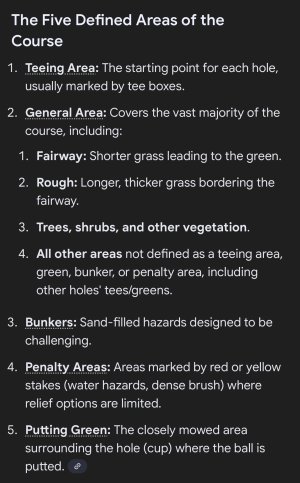
I am not a fan of the descriptions in the graphic above. The defintions of teeing area and putting green, in particular, don't tell the full story.

The teeing area is just the the small defined piece of land between the tee markers (not tee boxes) and two club lengths deep that the player must play from in starting the hole they are playing. Importantly, and not covered in the description above, other teeing locations on the course (whether on the same hole or any other hole) are part of the general area. The use of the term 'tee boxes' in the graphic above is particularly unhelpful.

Similarly, there is only one putting green on the course - and that is the one for the hole the player is playing. The putting greens for all other holes (which the player is not playing at the time) are wrong greens and part of the general area.

The reference to trees, shrubs and other vegetation under the general area description above is misleading and misconstrues what Rule 2.2a says. Parts of the course other than the general area can also have trees, shrubs and other vegetation.

The general area covers the entire course except for the other four specific areas of the course. If it is not in a bunker or a penalty area, or the teeing area for the hole being played, or the putting green for the hole being played, then it is the general area.

For those wanting to learn about the five defined areas of the course, I suggest looking at Rule 2.2 and the relevant Definitions.
 
Where can I find guidance on what constitutes 'being repaired'?
I don't know but perhaps Kent can tell us if work on the newly reconstructed bunkers has finished? My impression is that there still some to be replaced.
But given that the work has been done over time, are some 'completed' or already repaired (ie in play in normal weather) and others still 'maturing' or being repaired?

Repair: to put something that is damaged, broken, or not working correctly, back into good condition or make it work again.
Do the bold words qualify for a new bunker replacing an old bunker (or substitute building for bunker).
 
Yes it is.

I am not a fan of the descriptions in the graphic above. The defintions of teeing area and putting green, in particular, don't tell the full story.

The teeing area is just the the small defined piece of land between the tee markers (not tee boxes) and two club lengths deep that the player must play from in starting the hole they are playing. Importantly, and not covered in the description above, other teeing locations on the course (whether on the same hole or any other hole) are part of the general area. The use of the term 'tee boxes' in the graphic above is particularly unhelpful.

Similarly, there is only one putting green on the course - and that is the one for the hole the player is playing. The putting greens for all other holes (which the player is not playing at the time) are wrong greens and part of the general area.

The reference to trees, shrubs and other vegetation under the general area description above is misleading and misconstrues what Rule 2.2a says. Parts of the course other than the general area can also have trees, shrubs and other vegetation.

The general area covers the entire course except for the other four specific areas of the course. If it is not in a bunker or a penalty area, or the teeing area for the hole being played, or the putting green for the hole being played, then it is the general area.

For those wanting to learn about the five defined areas of the course, I suggest looking at Rule 2.2 and the relevant Definitions.
Similarly the player pedant in me might suggest that the definition of a bunker as a sand-filled hazard, does not say that the surrounds to the sandy area are not a constituent part of the hazard.

But the rules pedant in me counters by pointing out that the sides and surrounds are not sand-filled so not part of the hazard that is a bunker.

Love it…🤣👍
 
And in case it hasn't been abundantly clear for those that have worked through this thread, the course marking is currently inadequate if there is no published wording advising that those above-sand revetted faces are intended to also be GUR.

Similarly the player pedant in me might suggest that the definition of a bunker as a sand-filled hazard, does not say that the surrounds to the sandy area are not a constituent part of the hazard.

But the rules pedant in me counters by pointing out that the sides and surrounds are not sand-filled so not part of the hazard that is a bunker.

Love it…🤣👍
If you were a pedantic pedant, you would realize that “hazard” is no longer used in the Rules and a lip, wall or face consisting of soil, stacked turf, grass or other material surrounding the prepared area of sand are not part of the bunker (see definition of bunker).
 
If you were a pedantic pedant, you would realize that “hazard” is no longer used in the Rules and a lip, wall or face consisting of soil, stacked turf, grass or other material surrounding the prepared area of sand are not part of the bunker (see definition of bunker).
Excellent pedantic pedantry…👍

Btw…is there any other sort…🤔
 
Top