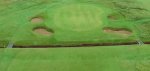
Bridge over ditch

Well spotted. The curious thing is that up till this year, having done this tournament for 5 years, there were indeed stakes helpfully positioned on either side and I remember the first time I was there thinking it was good to see it marked properly.

I don't know why it has changed but your reference to greenstaff may well be the clue. I'll be mentioning it to the club manager the next time I see him.

 
There seems to be a distinct shortage of anything red in the area.

It's generally ok apart from the disappearance of the stakes marking the grass bit over the drainpipe. There are stakes just behind where I was standing and the photo seems to exaggerate the length of the ditch. If I were very critical, the stakes don't quite take in the curvature of the ditch but the margin is very clear.
 
If the local rules on a scorecard state "water hazards, identified by yellow stakes or unmarked are ordinary water hazards. Water hazards identified by red stakes are lateral water hazards"...

...what should be used to define the margins of the hazard? The natural break of the hazard?

Where would you then consider the natural break to be in the following picture....the beginning of the subtle slope (a drop of 1ft over a lateral distance of 5-6ft) leading down to the cut channel....or the drop from the grass into the cut channel itself (the channel for the most part is no more than 8 inches wide and 3 or 4 inches deep).
 

Attachments

  • small2.jpg
    small2.jpg
    100.8 KB · Views: 49
Where would you then consider the natural break to be in the following picture....the beginning of the subtle slope (a drop of 1ft over a lateral distance of 5-6ft) leading down to the cut channel....or the drop from the grass into the cut channel itself (the channel for the most part is no more than 8 inches wide and 3 or 4 inches deep).
Those yellow stakes seem a long way from the channel - does the general area tend to get flooded in winter?

If I came across something like this while playing, I'd use straight lines between stakes to define the margin of the hazard.
 
The yellow stakes as stated in the Local Rules only identify the water hazard; they do not define it. The natural margin is the drop from the cut edge into the channel and that is what defines the water hazard. In effect, it looks as if your ball would be usually be in the water hazard only if it fell into the ditch, but it might be possible for a ball to be overhanging the edge in which case it would be in the hazard.
 
Last edited:
Those yellow stakes seem a long way from the channel - does the general area tend to get flooded in winter?

No.... we had a natural spring suddenly appear in the trees behind the buggy.... this caused a bunker (that is no longer there!) to fill with water along with the general area in the trees. The channel was cut to allow the water to flow away from the area to a pond on the other side of the fairway (behind where the picture was taken from)... in winter the water flows quite nicely down the channel but the general area doesn't flood.
 
The yellow stakes as stated in the Local Rules only identify the water hazard; they do not define it. The natural margin is the drop from the cut edge into the channel and that is what defines the water hazard. In effect, it looks as if your ball would be usually be in the water hazard only if it fell into the ditch, but it might be possible for a ball to be overhanging the edge in which case it would be in the hazard.

I've never seen a ball finish overhanging the edge of the cut channel... in winter when the grass grows a bit longer I guess it is more likely but like I say... I've never seen it. However there are numerous occasions where a ball comes to rest on either bank and the general discussion is whether the ball is within the hazard and whether a player may ground his club or not.

I'm wondering if we should be specifically rewording the local rule on the card to clarify that the hazard is defined by where it naturally breaks.
 
I've never seen a ball finish overhanging the edge of the cut channel... in winter when the grass grows a bit longer I guess it is more likely but like I say... I've never seen it. However there are numerous occasions where a ball comes to rest on either bank and the general discussion is whether the ball is within the hazard and whether a player may ground his club or not.

l'm wondering if we should be specifically rewording the local rule on the card to clarify that the hazard is defined by where it naturally breaks.

The local rule only indicates which colour stake is used for what kind of water hazard. The definition of a water hazard in the Rules of Golf states that if only stakes are used to mark it, then the stakes actually define the margin of the hazard. So in your picture, I'd say the hazard is about 5 yards wide - ie stake to stake either side of it.

So, if it is intended that only the cut channel is the hazard, then the stakes should be moved up to its natural edge (as given in decision 33-2a/4). If that gives difficulty in them being seen from further back (ie from where shots are likely being played), then the stakes could stay where they are, but the actual edge of the hazard needs to be marked by a line. (I don't think you can get round it by just re-wording the local rule).
 
Last edited:
The local rule only indicates which colour stake is used for what kind of water hazard. The definition of a water hazard in the Rules of Golf states that if only stakes are used to mark it, then the stakes actually define the margin of the hazard. So in your picture, I'd say the hazard is about 5 yards wide - ie stake to stake either side of it.

The local rule states that the stakes identify the water hazard. That is, they tell players that there is a water hazard there: they do not define it. The stakes in this instance are black with a yellow top whereas stakes defining a water hazard must be yellow - perhaps a deliberate indication that they are identifying not defining (perhaps accidental!).

It would indeed be better if either the margins of the WH ie the edge of the ditch were yellow lined or the margins were clarified in the local rule, but I would venture that the situation as illustrated and as stated in the LR is understandable. A ball lying between the indicative stakes and the ditch is not in the water hazard unless it is overhanging the edge of the ditch.
 
Last edited:
I've never seen a ball finish overhanging the edge of the cut channel... in winter when the grass grows a bit longer I guess it is more likely but like I say... I've never seen it. However there are numerous occasions where a ball comes to rest on either bank and the general discussion is whether the ball is within the hazard and whether a player may ground his club or not.

I'm wondering if we should be specifically rewording the local rule on the card to clarify that the hazard is defined by where it naturally breaks.

I don't think you need to reworked the LR, it's clear and in line with the rules.

It may help to post a reminder on you LR board that yellow topped stakes are simply indicating the presence of a water hazard, whilst yellow stakes would indicate the margin of a hazard (in the absence of any yellow lines!)
 
I don't think you need to reworked the LR, it's clear and in line with the rules.

It may help to post a reminder on you LR board that yellow topped stakes are simply indicating the presence of a water hazard, whilst yellow stakes would indicate the margin of a hazard (in the absence of any yellow lines!)

The local rule states that the stakes identify the water hazard. That is, they tell players that there is a water hazard there: they do not define it. The stakes in this instance are black with a yellow top whereas stakes defining a water hazard must be yellow - perhaps a deliberate indication that they are identifying not defining (perhaps accidental!).

Well you learn something new every day!!! I'd never even thought about the possible difference between fully yellow stakes and yellow topped black stakes....I'm going to have to have a closer look at all of our stakes next time I'm at the course as I'm now trying to remember if we have any purely yellow or red stakes anywhere!!

That distinction should be enough to help clarify matters!!! Many thanks fellas.
 
Well you learn something new every day!!! I'd never even thought about the possible difference between fully yellow stakes and yellow topped black stakes....I'm going to have to have a closer look at all of our stakes next time I'm at the course as I'm now trying to remember if we have any purely yellow or red stakes anywhere!!

That distinction should be enough to help clarify matters!!! Many thanks fellas.

I'm only guessing that the stakes are coloured as they are. What is clear, however, is the the LR says that they identify the hazard. It would be interesting to know if that is indeed why the stakes are black and yellow.
 
I'm only guessing that the stakes are coloured as they are. What is clear, however, is the the LR says that they identify the hazard. It would be interesting to know if that is indeed why the stakes are black and yellow.

and the answer to that will be lost in the depths of time as I've been a member for 17 years now and the stakes are as they've always been....I guess when he created the "new" hazard in question a couple of years ago the greenkeeper looked in the corner of his shed, dug out his stock of yellow capped black posts and thought....they'll do.
 
Basically, is Jack Nicklaus in the hazard?

article-0-02E448200000044D-679_468x296.jpg
 
The yellow stakes as stated in the Local Rules only identify the water hazard; they do not define it. The natural margin is the drop from the cut edge into the channel and that is what defines the water hazard. In effect, it looks as if your ball would be usually be in the water hazard only if it fell into the ditch, but it might be possible for a ball to be overhanging the edge in which case it would be in the hazard.

Given that stakes alone (ie without a line as well) normally define the margin of a water hazard, is the local rule (at least as quoted by nickjd) sufficient to clarify to a golfer that the margins of all the hazards on the course are not defined by stakes - ie merely that stakes indicate the presence of a hazard but don't define it? I'd suggest it leaves too much ambiguity. And further suggest that the purpose of the wording as quoted is indeed to just clarify to the players which are water hazards and which are lateral water hazards.

However, l do accept that the stakes in the photo are not "yellow stakes" - they are black with a yelow top. So presumably they don't define the hazard (in which case, at the very least the card should advise the golfer what their purpose is - its not fair to leave the player to guess)
 
Given that stakes alone (ie without a line as well) normally define the margin of a water hazard, is the local rule (at least as quoted by nickjd) sufficient to clarify to a golfer that the margins of all the hazards on the course are not defined by stakes - ie merely that stakes indicate the presence of a hazard but don't define it?

Yes, it is. The LR clearly states that the stakes identify the water hazard. That's the key word which means they indicate the presence of the water hazard but do not define its margin.

i came across this most recently on Western Gailes in Ayrshire (a superb links course) where the LR tells you that yellow stakes identify water hazards and the margins are defined as the edge of the wooden wall lining the ditches. The exact wording {which I don't have to hand} was clearer but the OP's Local Rule tells you the same.

Western Gailes WH marking.jpg
 
Last edited:
Yes, it is. The LR clearly states that the stakes identify the water hazard. That's the key word which means they indicate the presence of the water hazard but do not define its margin.

i came across this most recently on Western Gailes in Ayrshire (a superb links course) where the LR tells you that yellow stakes identify water hazards and the margins are defined as the edge of the wooden wall lining the ditches. The exact wording {which I don't have to hand} was clearer but the OP's Local Rule tells you the same.

View attachment 25069
Which i think proves my point - at Westetn Gailes, you say the wording was clearer ...
 
Which i think proves my point - at Westetn Gailes, you say the wording was clearer ...

I wouldn't want you to use what I said to prove your point. Both the OP's club and Western Gailes were clear in saying that the stakes identified the water hazard. The Western Gailes LR was only clearer in that it went on to define the margins quite precisely.
 
Top