Ball in No Play Zone?

Would seem to be obvious and easy…but for some reason it’s not considered necessary or whatever. The ‘whatever’ is probably that is very unlikely that a ball will not end up in the ditch/NPZ if it goes anywhere near it…so the need to define the edge of the ditch/NPZ is not there.
But if it does?
 
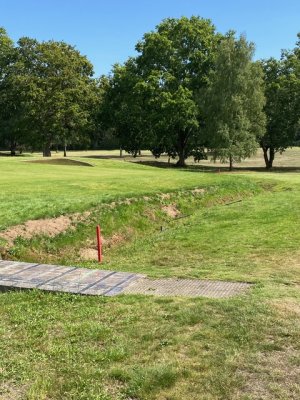
I took a couple of pics when playing today. Will post them so all interested can see what I've bee talking about. I note, meanwhile, that the red posts indicate that the ditch is a penalty area and the LR states that it is defined by the break from the fairway level (not mown short - the nearside edge is same as far side edge) into the ditch. The PA is not defined or delineated by the red posts.

I'll repeat, those who made the decision being discussed here will not have made it lightly - they must have had a very good reason from everything they tried out when test rolling balls towards the ditch to not be concerned about a ball stopping on what might be the very edge of the ditch and PA.

IMG_ONE.jpegIMG_TWO.jpeg
 
Last edited:
The lower picture gives us a much better idea of the problem. It seems that there is is a sharp distinction between the fairway and the relatively steep slope of the ditch. I can see why they came to that conclusion.
I have one caveat though. The fringe of longer grass on the margin. If the ball is sitting in that grass one could envisage it sitting above and within the actual void. Would players understand that the ball is now in the PA?
 
The lower picture gives us a much better idea of the problem. It seems that there is is a sharp distinction between the fairway and the relatively steep slope of the ditch. I can see why they came to that conclusion.
I have one caveat though. The fringe of longer grass on the margin. If the ball is sitting in that grass one could envisage it sitting above and within the actual void. Would players understand that the ball is now in the PA?
I think the point is that the intention is to protect the irrigation pipe and sprinklers running along the base of the ditch. We really want the NPZ be there to protect that irrigation system. So if a ball ends up on the edge of the ditch - and so has not dropped into it, then there is no risk to the system and so a player can conclude that the ball is not in the PA/NPZ as it is not in the ditch.

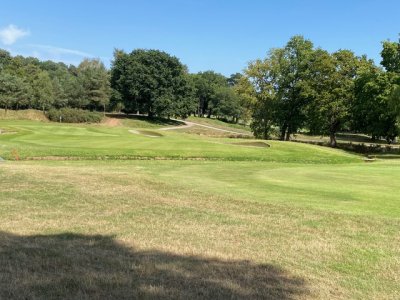
I posted the upper picture to show how visible the ditch and red posts are from a distance.
 
I think the point is that the intention is to protect the irrigation pipe and sprinklers running along the base of the ditch. We really want the NPZ be there to protect that irrigation system. So if a ball ends up on the edge of the ditch - and so has not dropped into it, then there is no risk to the system and so a player can conclude that the ball is not in the PA/NPZ as it is not in the ditch.

I posted the upper picture to show how visible the ditch and red posts are from a distance.
Yes, I can see that the PA is pretty obvious and can see why NPZ is being proposed.
I am still wary of players recognising the status of a ball which is in grass and 'over' the margin when the margin is not clearly defined.
I agree with Steven Rules that it should simply be a NPZ in the General Area pro tem.
 
Posts #1 and #3 are telling us that the edge of the penalty area is not well defined
The edge of the penalty appears a lot more well defined than the impression in my mind from #1 and #3. At the same time, though, to my naked eye the last few yards before the ditch don’t seem so steep that it would be impossible for a ball to stop short of it.

Now a few other questions.

Does the original, small, natural, unexcavated ditch extend beyond the bridges and red stakes at either end? (From the front-on photo, it appears that it does.) Is that part defined as part of the penalty area?

How are the ends of the penalty area defined? (Remembering that in this case the red stakes show the penalty area but don't define it.)

Are the bridges in the penalty area?
 
I'll repeat, those who made the decision being discussed here will not have made it lightly - they must have had a very good reason from everything they tried out when test rolling balls towards the ditch to not be concerned about a ball stopping on what might be the very edge of the ditch and PA.
Did those who made the decision include a qualified referee or an experienced county course rater?
 
The edge of the penalty appears a lot more well defined than the impression in my mind from #1 and #3. At the same time, though, to my naked eye the last few yards before the ditch don’t seem so steep that it would be impossible for a ball to stop short of it.

Now a few other questions.

Does the original, small, natural, unexcavated ditch extend beyond the bridges and red stakes at either end? (From the front-on photo, it appears that it does.) Is that part defined as part of the penalty area?

How are the ends of the penalty area defined? (Remembering that in this case the red stakes show the penalty area but don't define it.)

Are the bridges in the penalty area?
Precisely. Does the PA continue on the other side of the bridges? If not, this marking suggests bridges and approach matting are free relief and the gully is play as lies unless ball in gully has bridge interference then gets free relief, sometimes the RA would extend outside the gully, sometimes probably not. That, if it is the intent, is a dog's breakfast.
And the suggestion a ball would commonly run into the gully doesn't seem to hold water (sorry), the short rough LHS at least can hold a slowing ball up.
If the club is happy to have a player free for all, and inconsistent taking of penalty relief (when it is NPZ), leave it the way it is. Note also, if any part of the player's stance in playing a ball outside the PA overhangs the PA, the player gets the general penalty for playing from a wrong place. The alternative is mark lines or put very small pegs in that central section.
This discussion highlights the challenges in offering course marking advice without being able to see the complete picture. We still are unaware of the broader setting and that can be an important driver of the key choices the club faces.
 
Precisely. Does the PA continue on the other side of the bridges? If not, this marking suggests bridges and approach matting are free relief and the gully is play as lies unless ball in gully has bridge interference then gets free relief, sometimes the RA would extend outside the gully, sometimes probably not. That, if it is the intent, is a dog's breakfast.
And the suggestion a ball would commonly run into the gully doesn't seem to hold water (sorry), the short rough LHS at least can hold a slowing ball up.
If the club is happy to have a player free for all, and inconsistent taking of penalty relief (when it is NPZ), leave it the way it is. Note also, if any part of the player's stance in playing a ball outside the PA overhangs the PA, the player gets the general penalty for playing from a wrong place. The alternative is mark lines or put very small pegs in that central section.
This discussion highlights the challenges in offering course marking advice without being able to see the complete picture. We still are unaware of the broader setting and that can be an important driver of the key choices the club faces.
I’ll try and answer the above and others posed by @Steven Rules.

There was no original natural unexcavated ditch - the whole approach to the green, including a short distance before the ditch, has been raised by 2-3ft (part of our flood management). The ditch is therefore completely new and connects water holding areas/ponds positioned one each side of the fairway on the approach to the green. The ditch was defined as a PA at its creation. The water holding areas and the ditch to these areas beyond both bridges are PA (not NPZ as the irrigation system is not present). Free relief is provided for a ball or stance on the bridges or matting to the bridges. The near edges of the bridges define the limits of the NPZ. Once the water holding area to the RHS of the fairway fills, water will flow along the ditch to the area on the LHS - it becomes a 'brook'.

The ditch is about 50-60yds (maybe less - only 30-40yds not sure) from centre of the green on what is a 540/515yd SI 5 par 5. The fairway of the hole is level to about 260yds off the back tee, from which point it slopes gently down to the ditch so the ditch is clearly visible. Off a 260yd tee shot the ditch therefore presents players with a choice…lay up or go for the ~220-230+yds carry. Carry the ditch and your ball can most likely be on or close to the front of the green.

The objective of the NPZ in the ditch PA is to protect the irrigation pipe and sprinklers from damage - these are temporary while the sides and base of the ditch grow and mature. The key decision the club made was to maintain the risk/reward presented by the ditch - at least for the remainder of the competition season. Without that risk element everyone will simply whack their ball down the fairway as they approach the ditch.

Also I can’t see how I could reasonably try and take a stance in the NPZ with my ball not in the NPZ - the sides are too steep and the ditch too deep.
 
Last edited:
Also I can’t see how I could reasonably try and take a stance in the NPZ with my ball not in the NPZ - the sides are too steep and the ditch too deep.
That wasn't my point, it was if even a quarter of an inch of the lead foot (tee side) or back foot (green side) touches/overhangs the "drop off" during a stroke, the player has played from a wrong place. Again, I'm emphasising the precise edge of the PA needs to be entirely unambiguous to anyone playing in the vicinity when that PA is an NPZ. Once it is no longer an NPZ it really doesn't matter much.
 
That wasn't my point, it was if even a quarter of an inch of the lead foot (tee side) or back foot (green side) touches/overhangs the "drop off" during a stroke, the player has played from a wrong place. Again, I'm emphasising the precise edge of the PA needs to be entirely unambiguous to anyone playing in the vicinity when that PA is an NPZ. Once it is no longer an NPZ it really doesn't matter much.
OK...I get that...but I know that were I to mention that to those who defined things I'd get a 'really...' response. They know I am a bit of a 'stickler' about the rules and clarity around them - especially where I see ambiguity or lack of certainty..as indeed I do in this instance.

Besides. I have been told that for any major competition they will most probably paint the line. And given where we are in the year all that is left is the Club Champs end of the month.
 
OK...I get that...but I know that were I to mention that to those who defined things I'd get a 'really...' response. They know I am a bit of a 'stickler' about the rules and clarity around them - especially where I see ambiguity or lack of certainty..as indeed I do in this instance.

Besides. I have been told that for any major competition they will most probably paint the line. And given where we are in the year all that is left is the Club Champs end of the month.
My view, and practice, is to attempt to set the course up so as few folk as possible (regardless of their Rules knowledge) breach any rules. Quite a few Committees fail on this objective. The suggestion that only the club champs are important enough to mark the course well is a disappointing attitude.
 
OK...I get that...but I know that were I to mention that to those who defined things I'd get a 'really...' response. They know I am a bit of a 'stickler' about the rules and clarity around them - especially where I see ambiguity or lack of certainty..as indeed I do in this instance.

Besides. I have been told that for any major competition they will most probably paint the line. And given where we are in the year all that is left is the Club Champs end of the month.
I fully agree with salfordlad's comments but I am interested in the longer grass at the unmarked margins of the ditch. How long is it? Does it extend into the ditch and if so, how far? How far from the 'nominal' margin does it extend?
You will have realised that I am as much concerned about the status of PA or GUR as about NPZ.
 
My view, and practice, is to attempt to set the course up so as few folk as possible (regardless of their Rules knowledge) breach any rules. Quite a few Committees fail on this objective. The suggestion that only the club champs are important enough to mark the course well is a disappointing attitude.
Its the only major comp left - other than some KO finals...hmmm...

But as mentioned - my club is diligent and I am certain that if they felt there was any issue or even a small likelihood of issues arising they would have marked the NPZ with a line. I do not know why they haven't...maybe the turf and ground surface is too rough to mark a line consistently and that that, in itself, would cause debate and annoyance.
 
I fully agree with salfordlad's comments but I am interested in the longer grass at the unmarked margins of the ditch. How long is it? Does it extend into the ditch and if so, how far? How far from the 'nominal' margin does it extend?
You will have realised that I am as much concerned about the status of PA or GUR as about NPZ.
not quite sure of the reasoning for your question - but I am pretty certain (though I'll check on my next visit) that there is little or no chance of a ball just rolling over the edge of the ditch and not dropping down into the bottom of it i.e. by getting stuck in some grass just over the edge. In my 2nd picture you can see the edge of the ditch quite clearly (IMO) and though there is some grass growing on the side of the ditch it is beneath the level of the fairway and if a ball somehow came to rest on it, it would be clear to all that it was in the NPZ.
 
Last edited:
Did those who made the decision include a qualified referee or an experienced county course rater?
I am not sure a course rater will have the same skill set of a qualified referee. I recently had to point out to our county lead course rater that they did not get two clubs lengths from the nearest point of complete relief when taking RPA relief.
 
You could describe me as a qualified referee having achieved Level 2 with the appropriate pass level as well as attending the Rules Ambassador course which covered some of the basic course marking issues, I also am on the County Course Ratings team; however when we have a tricky, new or potentially controversial situation re course marking or implementation of a new Local Rule we seek the advice of the County Lead Referee as those with experience of multiple courses at both elite and professional levels have a far, far better view of what is done elsewhere than me and foresee issues that I probably couldn’t.
Our County, and I am sure most others, are always very good at providing advice and on site visits to ensure best practice
 
I am not sure a course rater will have the same skill set of a qualified referee. I recently had to point out to our county lead course rater that they did not get two clubs lengths from the nearest point of complete relief when taking RPA relief.
Something lost in translation here - NPCR and RPA are oil and water, they do not mix.
 
Top