rulefan
Tour Winner
NPCR and RPA. What do the initials stand for?Something lost in translation here - NPCR and RPA are oil and water, they do not mix.

NPCR and RPA. What do the initials stand for?Something lost in translation here - NPCR and RPA are oil and water, they do not mix.
I read it as Nearest Point of Complete Relief and Red Penalty Area - could be wrong though.NPCR and RPA. What do the initials stand for?
Oh!I read it as Nearest Point of Complete Relief and Red Penalty Area - could be wrong though.
That was my point.Something lost in translation here - NPCR and RPA are oil and water, they do not mix.


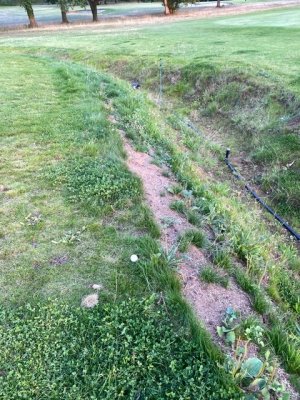
At the risk of stating the obvious, the latest picture indicates (to me, at least) that it would be very straightforward to play - inadvertently or not - with at least one foot inside the NPZ while the ball is just inside or just outside the NPZ.I can’t see how I could reasonably try and take a stance in the NPZ with my ball not in the NPZ - the sides are too steep and the ditch too deep.
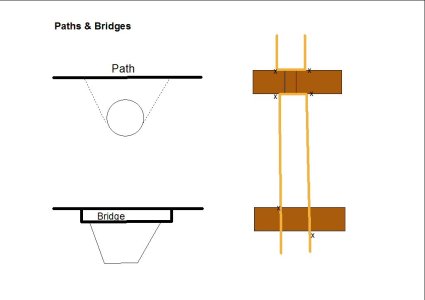
So if I understand this correctly - and please correct me at any time if I am misunderstanding something - we have the new ditch that is a penalty area/NPZ. Then immediately next to that at each end we have a bridge that is not in a penalty area. Then immediately the other side of each bridge we have another penalty area (i.e. the ditch to the water holding area).The ditch was defined as a PA at its creation. The water holding areas and the ditch to these areas beyond both bridges are PA (not NPZ as the irrigation system is not present). Free relief is provided for a ball or stance on the bridges or matting to the bridges. The near edges of the bridges define the limits of the NPZ.
That area behind my ball running top to bottom of my picture is actually on the slope down into the ditch (though it looks level in the photo). I think the break is the left edge of that - so my ball sitting maybe 6” before the break and so just outside the NPZ…maybe. But my right foot on the seeded area would be in the NPZ.Excellent.
But would a ball in the seeded area (to the top of the picture) be in or out of a the suggested NPZ. It does look level(ish) but where does the ground start to slope? Would there be differences of opinion if not marked?
I think you are mostly right…except the ditch ‘beyond’ each bridge is not NPZ, the NPZ is only the ditch between the bridges. So a ball coming to rest under a bridge will not be in the NPZ, and yes…free relief due to the bridge.So if I understand this correctly - and please correct me at any time if I am misunderstanding something - we have the new ditch that is a penalty area/NPZ. Then immediately next to that at each end we have a bridge that is not in a penalty area. Then immediately the other side of each bridge we have another penalty area (i.e. the ditch to the water holding area).
It sounds to me like each bridge is an 'island' (if you will) in the general area sandwiched between two penalty areas.
A ball that finds its way into the ditch/penalty area either left or right of either bridge is subject to the normal penalty area (and NPZ) provisions of Rule 17.
But a poorly struck ball that finds its way under the bridge and comes to rest in that part of the ditch under the bridge is in the general area and would have free relief available under Rule 16.1b due to interference from the bridge (immovable obstruction). Doesn't seem like a very equitable outcome to me.
What am I missing or misunderstanding?
It maybe the photo angle but the areas on both sides of the ditch where the fairway runs into the ditch doesn't appear to have a distinct margin. I suspect there would be a lot of discussion about 'is it in or out'.That area behind my ball running top to bottom of my picture is actually on the slope down into the ditch (though it looks level in the photo). I think the break is the left edge of that - so my ball sitting maybe 6” before the break and so just outside the NPZ…maybe. But my right foot on the seeded area would be in the NPZ.
The bridges are, by defintition, immovable obstructions. There is no need for them to be included in any list in any Local Rule. They are immovable obstrctions - whether in a penalty area or not and whether in a Local Rule or not.I will recheck the original LR regarding the ditch, as bridges are not included in the list of immovable obstructions in our standard set of LRs - it is possible that list simply hasn’t been updated, but maybe they actually aren’t IOs.
Given that free relief is available from the bridges, we can deduce that they are not integral objects because, again by definition, there is no free relief allowed from integral objects.Free relief is provided for a ball or stance on the bridges or matting to the bridges.
free relief due to the bridge.
It needs to be one or the other. It can't be both.Any part of the wooden footbridge that is in the penalty area, is treated as part of the penalty area.
I had been concentrating on the aspect of the margin but you have identified another issue. Some years ago, in correspondence with the R&A, they specified that an 'open water course' was a water hazard but that a 'bridge' formed by a pipe or tube running underground was not in the hazard. I wonder if someone has forgotten that the IO rule has changed.So if I understand this correctly - and please correct me at any time if I am misunderstanding something - we have the new ditch that is a penalty area/NPZ. Then immediately next to that at each end we have a bridge that is not in a penalty area. Then immediately the other side of each bridge we have another penalty area (i.e. the ditch to the water holding area).
It sounds to me like each bridge is an 'island' (if you will) in the general area sandwiched between two penalty areas.
A ball that finds its way into the ditch/penalty area either left or right of either bridge is subject to the normal penalty area (and NPZ) provisions of Rule 17.
But a poorly struck ball that finds its way under the bridge and comes to rest in that part of the ditch under the bridge is in the general area and would have free relief available under Rule 16.1b due to interference from the bridge (immovable obstruction). Doesn't seem like a very equitable outcome to me.
What am I missing or misunderstanding?
In addition to the ugly NPZ PA edge issues we have been discussing: your original photos (post #22) showed no PA stakes other than those a foot or two inside each of the bridges. That is, there appears to be no course marking indicating that a foot or two of gully inside the bridges, the bridges themselves or the gully outside each bridge are PA. In short, the course marking here is quite bewildering and the implications for the membership correctly applying the rules are profound.I think you are mostly right…except the ditch ‘beyond’ each bridge is not NPZ, the NPZ is only the ditch between the bridges. So a ball coming to rest under a bridge will not be in the NPZ, and yes…free relief due to the bridge.
From the original LRs..note there was originally just one bridge - and the LR is stated for our 17th…no mention of the 14th…the hole in question. I must check.
Any part of the wooden footbridge that is in the penalty area, is treated as part of the penalty area.
As an aside on reading the LRs, I note another big misconception a lot of members make. We have a few ‘foot-worn’ tracks that many interpret as ‘man-made’ and so from which they have free relief. Wrong! The LR gives free relief from any path or track having an artificial surface. I have been wondering on that and been meaning to check our LRs.
Would that be a permissible change to a rule? Running it past the R&A (or the USGA Facebook site) might be more appropriate.He did however recognise that my stance would be in the NPZ. His view was that as the objective of the NPZ is to protect the temporary irrigation system and not the banks of the ditch, he felt that our LR for the ditch should be revised to state that a stance could be taken IN the NPZ if the ball is OUTSIDE of the NPZ. He will run that past our Handicap Sec.
Dunno. He seemed to think we could have a LR for a NPZ so defined. It may be that our Handicap Sec (a R&A qualified ref) may think differently and that we can't have such a change - but that the LR requires clarity about stance in the NPZ.Would that be a permissible change to a rule? Running it past the R&A (or the USGA Facebook site) might be more appropriate.
Each time you ask a question, the response is inconsistent with the visible markings in your photos. Is there no Local Rules sheet that explains these things? And the proposed LR is unauthorised as it changes the rules in a manner inconsistent with the Model Local Rules so would require golf association authority.Update - asked our Golf Manager. The bridges are in the PA and so no free relief is provided. A ball in the ditch but under a bridge is in the PA - not in the NPZ and no free relief. The matting for each bridge is not in the PA so Immovable Obstruction and free relief provided.
On my photo of where my balll ended up. View is that my ball is 'clearly' NOT in the NPZ. He feels that there is sufficient definition in the ground to indicate the boundary of the PA/NPZ - the posts do not define the PA/NPZ - they indicate that there is one defined by the bridges and break of the ground into the sides of the ditch between them. He did however recognise that my stance would be in the NPZ. His view was that as the objective of the NPZ is to protect the temporary irrigation system and not the banks of the ditch, he felt that our LR for the ditch should be revised to state that a stance could be taken IN the NPZ if the ball is OUTSIDE of the NPZ. He will run that past our Handicap Sec.
There is a Local Rule in place specifically addressing the ditch. It has been distributed to all members and is available on the website. Our. Handicap Sec has this pm said to me that he could not agree to wording being put in the LR that makes it OK to take a stance in the NPZ.Each time you ask a question, the response is inconsistent with the visible markings in your photos. Is there no Local Rules sheet that explains these things? And the proposed LR is unauthorised as it changes the rules in a manner inconsistent with the Model Local Rules so would require golf association authority.
 I'm not sure when he will have a conversation with our Golf Manager about it. Hope he does.

