Why Does He get To Choose?

6Aces

Hacker
Joined
Feb 13, 2015
Messages
27
Visit site
2019 Rules Quiz Questions

In the first quiz question below, the player gets to play either the dropped ball or the original ball. But in the quiz second question, the player must abandon the dropped ball and play the original. In my mind, the scenarios are identical. (a) a brief search, (b) return to where previous stroke made and ball intended to be a provisional, dropped, (c) original ball found within 3 minutes, (d) dropped ball not played.
Would someone kindly point out why the answers are different? Thanks.

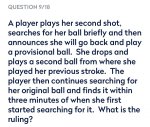
(1) In stroke play, after a one-minute search, the player returns to the spot in the fairway from which she had made her previous stroke and drops a ball having declared her intention to play a provisional ball. The player's original ball is then found by a spectator before the three-minute search period ends and before the player has made a stroke at the dropped ball. What is the ruling?

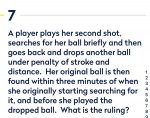
(2) A player searches for his ball for 2 minutes and then announces that he will return to play a provisional ball. The player drops the ball and then, prior to making a stroke with the provisional, the original ball is found within the 3 minutes search period. What is the ruling?
 
Shome mishtake shurely. Like you, I cannot see any difference between the two narratives.

The answers should not be different and neither should be that the player gets a choice of which ball to play. By the way, it would be the same answer if the player had made a stroke at the provisional ball. If the original is found within 3 minutes it must be played.
 
they are both the same, they both mention playing a provisional and both times the original ball is found inside 3 mins so its play the original in both cases.
 
Can you play a provisional before you go ahead to search?
You must play a provisional ball before you go, by more than just a short distance, to search. If the OP means by "provisional" the intention to put another ball in play she must play the original ball, if found within the 5, or soon to be 3, minutes. There's no choice in either case.
 
Sorry but am I reading something that isn’t there. In 1) am I understanding that after a minute search the player goes to original spot to Drop a ball as a provisional but in 2) a provisional has already been played
 
Please correct me if I'm wrong but I didn't think you could walk back to play a provisional?
 
Please correct me if I'm wrong but I didn't think you could walk back to play a provisional?

New rule 18.3b doesn't mention anything about not walking back, and the "proposed changes" document was explicit that walking back is not a consideration now; only that it can only be a provisional if played within the 3 minutes (and original not found yet, and right words used).
 
Found the following 2 similar questions on the 2019 Rules app quiz.
Not saying the op has misread them, I did though(first time);)
380BC76C-0193-4A66-A104-5F1391277921.jpegDDDE229F-B01A-4795-B979-3A429C84B258.jpeg
 
Last edited by a moderator:
You must play a provisional ball before you go, by more than just a short distance, to search. If the OP means by "provisional" the intention to put another ball in play she must play the original ball, if found within the 5, or soon to be 3, minutes. There's no choice in either case.
Forget this. I I've just learned something!
 
Clearly a question with its basis in whether the dropped ball has been played (see post #13 as a good example of possible situation.

So the answer lies in the principle raised (correctly) in the opening post.

If a provisional ball has been played the player cannot choose whether to continue with it if the original ball is neither lost nor OOB.

If the ball hasn't been played it can still be played rather than continuing with the original ball that was found. You can play under stroke and distance under the new rules in the same way as the old. In choosing to play at that point it it would not be a provisional ball.
 
Clearly a question with its basis in whether the dropped ball has been played (see post #13 as a good example of possible situation.

So the answer lies in the principle raised (correctly) in the opening post.

If a provisional ball has been played the player cannot choose whether to continue with it if the original ball is neither lost nor OOB.

If the ball hasn't been played it can still be played rather than continuing with the original ball that was found. You can play under stroke and distance under the new rules in the same way as the old. In choosing to play at that point it it would not be a provisional ball.
There is no logical reason why the player would do this but, from 18.1 “At any time, a player may take stroke-and-distance relief by adding one penalty stroke and playing the original ball or another ball from where the previous stroke was made (see Rule 14.6).” Quite simple after all.
 
Clearly a question with its basis in whether the dropped ball has been played (see post #13 as a good example of possible situation.

So the answer lies in the principle raised (correctly) in the opening post.

If a provisional ball has been played the player cannot choose whether to continue with it if the original ball is neither lost nor OOB.

If the ball hasn't been played it can still be played rather than continuing with the original ball that was found. You can play under stroke and distance under the new rules in the same way as the old. In choosing to play at that point it it would not be a provisional ball.

We don't know the wording of the answer at the moment, but if it says that the player has a choice between the two balls of which to play, I would say that is incorrect. The moment the original ball is found, it is in play and the player must continue with it. He has no choice. If he decides to play the ball dropped as a provisional, that is a continuation of play with the original ball and, would be under stroke and distance in relation to his ball in play. Only in a loose and misleading way can you say that he had a choice of which ball to play, and neither the rules nor rulings made from them should use language loosely. But I would wnat to see what the multiple choice options are and what is said in explanation of the correct answer.
 
We don't know the wording of the answer at the moment, but if it says that the player has a choice between the two balls of which to play, I would say that is incorrect. The moment the original ball is found, it is in play and the player must continue with it. He has no choice. If he decides to play the ball dropped as a provisional, that is a continuation of play with the original ball and, would be under stroke and distance in relation to his ball in play. Only in a loose and misleading way can you say that he had a choice of which ball to play, and neither the rules nor rulings made from them should use language loosely. But I would wnat to see what the multiple choice options are and what is said in explanation of the correct answer.
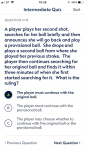
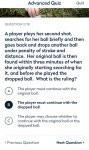
Here’s the full question and answer for one of the questions.
53B2CB27-4906-4495-9E9F-811242C29438.pngBA4B8CD2-6529-431B-8C22-FBD4333BF29F.jpeg
 
Last edited by a moderator:
We don't know the wording of the answer at the moment, but if it says that the player has a choice between the two balls of which to play, I would say that is incorrect. The moment the original ball is found, it is in play and the player must continue with it. He has no choice. If he decides to play the ball dropped as a provisional, that is a continuation of play with the original ball and, would be under stroke and distance in relation to his ball in play. Only in a loose and misleading way can you say that he had a choice of which ball to play, and neither the rules nor rulings made from them should use language loosely. But I would wnat to see what the multiple choice options are and what is said in explanation of the correct answer.
I'm simply pointing out how the answers could be different.
No more loose or misleading than the wording to many of the questions designed to draw out the nuances of some rules.
It's a somewhat mute point as to whether your earlier statement that the player should never have a choice as to which ball to play, or mine that the player always has a choice because he can proceed under stroke and distance, is the misleading ststement.
Without the actual wordings you can only deal in what could be, or when 2 similar questions are quoted (#13), highlight what they are trying to draw out.

I trust that we can agree that where you have played 2 different balls the rules will not permit you choice as to which one to proceed with...after which 5he question of which one, and what choices, will depend on the variables of any situation.
 
Top