• We'd like to take this opportunity to wish you a Happy Holidays and a very Merry Christmas from all at Golf Monthly. Thank you for sharing your 2025 with us!

WHS and club competitions

I must say that I am somewhat shocked that this was obviously known about and not communicated by EG in their handicap workshop a couple of weeks ago.
The presenter explicitly said that there were no proposed changes at all to WHS or the application of rules in the pipeline. He maintained that there would be no alterations at all prior to the 2028 revisions. He said he specifically knew this as he sat on the GB&I Technical committee.
To be faced with this that wasn’t even hinted at let alone discussed is extremely disappointing.
A real missed opportunity to properly understand the implications and methods of implementation.
I agree. Seems odd (pretty poor) that they would be in the dark on this or withhold the information.

I suppose, technically it's a change in national guidance relating to allowances, not a change in the rules or their application.
 
We were going with two competitions off 90% this year anyway, so rather than threats of disassociation, it now looks like our committee were just ahead of the curve.
 
I agree. Seems odd (pretty poor) that they would be in the dark on this or withhold the information.

I suppose, technically it's a change in national guidance relating to allowances, not a change in the rules or their application.
I think,as you imply, it is really splitting hairs as it a change to national guidance not to the rules.

But in a workshop designed for Handicap Committee members and County Advisors, the very people, who will have to implement or advise on how to implement these changes not to even refer to them but also to categorically deny them from someone who sat on the committee recommending them does not sit well at all.
 
But in a workshop designed for Handicap Committee members and County Advisors, the very people, who will have to implement or advise on how to implement these changes not to even refer to them but also to categorically deny them from someone who sat on the committee recommending them does not sit well at all.
All true. However, it seems clear that GB will be looking at how it goes in I before jumping on board (probably) next year, so it's really not something that committees in England need to be worrying about right now. And if/when it does happen, they'll have more notice than their Irish counterparts appear to be getting (I've seen nothing in the Irish golf media that would normally cover this stuff, and the GI memo to clubs is dated March).
 
All true. However, it seems clear that GB will be looking at how it goes in I before jumping on board (probably) next year, so it's really not something that committees in England need to be worrying about right now. And if/when it does happen, they'll have more notice than their Irish counterparts appear to be getting (I've seen nothing in the Irish golf media that would normally cover this stuff, and the GI memo is dated March).
If your going to on of these seminars (the Wheathill one?) it will be interesting to hear whether Mike repeats his 'no changes before 2028 stance'. Please let me know.
 
If your going to on of these seminars (the Wheathill one?) it will be interesting to hear whether Mike repeats his 'no changes before 2028 stance'. Please let me know.
Yes, unfortunately it's not on the best day for me but I'm hoping to be able to get there and will report back if I do.
 
  • Like
Reactions: D-S
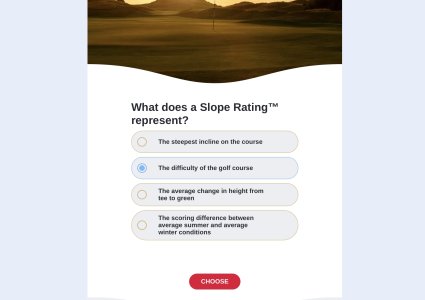
Whilst I’m being irritated by EG, this is from their latest email and WHS test.

We have spent years trying to educate golfers that slope is not difficulty, it is relative difficulty between a scratch and bogey golfer. This has been one of the fundamentals misunderstandings about WHS. Nevertheless this is one of the questions with the ‘correct’ answer highlighted.
1741201201369.jpeg
 
Whilst I’m being irritated by EG, this is from their latest email and WHS test.

We have spent years trying to educate golfers that slope is not difficulty, it is relative difficulty between a scratch and bogey golfer. This has been one of the fundamentals misunderstandings about WHS. Nevertheless this is one of the questions with the ‘correct’ answer highlighted.
View attachment 57266
Someone has had an absolute shocker there.
 
Whilst I’m being irritated by EG, this is from their latest email and WHS test.

We have spent years trying to educate golfers that slope is not difficulty, it is relative difficulty between a scratch and bogey golfer. This has been one of the fundamentals misunderstandings about WHS. Nevertheless this is one of the questions with the ‘correct’ answer highlighted.
View attachment 57266
Yeah, I keep seeing people say that, but in reality, to the layman let's say, there is very little difference in that distinction. If a golf course is harder, then obviously worse golfers will find it more harder than good golfers. So on a sliding scale it means pretty much the same thing.
 
Last edited:
Yeah, I keep seeing people say that, but in reality, to the layman let's see, there is very little difference in that distinction. If a golf course is harder, then obviously worse golfers will find it more harder than good golfers. So on a sliding scale it means pretty much the same thing.
Exactly. The technical distinction doesnt really matter. If there is a strong enough correlation coefficient between difficult and slope, then, it reasonable to call, and use it casually, as a measure of a course's difficulty. Examples that show it isnt universally true wont sway the convenient ready reckoner that it is for difficulty.
 
Exactly. The technical distinction doesnt really matter. If there is a strong enough correlation coefficient between difficult and slope, then, it reasonable to call, and use it casually, as a measure of a course's difficulty. Examples that show it isnt universally true wont sway the convenient ready reckoner that it is for difficulty.
So a course that's rated at 67 is more difficult than a course rated at 75 if it's slope is higher by a value of 1? Makes sense to some no doubt. :unsure:
 
So a course that's rated at 67 is more difficult than a course rated at 75 if it's slope is higher by a value of 1? Makes sense to some no doubt. :unsure:
Exactly. The technical distinction doesnt really matter. If there is a strong enough correlation coefficient between difficult and slope, then, it reasonable to call, and use it casually, as a measure of a course's difficulty. Examples that show it isnt universally true wont sway the convenient ready reckoner that it is for difficulty.
 
Notice to all Clubs
From 1st April 2025, Golf Ireland will be implementing a change in the application of the WHSTM Rules of Handicapping in Ireland in respect of the guidance for the calculation of the Playing Handicaps.
This will mean that effective 1st April 2025, the Committee in charge of
Competitions in a Club will have the option to change the Playing HandicapTM allowance which applies in competitions.
In Singles competitions which count for handicap purposes, this effectively means
clubs will have three broad choices going forward:
1. They can retain the current allowance of 95%, as recommended in Appendix
C of the Rules of Handicapping.
2. They can reduce the allowance to either 90% or 85%.
3. They can increase the allowance to 100% of the Course HandicapTM, thereby removing the concept of a Playing Handicap as a separate value completely in singles competitions.
Likewise, in Four-Ball stroke play, stableford or V-Par competitions which are played in counting conditions and for which scores in certain specified
circumstances may count on a player’s Handicap Record, the same choices apply and equate as follows:
1. Retain the current allowance of 85%.
2. Reduce the allowance to either 80% or 75%.
3. Increase the allowance to 90%.

Why might a club consider opting for a lower Playing Handicap allowance?
If circumstances have been observed in a club where lower handicappers are
struggling to compete, the Committee in charge of a competition may wish to
consider a lower Playing Handicap allowance as a means of enhancing the equity of a competition. The feedback which Golf Ireland has received through tracking surveys in the past year suggests that this is an acutely felt issue in a number of clubs.
The general guidance provided in Appendix C of the Rules of Handicapping is that a lower Playing Handicap allowance is more likely to provide equity larger fields (i.e., in excess of 100 golfers) where the difference in shots between the lowest and highest Handicap Index in the field is significant.

Why might a club considering opting for a higher Playing Handicap allowance?
Essentially, this might be considered in circumstances which are the opposite of the above – i.e., where there are smaller fields (e.g. fewer than 30 players) and the difference in shots between the lowest and highest Handicap Index in the field is
negligible.

Why is Golf Ireland doing this?
Consistent feedback indicates that many clubs feel the need for more options to
address specific issues they are encountering with handicapping in their
competitions. Moreover, a similar trendline in the feedback has indicated that lower handicappers in a number of clubs feel less competitive as a result of the changeover to the WHS, and in some cases are even less inclined to play in club competitions. In these circumstances, the option to lower the Playing Handicap allowance is one that club committees may wish to consider.
Similarly, however, a number of clubs also find that their members are struggling with the complexity of the WHS, and that in scenarios where there are comparatively few golfers playing in competitions, there is a question as to
whether there is a need for such complexity. In such clubs, having a Playing Handicap that is directly equal to the player’s Course Handicap (ie, 100%) goes some way to simplifying the handicap calculation that is made for competitions.
The purpose of the changes, therefore, is to give clubs a degree of flexibility in
responding to their own specific challenges with regard to handicapping in their own competitions.

When do clubs have to implement this change?
The options will be available from 1 April 2025, but clubs can proceed at their own pace, and there is no requirement for a club to introduce this change if the
judgement of the club committee is that the current Playing Handicap allowances remain appropriate.

If a club wishes to implement this change, how do they go about it?
The setting for the Playing Handicap allowance will be available on the club’s own competition software. No change to any settings will need to be made on the Clubhouse.

Will changing the Playing Handicap allowance have any repercussions for the PCC?

No. However, it will be even more important to ensure players are aware that their score for the purposes of their handicap record is always based on their Course Handicap rather than their Playing Handicap. As a result, players should be encouraged to finish out on holes where they may not have a stroke in the competition, but do if applying their Course Handicap.

Does the Club have to introduce this rule for a minimum period of time, or apply it
to all competitions?
A committee in charge of competitions can apply a new Playing Handicap
allowance to all of its competitions – and in many cases this is probably desirable in most cases to give players’ clarity. However, this is also at the committee’s discretion and a club could also choose to apply different allowances to different
competitions. Likewise, a different approach could be applied to Men’s and Women’s competitions within a club. Whatever approach is taken, the decision should be made following consideration of the size of fields and the spread of Handicap Indexes in order to rationalize their decision.
Note:
At this time, no change is being made to the Other formats of play listed in
Appendix C, i.e., Matchplay, scrambles etc..
 
Notice to all Clubs
From 1st April 2025, Golf Ireland will be implementing a change in the application of the WHSTM Rules of Handicapping in Ireland in respect of the guidance for the calculation of the Playing Handicaps.
This will mean that effective 1st April 2025, the Committee in charge of
Competitions in a Club will have the option to change the Playing HandicapTM allowance which applies in competitions.
In Singles competitions which count for handicap purposes, this effectively means
clubs will have three broad choices going forward:
1. They can retain the current allowance of 95%, as recommended in Appendix
C of the Rules of Handicapping.
2. They can reduce the allowance to either 90% or 85%.
3. They can increase the allowance to 100% of the Course HandicapTM, thereby removing the concept of a Playing Handicap as a separate value completely in singles competitions.
Likewise, in Four-Ball stroke play, stableford or V-Par competitions which are played in counting conditions and for which scores in certain specified
circumstances may count on a player’s Handicap Record, the same choices apply and equate as follows:
1. Retain the current allowance of 85%.
2. Reduce the allowance to either 80% or 75%.
3. Increase the allowance to 90%.

Why might a club consider opting for a lower Playing Handicap allowance?
If circumstances have been observed in a club where lower handicappers are
struggling to compete, the Committee in charge of a competition may wish to
consider a lower Playing Handicap allowance as a means of enhancing the equity of a competition. The feedback which Golf Ireland has received through tracking surveys in the past year suggests that this is an acutely felt issue in a number of clubs.
The general guidance provided in Appendix C of the Rules of Handicapping is that a lower Playing Handicap allowance is more likely to provide equity larger fields (i.e., in excess of 100 golfers) where the difference in shots between the lowest and highest Handicap Index in the field is significant.

Why might a club considering opting for a higher Playing Handicap allowance?
Essentially, this might be considered in circumstances which are the opposite of the above – i.e., where there are smaller fields (e.g. fewer than 30 players) and the difference in shots between the lowest and highest Handicap Index in the field is
negligible.

Why is Golf Ireland doing this?
Consistent feedback indicates that many clubs feel the need for more options to
address specific issues they are encountering with handicapping in their
competitions. Moreover, a similar trendline in the feedback has indicated that lower handicappers in a number of clubs feel less competitive as a result of the changeover to the WHS, and in some cases are even less inclined to play in club competitions. In these circumstances, the option to lower the Playing Handicap allowance is one that club committees may wish to consider.
Similarly, however, a number of clubs also find that their members are struggling with the complexity of the WHS, and that in scenarios where there are comparatively few golfers playing in competitions, there is a question as to
whether there is a need for such complexity. In such clubs, having a Playing Handicap that is directly equal to the player’s Course Handicap (ie, 100%) goes some way to simplifying the handicap calculation that is made for competitions.
The purpose of the changes, therefore, is to give clubs a degree of flexibility in
responding to their own specific challenges with regard to handicapping in their own competitions.

When do clubs have to implement this change?
The options will be available from 1 April 2025, but clubs can proceed at their own pace, and there is no requirement for a club to introduce this change if the
judgement of the club committee is that the current Playing Handicap allowances remain appropriate.

If a club wishes to implement this change, how do they go about it?
The setting for the Playing Handicap allowance will be available on the club’s own competition software. No change to any settings will need to be made on the Clubhouse.

Will changing the Playing Handicap allowance have any repercussions for the PCC?

No. However, it will be even more important to ensure players are aware that their score for the purposes of their handicap record is always based on their Course Handicap rather than their Playing Handicap. As a result, players should be encouraged to finish out on holes where they may not have a stroke in the competition, but do if applying their Course Handicap.

Does the Club have to introduce this rule for a minimum period of time, or apply it
to all competitions?
A committee in charge of competitions can apply a new Playing Handicap
allowance to all of its competitions – and in many cases this is probably desirable in most cases to give players’ clarity. However, this is also at the committee’s discretion and a club could also choose to apply different allowances to different
competitions. Likewise, a different approach could be applied to Men’s and Women’s competitions within a club. Whatever approach is taken, the decision should be made following consideration of the size of fields and the spread of Handicap Indexes in order to rationalize their decision.
Note:
At this time, no change is being made to the Other formats of play listed in
Appendix C, i.e., Matchplay, scrambles etc..
Notice from who??
 
Top