Red Stakes

I'm not wrong.
You are wrong to state that my being wrong is a fact.
I understand the rule.
I continue to hold the view that the form of the explanation could be improved. This does not make me wrong.
As it stands, "May be in any area of the course except the same penalty area" can lead someone to not realise a potential relief area on the other side from the entry point of a red penalty area. I am 95% certain that this does occur in the minds of many golfers.

(Those who vote on something and turn out to be in a minority are not wrong to have voted the way that they did. They held a valid opinion.
You ARE wrong. This whole saga started when you stated:

"The relief area can not be two separate parts. It must be one whole area."

That was wrong. It has been pointed out that it was wrong. If it happened to you on a golf course, a referee would tell you it is wrong. If you asked your club to contact the R&A, they would say your interpretation is wrong.

The only thing that is probably true is that you do not understand the rule, and you will never understand the rule, even if others go to a lot of effort to break things down for you. Either that, or you innocently made the statement above without really thinking about the detail of the rule. It was pointed out that you were wrong. And instead of just saying "ahh, fair enough", you have then decided to comb through the rule in detail, and try and twist any part of it which will make your initial statement seem correct.
 
That’s quite a shift from where you started. At least, I think it is. If so, that’s good. If nothing else you have confirmed that I was right when marking a narrow ditch to have the stakes positioned far enough apart there couldn’t be any part of a relief area on the other side from the reference point.
 
You ARE wrong. This whole saga started when you stated:

"The relief area can not be two separate parts. It must be one whole area."

That was wrong. It has been pointed out that it was wrong. If it happened to you on a golf course, a referee would tell you it is wrong. If you asked your club to contact the R&A, they would say your interpretation is wrong.

The only thing that is probably true is that you do not understand the rule, and you will never understand the rule, even if others go to a lot of effort to break things down for you. Either that, or you innocently made the statement above without really thinking about the detail of the rule. It was pointed out that you were wrong. And instead of just saying "ahh, fair enough", you have then decided to comb through the rule in detail, and try and twist any part of it which will make your initial statement seem correct.
Yes that was wrong. I have been corrected. And I have clearly stated that.
My first post stated, "Unless I'm wrong." Clearly showing that I had doubt.

I can confirm absolutely that I understand the rule. Far better than I did before.

But I continue to be castigated for my view that the wording of the rule, at a certain point in the instruction of limits of the relief area, could be improved for a better and clearer understanding of the potential relief area on the opposite side from the entry point. I had a misconception and I am certain, absolutely certain, that many others would have the same misconception and not conceive or perceive of the potential for a a relief area on the opposite side from the entry point.

Or I could be the only person in the world to think the way I do, or to have had the experience that I have had. That would still not make my view wrong.

If I say that it will rain tomorrow and then it does not rain - I am wrong.
If I say that the wording of the rule will change in the next five years - and it does not change - I will be wrong.
If I hold a view that a change to the wording would be an improvement. I can not be right or wrong. I merely hold a view.
 
Yes that was wrong. I have been corrected. And I have clearly stated that.
My first post stated, "Unless I'm wrong." Clearly showing that I had doubt.

I can confirm absolutely that I understand the rule. Far better than I did before.

But I continue to be castigated for my view that the wording of the rule, at a certain point in the instruction of limits of the relief area, could be improved for a better and clearer understanding of the potential relief area on the opposite side from the entry point. I had a misconception and I am certain, absolutely certain, that many others would have the same misconception and not conceive or perceive of the potential for a a relief area on the opposite side from the entry point.

Or I could be the only person in the world to think the way I do, or to have had the experience that I have had. That would still not make my view wrong.

If I say that it will rain tomorrow and then it does not rain - I am wrong.
If I say that the wording of the rule will change in the next five years - and it does not change - I will be wrong.
If I hold a view that a change to the wording would be an improvement. I can not be right or wrong. I merely hold a view.
My advice would be to simply ignore any castigations or posts you consider ungenerous or critical. I am certain that your views expressed above represented your genuine effort to understand a rule. And the person that has never misunderstood some of the written words does not exist.

A number of us here have done nothing but try to help you see what the rules mean and how they apply to an uncommon situation - penalty area relief that may be available on more than one side of the penalty area. I do not begrudge the time spent in that effort, I think the journey in this thread got us all a bit closer to some of the issues relating to relief areas.

I have long held the view that the relief area diagrams in the book are too plain vanilla and would benefit from examples that demonstrate the "cross hatched" type of scenarios, where the relief area is a patchwork of viable and non-viable ground. I have submitted such views to a Ruling Body and the response, while recognising potential benefits, speaks to the overarching reluctance of the Rules of Golf Committees (of the USGA and R&A) to let the book get any bigger. We can but try! By all means, send your comments in also.
 
Well, we seem to have made progress from #10...
The relief area can not be two separate parts. It must be one whole area.
to #57:

"I am sure I could encounter many experienced golfers who would .... not be aware that there is a possibility of some relief area to be on the other side within two clublengths of the entry point.
It would be an improvement if .....

My view is not a fact.
It is a valid view."


I agree. There are many golfers - experienced and inexperienced - who are not aware of many Rules.

What all this illustrates is that the more a player knows and understands the Rules, the more the player can use the Rules to their advantage by, for example, opening up additional (parts of) relief areas that the player might be otherwise unaware of (as is the case in this discussion) or by avoiding Rule breaches through ignorance or carelessness.

It has been said time and time again that knowing the Rules helps the player use them to advantage.

We need to encourage those with a mind to do so to develop a greater understanding of the Rules and thereby use the Rules to their advantage.

The diagram in #8 precisely shows the correct relief area - the cross-hatched area. There is no contradiction, there is no error in the Rules and no requirement for re-write
I agree.

Players need to take some self-responsibilty to learn and understand what is already written.
 
We have a par 5 with a red staked small ditch running parallel to the fairway with the green on the other side of the ditch. Many times players find themselves in the ditch, as the fairway slopes towards the ditch and there is a decent sized tree to go over if going for the green in 2.

I have yet to play with anyone who has misunderstood the rule as currently written 🤷‍♂️
 
I'm not wrong.
You are wrong to state that my being wrong is a fact.
I understand the rule.
I continue to hold the view that the form of the explanation could be improved. This does not make me wrong.
As it stands, "May be in any area of the course except the same penalty area" can lead someone to not realise a potential relief area on the other side from the entry point of a red penalty area. I am 95% certain that this does occur in the minds of many golfers.

(Those who vote on something and turn out to be in a minority are not wrong to have voted the way that they did. They held a valid opinion.
I think if something needs clarification in another explanation book then the wording could be better!
 
Imo (view), the wording in the definition of relief area and Rule 17 is clear.
In fact, each "relief" Rule describes the size of the allowed relief area for that Rule, and then goes on to list the limits/exceptions to that Rule's particular relief area.
 
Last edited:
If nothing else you have confirmed that I was right when marking a narrow ditch to have the stakes positioned far enough apart there couldn’t be any part of a relief area on the other side from the reference point.
Why did you do that Colin? Did it not unnecessarily remove a potentially advantageous relief option for those with correct knowledge of the Rules?
 
Players need to take some self-responsibilty to learn and understand what is already written.
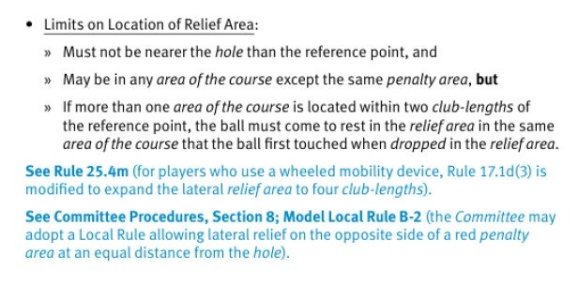
I apologise if taking this comment out of the context of all that went before is misleading, but I consider that many of those who will take time and responsibility to read the text below can draw the wrong conclusion even though they have a good understanding of the written word.

Rule 17 limits of relief area.jpg

Bullet point 2 can give the impression that the edge of the penalty area is a limit to the relief area.
It isn't, but this is not made clear enough for what I consider is reasonable for an average reader of the English language.
This is made clearer in the clarification for which there is no reference made in this text.

The final part can give the impression that relief on the opposite side is available only when a local rule is in place.

I don't feel the need to discuss bullet point 3. Either side of the penalty area the same area of the course if they are both the general area.

I will never share the view that the above text can not be improved in any way that would make the matter clearer. I think it can be improved.
 
Last edited:
Why did you do that Colin? Did it not unnecessarily remove a potentially advantageous relief option for those with correct knowledge of the Rules?
Agree. I think there would need to be a good reason to position the stakes to deliberately override the relief available per the rules. There could be good reason for some situations, but if it is just a narrow PA that someone can easily step over I would not apply Colin's approach. And, if there were uneven obstacles on the fairway side of a narrow lateral PA, I would also likely introduce MLR B-2 Opposite Side Relief on fairness grounds - if a player is stuck with a penalty and the fairway side randomly does not offer reasonably playable lateral relief area then there is a strong case for B-2.
 
I apologise if taking this comment out of the context of all that went before is misleading, but I consider that many of those who will take time and responsibility to read the text below can draw the wrong conclusion even though they have a good understanding of the written word.

View attachment 58502

Bullet point 2 can give the impression that the edge of the penalty area is a limit to the relief area.
It isn't, but this is not made clear enough for what I consider is reasonable for an average reader of the English language.
This is made clearer in the clarification for which there is no reference made in this text.

The final part can give the impression that relief on the opposite side is available only when a local rule is in place.

I don't feel the need to discuss bullet point 3. Either side of the penalty area the same area of the course if they are both the general area.

I will never share the view that the above text can not be improved in any way that would make the matter clearer. I think it can be improved.
There is nothing in the text or in your explanation of that text that prevents a player from dropping in the manor we are discussing here. I understand why some people wouold not ever think of doing so, but that applies to many things a player could do, but which requires some lateral thinking. Yes the wording could be improved so that every single player could understand, but if the rules bodies were to do that for every rule we would be looking at a rule book the size of War and Peace and I'm not sure anyone wants to see that.
 
There is nothing in the text or in your explanation of that text that prevents a player from dropping in the manor we are discussing here. I understand why some people wouold not ever think of doing so, but that applies to many things a player could do, but which requires some lateral thinking. Yes the wording could be improved so that every single player could understand, but if the rules bodies were to do that for every rule we would be looking at a rule book the size of War and Peace and I'm not sure anyone wants to see that.
I think what you say is largely irrefutable common sense. But I think it is also common sense that this text from the relevant clarification (or something very much like it) would better belong in the players' book.
It would not take up much page space.

"... it may be possible for the player to measure the two club-lengths from the reference point across the penalty area in determining the size of the relief area."

Generally, I think that most, or a large number, would assume there is no more to the rule than what they see in the players' book and not give any consideration at all to the clarifications.
 
I apologise if taking this comment out of the context of all that went before is misleading, but I consider that many of those who will take time and responsibility to read the text below can draw the wrong conclusion even though they have a good understanding of the written word.

View attachment 58502

Bullet point 2 can give the impression that the edge of the penalty area is a limit to the relief area.
It isn't, but this is not made clear enough for what I consider is reasonable for an average reader of the English language.
This is made clearer in the clarification for which there is no reference made in this text.

The final part can give the impression that relief on the opposite side is available only when a local rule is in place.

I don't feel the need to discuss bullet point 3. Either side of the penalty area the same area of the course if they are both the general area.

I will never share the view that the above text can not be improved in any way that would make the matter clearer. I think it can be improved.

From what I understand of reading this rule, there is no need for clarification as it clearly states two club lengths and that then is your relief area. If matters not which side of the ditch this is, as the rule does not state the relief area is on the side the entry point the ball crossed. Also, "See Committee Procedures" bit is irrelevant. (my club have actaully got this is place for one ditch on the course), but I think this is because it's a wide ditch. Any narrow ditch that can be crossed by two club lengths does not need the "Committee Procedure" added as a local rule.
 
Top