Investments - Strategies, Ideas, Options & advice

The government realistically can only do 3 things, Borrow more, Tax more or make cuts. Obviously borrowing was out of the question as we are drowning in debt so that only left two options… they chose not to make savings.
 
Last edited by a moderator:
I shall endeavour to make a neutral political comment on the budget with regard to savings and investments.

A remarkably unsensational budget.
2p tax rise on share dividends and rental incomes. This should bring a bit more into the treasury.
The enforced splitting of the £20,000 yearly ISA allowance into two parts for the under 65s. Doesn't bring more into the treasury, but encourages investment.

But faced with the situation of,
"The government realistically can only do 3 things, Borrow more, Tax more or make cuts. Obviously borrowing was out of the question as we are drowning in debt so that only left two options… they chose not to make savings cuts.",
which was brought about by over-borrowing and under-funding in previous years,
This can only be realistically rectified by raising tax income.
We remain a low-tax economy compared with our geographical neighbours.
 
I shall endeavour to make a neutral political comment on the budget with regard to savings and investments.

A remarkably unsensational budget.
2p tax rise on share dividends and rental incomes. This should bring a bit more into the treasury.
The enforced splitting of the £20,000 yearly ISA allowance into two parts for the under 65s. Doesn't bring more into the treasury, but encourages investment.

But faced with the situation of,
"The government realistically can only do 3 things, Borrow more, Tax more or make cuts. Obviously borrowing was out of the question as we are drowning in debt so that only left two options… they chose not to make savings cuts.",
which was brought about by over-borrowing and under-funding in previous years,
This can only be realistically rectified by raising tax income.
We remain a low-tax economy compared with our geographical neighbours.
Pointless to compare us with neighbours.
This was a big tax budget, when you add it to the previous one our tax burden has risen by over £65 Billion. That’s a heck of a lot to take out of the economy when you are relying on growth to fund your policies.
But don’t take my word for it: the Institute for Fiscal Studies says that "if an election were held tomorrow, the overall tax rises announced in this parliament would exceed those announced in any other since at least 1970."
 
I laid off my apprentice after his 1st 2 years, his wages had been driven up to a level that I couldn't really justify as a businesses - I try to offer good value and some of the invoices I was having to put in for longstanding customers just weren't sitting well with me. The minimum wage increase announced this week was just another tax raid on businesses - that's all they are interested in.

Anyway, I've hit 55, can now play in seniors comps and have a couple of small pension pots that I can now take if I so wish. If I leave them where they are they'll not make much difference to my retirement income, so I'm thinking about cashing them in over the next few years - anybody else done this and found a good investment strategy?

My preferred choice is to buy a boat with one of them :ROFLMAO:
 
Pointless to compare us with neighbours.
This was a big tax budget, when you add it to the previous one our tax burden has risen by over £65 Billion. That’s a heck of a lot to take out of the economy when you are relying on growth to fund your policies.
But don’t take my word for it: the Institute for Fiscal Studies says that "if an election were held tomorrow, the overall tax rises announced in this parliament would exceed those announced in any other since at least 1970."
I'm going to disagree with your first point.
Our neighbours are the countries most similar to us. They have the same challenges of: an ageing population, provision of welfare and universal healthcare, the offshoring of production to low wage countries. That being the case, they probably offer the most realistic comparison for how our own economy and finances are managed. Comparing us to countries with no social welfare, no universal healthcare and no state funded pensions would be pretty pointless.
 
I'm going to disagree with your first point.
Our neighbours are the countries most similar to us. They have the same challenges of: an ageing population, provision of welfare and universal healthcare, the offshoring of production to low wage countries. That being the case, they probably offer the most realistic comparison for how our own economy and finances are managed. Comparing us to countries with no social welfare, no universal healthcare and no state funded pensions would be pretty pointless.
there is an analysis from the FT somewhere... which looks beyond the 'we have universal healthcare/education' concept and looks at access or quality. So no point having Universal healthcare if the waitlist is 2 years. (i paraphrase) It came to the conclusion that we are pretty much in the worst case scenario.. Scandinavian taxes and American medical/education/social net
 
I'm going to disagree with your first point.
Our neighbours are the countries most similar to us. They have the same challenges of: an ageing population, provision of welfare and universal healthcare, the offshoring of production to low wage countries. That being the case, they probably offer the most realistic comparison for how our own economy and finances are managed. Comparing us to countries with no social welfare, no universal healthcare and no state funded pensions would be pretty pointless.
Good points but the reason I said it was pointless to compare us with peer countries is that we don’t live there. We live here, and all our experiences are from what we have or had here not in another country.

But if you want to draw comparisons you must consider, we don’t have cheap electricity or public transportation, we don’t have heavy industry or car manufacturing, we don’t have affordable housing, and we don’t have a cheaper cost of living.
 
If you think 100k is a lot of money, then ask a Londoner the pain. "Banker" is the best dog whistle that is convienetly used to typecast the 'city fatcats'... but it makes a narrow image. If you still have a local branch, ask your local branch manager if they think they are 'bankers'. Unfortunately, t he budget hits the most productivity part of our society the most. At the same time, our biggest gripe is that we have a Productivity problem. Excellent analysis from FT on the impact of budget for Henry's. While not many will weep for a Banker Henry, unfortunately one of our GPs has decided he had enough and moved overseas last week. So the community has lost an excellent Dr - but no one will say that.


A horrid Budget for the ‘Henrys’


Stealth taxes, not wealth taxes, were the cornerstone of this Budget. The biggest losers are set to be Henrys and Henriettas — a shorthand for young professionals who are High Earners, but Not Rich Yet.Two measures make this Budget particularly horrid for them. First, freezing income tax thresholds until 2031 will drag millions into higher-rate tax bands, with over 2mn expected to be snared by the £100,000 tax trap where an effective 60 per cent rate of income tax applies as the tax-free personal allowance is tapered away. This drops down to 45 per cent when their income exceeds £125,140.Second, the chancellor’s decision to impose a £2,000 cap on what employees can salary sacrifice without paying national insurance will make it much harder for individuals to “pension away the pain” — a blow for Henrys and Henriettas trying to keep their take-home pay below this threshold in order to avoid punitive tax rates, and keep valuable childcare benefits.

In her speech, Rachel Reeves poured venom on financial services workers who sacrifice their bonuses into pensions free of tax and employer and employee national insurance contributions, saying this was “not sustainable for our public finances”.

There was no acknowledgment that their behaviour is driven by a distortive cliff edge in the tax system that successive chancellors have failed to address. The FT has reported on how a parent with two children at a London nursery whose pay went a pound over the £100,000 threshold would need to earn more than £149,000 to compensate for the value of lost childcare support.

Saving into a pension is a tax-efficient work around for those who can afford the hit to take-home pay. So too is going part-time or working fewer hours. If more Henrys have to follow the latter route in future, that could undermine UK productivity and lengthen NHS waiting lists as more doctors and consultants fall into the trap.

The one saving grace of this policy change? It won’t kick in until April 2029 in order to give businesses time to adjust, meaning employees about to be “fiscally dragged” into higher tax rates can continue to use the pension route for now. After this date, employers would have to pay a 15 per cent national insurance charge on salary sacrifice contributions that their employees make above the cap — although standard employer workplace pension contributions would thankfully escape the charge.

In practice, the administrative complexity of a cap could see employers decide they will not allow staff to sacrifice higher amounts. But this will increase the levels of tax complexity for individuals. Henrys could of course contribute to private pensions to avoid the £100,000 trap, but this would be much more fiddly and involve reclaiming higher or additional rate tax relief through a personal tax return.

“Couples where one parent earns above the £100,000 threshold are really worried about these changes,” says Philly Ponniah, a certified financial coach in London. “Yes, they have a high income, but they are spending an awful lot of money on childcare and many have seen their finances squeezed by higher mortgage payments.

”How employers might absorb the extra costs remains to be seen. The Office for Budget Responsibility assumes that over a third of the cost of salary sacrifice changes will be passed to employees through lower
ordinary employer pension contributions, and a similar amount through lower salaries and bonuses — unwelcome news for ambitious Henrys and Henriettas. Plus, the compounding effect of lower pension contributions over time will hit the future value of their retirement pots.If they do get a pay rise, many younger professionals face the additional impact of higher student loan repayments. Reeves slipped out that repayment thresholds and interest rates for Plan 2 student loans will be frozen for three years from 2027, meaning repayments will be calculated on a higher proportion of their income.

High tax charges and mortgage interest rates mean that even high-earning Henrys in London and the south-east could struggle to get on the property ladder. Yet other Budget measures had further pain for the cash rich and asset poor who are trying to save for a property deposit. Those renting could see their landlords pass on the costs of an unexpected extra 2 percentage points of income tax, which will be applied to rental income from April 2027.And while the over-65s will retain the ability to save £20,000 into a cash Isa and avoid being taxed on their savings interest after that point, this limit will drop to £12,000 for everyone else. As a further blow, any interest generated from savings beyond an individual’s personal savings allowance will also be subject to an extra 2 percentage point income tax charge.

Few will weep for the Henrys, but further complicating the tax affairs of tomorrow’s top performers can only blunt the ambition of a generation of talent. As for being “not rich yet”, they may never be rich at all.
 
If you think 100k is a lot of money, then ask a Londoner the pain. "Banker" is the best dog whistle that is convienetly used to typecast the 'city fatcats'... but it makes a narrow image. If you still have a local branch, ask your local branch manager if they think they are 'bankers'. Unfortunately, t he budget hits the most productivity part of our society the most. At the same time, our biggest gripe is that we have a Productivity problem. Excellent analysis from FT on the impact of budget for Henry's. While not many will weep for a Banker Henry, unfortunately one of our GPs has decided he had enough and moved overseas last week. So the community has lost an excellent Dr - but no one will say that.


A horrid Budget for the ‘Henrys’


Stealth taxes, not wealth taxes, were the cornerstone of this Budget. The biggest losers are set to be Henrys and Henriettas — a shorthand for young professionals who are High Earners, but Not Rich Yet.Two measures make this Budget particularly horrid for them. First, freezing income tax thresholds until 2031 will drag millions into higher-rate tax bands, with over 2mn expected to be snared by the £100,000 tax trap where an effective 60 per cent rate of income tax applies as the tax-free personal allowance is tapered away. This drops down to 45 per cent when their income exceeds £125,140.Second, the chancellor’s decision to impose a £2,000 cap on what employees can salary sacrifice without paying national insurance will make it much harder for individuals to “pension away the pain” — a blow for Henrys and Henriettas trying to keep their take-home pay below this threshold in order to avoid punitive tax rates, and keep valuable childcare benefits.

In her speech, Rachel Reeves poured venom on financial services workers who sacrifice their bonuses into pensions free of tax and employer and employee national insurance contributions, saying this was “not sustainable for our public finances”.

There was no acknowledgment that their behaviour is driven by a distortive cliff edge in the tax system that successive chancellors have failed to address. The FT has reported on how a parent with two children at a London nursery whose pay went a pound over the £100,000 threshold would need to earn more than £149,000 to compensate for the value of lost childcare support.

Saving into a pension is a tax-efficient work around for those who can afford the hit to take-home pay. So too is going part-time or working fewer hours. If more Henrys have to follow the latter route in future, that could undermine UK productivity and lengthen NHS waiting lists as more doctors and consultants fall into the trap.

The one saving grace of this policy change? It won’t kick in until April 2029 in order to give businesses time to adjust, meaning employees about to be “fiscally dragged” into higher tax rates can continue to use the pension route for now. After this date, employers would have to pay a 15 per cent national insurance charge on salary sacrifice contributions that their employees make above the cap — although standard employer workplace pension contributions would thankfully escape the charge.

In practice, the administrative complexity of a cap could see employers decide they will not allow staff to sacrifice higher amounts. But this will increase the levels of tax complexity for individuals. Henrys could of course contribute to private pensions to avoid the £100,000 trap, but this would be much more fiddly and involve reclaiming higher or additional rate tax relief through a personal tax return.

“Couples where one parent earns above the £100,000 threshold are really worried about these changes,” says Philly Ponniah, a certified financial coach in London. “Yes, they have a high income, but they are spending an awful lot of money on childcare and many have seen their finances squeezed by higher mortgage payments.

”How employers might absorb the extra costs remains to be seen. The Office for Budget Responsibility assumes that over a third of the cost of salary sacrifice changes will be passed to employees through lower
ordinary employer pension contributions, and a similar amount through lower salaries and bonuses — unwelcome news for ambitious Henrys and Henriettas. Plus, the compounding effect of lower pension contributions over time will hit the future value of their retirement pots.If they do get a pay rise, many younger professionals face the additional impact of higher student loan repayments. Reeves slipped out that repayment thresholds and interest rates for Plan 2 student loans will be frozen for three years from 2027, meaning repayments will be calculated on a higher proportion of their income.

High tax charges and mortgage interest rates mean that even high-earning Henrys in London and the south-east could struggle to get on the property ladder. Yet other Budget measures had further pain for the cash rich and asset poor who are trying to save for a property deposit. Those renting could see their landlords pass on the costs of an unexpected extra 2 percentage points of income tax, which will be applied to rental income from April 2027.And while the over-65s will retain the ability to save £20,000 into a cash Isa and avoid being taxed on their savings interest after that point, this limit will drop to £12,000 for everyone else. As a further blow, any interest generated from savings beyond an individual’s personal savings allowance will also be subject to an extra 2 percentage point income tax charge.

Few will weep for the Henrys, but further complicating the tax affairs of tomorrow’s top performers can only blunt the ambition of a generation of talent. As for being “not rich yet”, they may never be rich at all.
Tell you what's another "dog whistle" That anyone in receipt of any type of benefit is "a bone idle shirker"
A phrase as off target as anyone who works in banking is "a fat cat"
 
Tell you what's another "dog whistle" That anyone in receipt of any type of benefit is "a bone idle shirker"
A phrase as off target as anyone who works in banking is "a fat cat"
100%. Both side will highlight the most extreme view... The truth is always in the middle and the middle is the one that gets sqeezed.
So the 'broadest shoulders' are also the hit the most. and number of the broad shoulder is shrinking faster than the ice caps.
 
To describe very many who those who are less fortunate and in receipt of support as 'Breeders and Shirkers' is pretty awful. I am sure that none on here would ever consider saying such a thing - because we are all decent, understanding and caring members of society...are we not.

For some balance, my wife visited a HMO today to handout some money to a family that live there. They were all asleep at 9.30am and she had to bray on the door to wake them to hand over the cash. In the same building there is a single parent with 3 children who is always about whenever I or the wife call in, she offers drinks, she's made us curries to bring home, she works in a charity shop voluntarily.

Some people are definitely more deserving of help than others.
 
For some balance, my wife visited a HMO today to handout some money to a family that live there. They were all asleep at 9.30am and she had to bray on the door to wake them to hand over the cash. In the same building there is a single parent with 3 children who is always about whenever I or the wife call in, she offers drinks, she's made us curries to bring home, she works in a charity shop voluntarily.

Some people are definitely more deserving of help than others.
Well…that may be the case but on an individual basis I try to not judge people if I do not know their background and circumstances.

I grant you that at times…many times perhaps…that is not easy, but when I get feelings of undeserving these can trigger resentments and sometimes anger…and I neither need resentments nor do I need angers swilling around in my head when life can be difficult enough as it is.
 
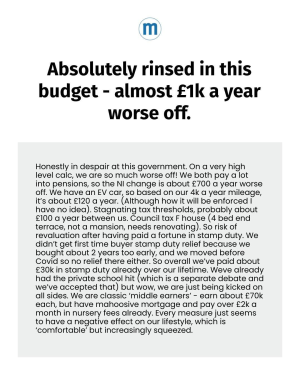
The real squeezed middle.. which everyone wants to blame for making the choices like - working hard to get jobs, paye, saving hard to buy a house/pension, aspiring too much by sending kids to private schools.

We should be worshipping them not treating them as unlimited ATMs


1764283319604.png
 
Top