• Thank you all very much for sharing your time with us in 2025. We hope you all have a safe and happy 2026!

Bridge over ditch

cliveb

Head Pro
Joined
Oct 8, 2012
Messages
3,322
Visit site
There's been a debate at our club about the status of a bridge spanning a ditch.

There is no disagreement at all that if a bridge is over a water hazard, then a ball on the bridge is in the hazard.

However, somebody argued as follows: if there is a bridge over a ditch, and there is a pair of yellow posts either side of the bridge, and there is no yellow line across the width of the bridge, then it can be argued that there are in fact two separate water hazards, and the bridge is between them - and hence not in a hazard. In which case, they can have a free drop off the bridge.

I think they are trying to pull a fast one. My understanding is that any surface drainage ditch is by definition a water hazard, and the bridge must therefore be in the hazard, regardless of what yellow stakes and/or lines happen to be in place. But to be sure, I'd like to get the opinion of the experts here.
 
The bridge is an immovable obstruction - so rule 24-2 applies.

The ball is not in the hazard because it is sat on the bridge. So its not touching any part of the hazard.
 
The bridge is an immovable obstruction - so rule 24-2 applies.

The ball is not in the hazard because it is sat on the bridge. So its not touching any part of the hazard.

Sorry, but that is incorrect. The margins of a water hazard extend vertically up and down. The part of anything spanning the hazard which is within its margin is in the hazard. A ball sitting on it is in the hazard. Rule 24-2b applies only inasmuch as it tells you there is no relief from an immmovable obstruction in a water hazard or lateral water hazard.
 
Last edited:
Sorry, but that is incorrect. The margins of a water hazard extend vertically up and down...
Thanks, Colin, for making that correction. But we're in danger of veering away from my original question.

Can the experts here confirm (or otherwise) that any surface drainage ditch is BY DEFINITION a water hazard, regardless of how it may (or may not) be marked? And therefore any bridge over any ditch is in the hazard?
 
Thanks, Colin, for making that correction. But we're in danger of veering away from my original question.

Can the experts here confirm (or otherwise) that any surface drainage ditch is BY DEFINITION a water hazard, regardless of how it may (or may not) be marked? And therefore any bridge over any ditch is in the hazard?

Any bridge over an open drainage ditch is within the hazard no matter how the hazard is marked. I would add though that if your ball lies on the bridge you may ground your club.
 
Thanks, Colin, for making that correction. But we're in danger of veering away from my original question.

Can the experts here confirm (or otherwise) that any surface drainage ditch is BY DEFINITION a water hazard, regardless of how it may (or may not) be marked? And therefore any bridge over any ditch is in the hazard?

I think you have answered your own question. Yes, a drainage ditch is by definition a water hazard - just reading the actual definition in the rules will clarify that. There is a decision ( 26-3) which confirms that an unmarked ditch is still by definition a water hazard. And Colin has indicated that the margins extend upwards, so any part of a bridge inside the margins of the hazard, is in the hazard.

The only slight difficulty with an unmarked hazard is determining precisely where the margins actually are. But if the ditch goes under the bridge, then at least some of the bridge is in the hazard. The problem lies if the bridge extends forwards & backwards of the ditch by a decent distance - so that some of it is clearly outside the margin of the hazard. In that case, it really is incumbent on the committee to determine how the margins are marked. But you can't get away from the fact that at least some of the bridge will be in the hazard.
 
There's been a debate at our club about the status of a bridge spanning a ditch.

There is no disagreement at all that if a bridge is over a water hazard, then a ball on the bridge is in the hazard.

However, somebody argued as follows: if there is a bridge over a ditch, and there is a pair of yellow posts either side of the bridge, and there is no yellow line across the width of the bridge, then it can be argued that there are in fact two separate water hazards, and the bridge is between them - and hence not in a hazard. In which case, they can have a free drop off the bridge.

I think they are trying to pull a fast one. My understanding is that any surface drainage ditch is by definition a water hazard, and the bridge must therefore be in the hazard, regardless of what yellow stakes and/or lines happen to be in place. But to be sure, I'd like to get the opinion of the experts here.
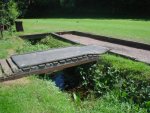
I think you have the correct answers above - the bridge is in the hazard, the hazard margins go stake to stake on the same side of the hazard, ie, you don't connect stake to stake that crosses the water hazard.
I was taught never to put paint on anything permanent, so wouldn't paint a line across a bridge just to convince a few contrary folks. However, it is easy enough to paint an arrow on the ground on each side of the bridge to show where the margin goes, or to paint a small dot on the bridge between the stakes on each side of the hazard to act as another stake.
 
I hope I am not adding too much information but first I agree that any open water course is a water hazard.

However, any stretch of such a body of water that runs through a circular conduit or pipe is not a water hazard (by definition)

The problem arises when a stream or ditch runs through a short length of closed conduit. According to the definition (and the R&A) that is not part of the water hazard, UNLESS the committee deem and mark it as being in the hazard.

Some committees, for the sake of convenience do. It's easier to run one continuous yellow line than breaking it up and having more stakes. However, this can get silly if the 'underground' stretch is more than a few yards long.

A bridge over water is in the hazard. Ground, whether grass or an artificially surfaced path, over a tunnel is not (unless the committee say otherwise).
 
I hope I am not adding too much information but first I agree that any open water course is a water hazard.

However, any stretch of such a body of water that runs through a circular conduit or pipe is not a water hazard (by definition)

The problem arises when a stream or ditch runs through a short length of closed conduit. According to the definition (and the R&A) that is not part of the water hazard, UNLESS the committee deem and mark it as being in the hazard.

Some committees, for the sake of convenience do. It's easier to run one continuous yellow line than breaking it up and having more stakes. However, this can get silly if the 'underground' stretch is more than a few yards long.

A bridge over water is in the hazard. Ground, whether grass or an artificially surfaced path, over a tunnel is not (unless the committee say otherwise).
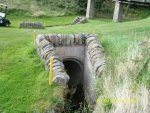
This is the situation at our place, a stone bridge crosses the ditch, under the bridge there is a closed pipe and our stakes are either side of the bridge.
If a ball lands on said bridge it is deemed not be in the hazard.
 
Thanks to everyone for their answers. At my club all the bridges are over open ditches so there is no debate. I will let the interested parties know.
 
This is the situation at our place, a stone bridge crosses the ditch, under the bridge there is a closed pipe and our stakes are either side of the bridge.
If a ball lands on said bridge it is deemed not be in the hazard.
Just to be pedantic, the bridge is not in the hazard by definition. It would only be in the hazard if the committee deemed it to be by local rule.
 
Just an aside for no purpose but clarity...and satisfying my anal urges. The reason you can "ground" your club on a bridge in a hazard is because the bridge is not "ground."
See dec 13-4/30.
 
Just an aside for no purpose but clarity...and satisfying my anal urges. The reason you can "ground" your club on a bridge in a hazard is because the bridge is not "ground."
See dec 13-4/30.

Not just anal, but helpful - because l knew a decision of that nature existed, but couldn't find it.

And reason l wanted to find it was to help illustrate this thread - along lines that if the bridge wasn't in the hazard then there wouldn't be a need for the decision about grounding a club on a bridge. (If you see what i mean?)
 
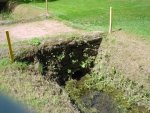
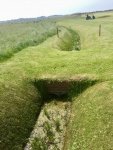
Just to add to Rulefan's illustrations, this picture was taken yesterday on the course I was refereeing on. I did on a previous occasion on that course have to advise a player on the status of the grass bit over the pipes. As it was through the green, she could move loose impediments and ground her club. On another course, a advised a player whose ball was on a bridge over an open ditch. The track over the bridge was surfaced with loose stones. In that situation, the player could ground his club but could not move any of the stones.
 
That one is a classic case where putting the stakes either side of the non bridge would help everyone..(except possibly the greenstaff)
 
Top