
Over the green unplayable rule

inc0gnito

Assistant Pro
Joined
Sep 16, 2017
Messages
924
Visit site
Help explain the rules under this situation please. It relates to an unplayable ball when you shoot over the green from 1. The tee box, and 2. from an approach shot.

The central question is what are my options when the ball blazes over the green and lands in an unplayable area (eg thick bushes) - say the red X in the picture.

I understand what the unplayable rules are, but not the nuances below. And do the same rules/answers apply when the ball is played from 1. The tee box, compared to 2. approach shot?

A. With 'stroke and distance' I can play the ball from where I originally played the ball.
B. With 'back on the line' I can play the ball anywhere on an imaginary line from X through the hole. But does that include the section north of the hole between the hole and X?
C. With 'lateral relief' you can drop within two club lengths of the ball. But what if there is NO relief within two club lengths from X? Or if the only relief is that section between X and the hole, which is 'closer to the hole'?
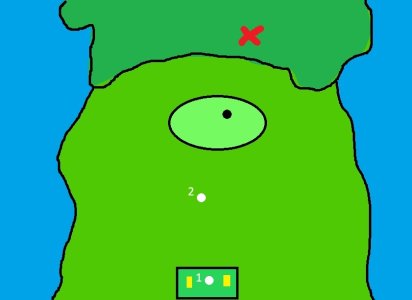


1749896450116.jpeg
 
A. Yes, you could do this (probably the only sensible option).
B. No; back on the line relief must be taken no nearer the hole, i.e. back, not forward.
C. You could take successive 2 club length drops, adding the penalty for each, until you reach a playable point, but you cannot drop nearer the hole than where the ball lies each time. You also have to actually perform the drops and start a new relief procedure each time; you can't just take 6 club lengths and add 3 penalty strokes.
 
In addition to the above there is no difference between 1 and 2 with regard to lateral or back on the line relief. All that matters is where the ball lies. Although your illustration does not show that possibility, had your original shot been played from closer to the hole than where your ball ended up, stroke and distance would result in you dropping from closer to the hole than where the ball lies - but that's ok. I hope that makes sense - I don't have time at the moment to draw a diagram.
 
The above posts answer the rules questions.
From a practical point of view, if you know they are thick bushes and the ball is likely to be in the middle of them, it would be sensible to play a provisional ball, and then not look for, or find, the original.
 
A. Yes, you could do this (probably the only sensible option).
B. No; back on the line relief must be taken no nearer the hole, i.e. back, not forward.
C. You could take successive 2 club length drops, adding the penalty for each, until you reach a playable point, but you cannot drop nearer the hole than where the ball lies each time. You also have to actually perform the drops and start a new relief procedure each time; you can't just take 6 club lengths and add 3 penalty strokes.

For B. Would you always draw the imaginary line starting from the hole through the X? So you would need to play anywhere 'behind' the X (ie further away from the hole)

Also I never knew that about allowing successive drops. Unusual anyone would use that rule i'd imagine!
 
In addition to the above there is no difference between 1 and 2 with regard to lateral or back on the line relief. All that matters is where the ball lies. Although your illustration does not show that possibility, had your original shot been played from closer to the hole than where your ball ended up, stroke and distance would result in you dropping from closer to the hole than where the ball lies - but that's ok. I hope that makes sense - I don't have time at the moment to draw a diagram.
Yeah I think I know what you mean. Thanks.
 
For B. Would you always draw the imaginary line starting from the hole through the X? So you would need to play anywhere 'behind' the X (ie further away from the hole)
Yes.
But note the qualifications underlined in the wording of

Back-on-the-Line Relief​

The player may drop the original ball or another ball (see Rule 14.3) behind the spot of the original ball, keeping the spot of the original ball between the hole and the spot where the ball is dropped (with no limit as to how far back the ball may be dropped). The spot on the line where the ball first touches the ground when dropped creates a relief area that is one club-length in any direction from that point, but with these limits:

 
The above posts answer the rules questions.
From a practical point of view, if you know they are thick bushes and the ball is likely to be in the middle of them, it would be sensible to play a provisional ball, and then not look for, or find, the original.
In this scenario given you might not intend to even look for the 1st ball, never mind hope find it, then why play a provisional...just put a new ball in play.

If you play a provisional and, say, you actually hole it out or stick it close, but when you get to the green someone either tells you where your first ball is or you or one of your companions spots a white thing deep in - you must try and identify that ball. If you can identify it as yours then that is the ball in play - the provisional is now irrelevant - you have no choice but to play your original ball. Putting a new ball in play gets rid of all of that possibility.

I am not sure what happens if a ball is spotted in a place close to where you think (or someone else thinks) your ball has ended up - but you absolutely within reason can't get to it to check your ball or not. I'm not sure whether Known or Virtually Certain comes into play and so it is your ball in play (as it is not recoverable I think you'd be able to use a new ball as 'proxy' and play it as your original), or whether not being able to positively identify it as yours means that your provisional is your ball in play. Someone here will know.
 
Last edited:
For B. Would you always draw the imaginary line starting from the hole through the X? So you would need to play anywhere 'behind' the X (ie further away from the hole)

Also I never knew that about allowing successive drops. Unusual anyone would use that rule i'd imagine!

Two drops may get you clear of a problem (not in your situation) so a player would be playing their 4th without the risk that taking stroke and distance has.
 
In this scenario given you might not intend to even look for the 1st ball, never mind hope find it, then why play a provisional...just put a new ball in play.

If you play a provisional and, say, you actually hole it out or stick it close, but when you get to the green someone either tells you where your first ball is or you or one of your companions spots a white thing deep in - you must try and identify that ball. If you can identify it as yours then that is the ball in play - the provisional is now irrelevant - you have no choice but to play your original ball. Putting a new ball in play gets rid of all of that possibility.

I am not sure what happens if a ball is spotted in a place close to where you think (or someone else thinks) your ball has ended up - but you absolutely within reason can't get to it to check your ball or not. I'm not sure whether Known or Virtually Certain comes into play and so it is your ball in play (as it is not recoverable I think you'd be able to use a new ball as 'proxy' and play it as your original), or whether not being able to positively identify it as yours means that your provisional is your ball in play. Someone here will know.
The ball must be identified, KVC does not come in to an unplayable scenario.
 
The Rules require that the player must promptly attempt to identify the ball and is allowed a reasonable time to do so. In some circumstances such an attempt will be fruitless or impossible, in which case the ball is lost. See Rule 18.2a(1).
 
The Rules require that the player must promptly attempt to identify the ball and is allowed a reasonable time to do so. In some circumstances such an attempt will be fruitless or impossible, in which case the ball is lost. See Rule 18.2a(1).
Of course…rather obvious really - but wasn’t thinking down the ‘lost’ route 👍
 
Top