Out of Bounds very close to track

SwingsitlikeHogan

Major Champion
Joined
Jul 24, 2012
Messages
35,248
Visit site
My ball lands on a track from which I can take relief. My ball is close to the side of the track close to which the course boundary runs alongside, and parallel to, the track. I can take a stance immediately off the track but I cannot make a normal address - the course boundary being less than 2ft from the edge of the track. What is the ruling?

Where the course boundary is a little further from the edge of the track and I can take a stance and take a normal address - then that would be my NPR - but there is not one club length to the course boundary - in line with my original ball position and the NPR. What is the ruling?
 
This (I think is the appropriate ruling)

[h=2]24-2b/3[/h] [h=4]Player Determines Nearest Point of Relief But Physically Unable to Play Intended Stroke[/h]Q.In proceeding under Rule 24-2b(i) or Rule 25-1b(i), the Definition of "Nearest Point of Relief" provides that to determine the nearest point of relief accurately, the player should use the club, address position, direction of play and swing (right or left-handed) that he would have used to make his next stroke had the obstruction or condition not been there. What is the procedure if, having determined the stroke he would have used, he is unable physically to make such a stroke from, what would appear to be, the nearest point of relief because either (a) the direction of play is blocked by a tree, or (b) he is unable to take the backswing for the intended stroke due to a bush?

A.The point identified is the nearest point of relief. The fact that at this point the player cannot make the intended stroke due to something other than the obstruction or condition from which relief is being taken does not alter this result. The player must drop the ball within one club-length of the nearest point of relief, not nearer the hole. Once the ball is in play, the player must then decide what type of stroke he will make. This stroke may be different from the one he would have made from the ball's original position had the obstruction or condition not been there.
 
This (I think is the appropriate ruling)

[h=2]24-2b/3[/h] [h=4]Player Determines Nearest Point of Relief But Physically Unable to Play Intended Stroke[/h]Q.In proceeding under Rule 24-2b(i) or Rule 25-1b(i), the Definition of "Nearest Point of Relief" provides that to determine the nearest point of relief accurately, the player should use the club, address position, direction of play and swing (right or left-handed) that he would have used to make his next stroke had the obstruction or condition not been there. What is the procedure if, having determined the stroke he would have used, he is unable physically to make such a stroke from, what would appear to be, the nearest point of relief because either (a) the direction of play is blocked by a tree, or (b) he is unable to take the backswing for the intended stroke due to a bush?

A.The point identified is the nearest point of relief. The fact that at this point the player cannot make the intended stroke due to something other than the obstruction or condition from which relief is being taken does not alter this result. The player must drop the ball within one club-length of the nearest point of relief, not nearer the hole. Once the ball is in play, the player must then decide what type of stroke he will make. This stroke may be different from the one he would have made from the ball's original position had the obstruction or condition not been there.

Not sure it does - the former scenario prevents me taking an address position as I am too close to the course boundary fence - I can take a stance but not emulate my address position because the position of the ball were I to stand at the NPR, would be out of bounds. In this scenario I think I can take relief the other side of the track.

The latter is clearer to me. I can take a stance and an address position standing at the NPR - I just cannot drop within one club length of where the ball would sit given my addressing it at the NPR. The fact that one club length could take me out of bounds is irrelevant as I could still drop within one club length backwards. In this scenario I think I cannot take relief the other side of the track. But just checking.
 
Not sure it does - the former scenario prevents me taking an address position as I am too close to the course boundary fence - I can take a stance but not emulate my address position because the position of the ball were I to stand at the NPR, would be out of bounds. In this scenario I think I can take relief the other side of the track.

The latter is clearer to me. I can take a stance and an address position standing at the NPR - I just cannot drop within one club length of where the ball would sit given my addressing it at the NPR. The fact that one club length could take me out of bounds is irrelevant as I could still drop within one club length backwards. In this scenario I think I cannot take relief the other side of the track. But just checking.

Need some clarification of what you mean as the first paragraph sounds a little confused to me. I think though you are saying that is no where on the boundary side of the track where you could drop the ball in bounds that would enable you to take your normal stance. If that is the case, and I may have got it wring, by definition your NPR must be on the other side of the track.
 
There is nothing in the definition of an NPR that says you are entitled to your normal stance. "Relief" refers exclusively to relief from the obstruction or condition that is causing the interference.

Decision 24-2b.3.5 might be more helpful :
http://www.usga.org/rules/rules-and-decisions.html#!decision-24,d24-2b-3.5

If the boundary fence or anything else prevents you from taking up a normal stance you must estimate where the NPR is, imagining that the fence, or tree or whatever does not exist. You can, of course, play your ball with one or both feet out of bounds and may have to imagine that as well. The NPR must be on the course.

These are general points which may help you in the situation you describe but I can't be more precise, not having seen the area.
 
Firstly, remember that NPOR comes into play when you are taking relief because something (ie a "condition") interferes with the ball, your stance or the area of your intended swing. Having said that, I think in both cases one needs to look more closely at the definition of NPOR - which is, in part,

It is the point on the course nearest to where the ball lies:

(i)
that is not nearer the hole, and

(ii)
where, if the ball were so positioned, no interference by the condition from which relief is sought would exist for the stroke the player would have made from the original position if the condition were not there.


It only makes reference to the condition from which relief is being sought - ie in this case, the path. The NPOR is the point at which there would be no longer any interference (to ball/stance/swing) caused by the condition. There is no mention of there being no interference (to ball/stance/swing) by anything else.

The decisions referred to above, indicate that the NPOR should be estimated if it cannot be physically determined. NPOR is where it is. It is irrelevant whether or not something else now causes interference. That there is now no space to take a stance, or make a swing, or there is not 1 club length in which to drop, does not alter that fact of the NPOR being where it is.

From the description given, it sounds very much like in both cases that NPOR is on the boundary side of the path. In both cases you accept the fact that the NPOR is somewhat unsatisfactory - and use it taking the consequences - or you lump it and play the ball as it lies (or use the unplayable rule). You dont get to choose a different NPOR.

Of course, in some cases, if you did take "unsatisfactory relief", some things which cause the new interference, may entitle you to further free relief. But a boundary fence is not one of them.
 
Ps. I note that in SiLH's second post he refers to a situation of the ball being out of bounds were he to stand at the nearest point of relief.

Remember that NPOR refers to the position at which the ball would lie - not the position where where you place your feet.
 
My ball lands on a track from which I can take relief. My ball is close to the side of the track close to which the course boundary runs alongside, and parallel to, the track. I can take a stance immediately off the track but I cannot make a normal address - the course boundary being less than 2ft from the edge of the track. What is the ruling?

Where the course boundary is a little further from the edge of the track and I can take a stance and take a normal address - then that would be my NPR - but there is not one club length to the course boundary - in line with my original ball position and the NPR. What is the ruling?

I've gone back to the original question because it's easier that way!

The missing bit seems to be the consideration of your normal stance address etc if you read the decision Jim posted more carefully you will see that it starts with the definition of NOR and that the consideration of the appropriate club, direction etc relate to what you would do if the track your ball is on wasn t there - not what you would do if the boundary wasn t there!

Because of this you may have a valid NPR that, when used, subsequently becomes a relief situation for a revised (reasonable) stroke. Ie even though you will (obviously) end up taking relief from the same obstruction because you will change you direction of play, or swing, or club etc, you still drop in relation to thst NPR and then subsequently proceed from there. Which is what the decision is about.

In practice, and from your description, this will mean that you switch to left handed to establish your second NPR and, at that point, you would be back on the other side of the track in you first example and, as the space available increases, you will increasingly have the opportunity to end up in a right mess when you get a valid drop that ends up against the boundary for you to play left handed.....at which point you wished you were playing from the track in the first place!

Hope this makes sense
 
Of course, in some cases, if you did take "unsatisfactory relief", some things which cause the new interference, may entitle you to further free relief. But a boundary fence is not one of them.

Yes to everything in your post but this last bit doesn't go far enough IMO.

The key here is that the same obstruction can provide interference after the valid initial drop because of the revised stroke that, taking into account the boundary, could be considered reasonable.

The confusion tends to be a result of appreciating the general principle that an NPR has to be clear of the original obstruction to be valid - which is only true for the stroke established to meet condition (ii) in the definition.
 
I've gone back to the original question because it's easier that way!

The missing bit seems to be the consideration of your normal stance address etc if you read the decision Jim posted more carefully you will see that it starts with the definition of NOR and that the consideration of the appropriate club, direction etc relate to what you would do if the track your ball is on wasn t there - not what you would do if the boundary wasn t there!

Because of this you may have a valid NPR that, when used, subsequently becomes a relief situation for a revised (reasonable) stroke. Ie even though you will (obviously) end up taking relief from the same obstruction because you will change you direction of play, or swing, or club etc, you still drop in relation to thst NPR and then subsequently proceed from there. Which is what the decision is about.

In practice, and from your description, this will mean that you switch to left handed to establish your second NPR and, at that point, you would be back on the other side of the track in you first example and, as the space available increases, you will increasingly have the opportunity to end up in a right mess when you get a valid drop that ends up against the boundary for you to play left handed.....at which point you wished you were playing from the track in the first place!

Hope this makes sense

If you switched to play left handed after the first drop on the boundary side, and then got relief for the track interfering with your stance and therefore dropped again on the "inside" of the track, are you then bound to play left handed since playing right handed at the point would mean you hadn't taken full relief from the track as you'd be standing on it to play right handed? Or could you switch back to right handed and seek further relief?

I think I'd be playing from the track first time round :confused:
 
SwingsitlikeHogan
Can you please clarify.
Are the track and boundary to the left or right of the fairway? Are you left or right handed? Is the boundary a physical wall, hedge or wall etc or can you stand on the OOB ground?
 
Ps. I note that in SiLH's second post he refers to a situation of the ball being out of bounds were he to stand at the nearest point of relief.

Remember that NPOR refers to the position at which the ball would lie - not the position where where you place your feet.

This is what I was missing - I was thinking that the NPR was where I stand. Now I'm guessing that in many situations it IS - but by thinking it was it is that which has confused me.

And for @rulefan...

So on the basis that my NPR is the ball position - and NOT where I take my stance - in my scenarios (where track and course boundary fence run down rhs of hole; I am right handed and the distance from the track right hand edge (facing toward the green) to the out of bounds fence is less than two feet. I can't stand out of bounds - the boundary is a fence.

With my back to the track my NPR is out of bounds. My NPR then becomes that point where my ball will remain in bounds as I turn clock-wise (towards facing the tee). At some point I will be able to take a stance and mark a ball position just inside the boundary fence. Any other possible NPR where I take a stance and can drop the ball in bounds is - in the scenario - going to be further from the original ball position on the track. So that ball position against the fence is my NPR. I could then drop my ball at the NPR - just inside the boundary fence - and take a stance to hit it from there if I so chose - even though the ball would likely be very close to the fence (with a bit of luck it might have bounced a short distance away from it)

The second scenario is where my NPR is in bounds but I don't have one club length 'beyond it' as one club length takes me out of bounds. That I believe is tough, and irrelevant in respect of the NPR.
 
Last edited:
If you switched to play left handed after the first drop on the boundary side, and then got relief for the track interfering with your stance and therefore dropped again on the "inside" of the track, are you then bound to play left handed since playing right handed at the point would mean you hadn't taken full relief from the track as you'd be standing on it to play right handed? Or could you switch back to right handed and seek further relief?

I think I'd be playing from the track first time round :confused:

The latter; and in most cases you would then have your (final....) npr even further 'inside'
 
This is what I was missing - I was thinking that the NPR was where I stand. Now I'm guessing that in many situations it IS - but by thinking it was it is that which has confused me.

And for @rulefan...

So on the basis that my NPR is the ball position - and NOT where I take my stance - in my scenarios (where track and course boundary fence run down rhs of hole; I am right handed and the distance from the track right hand edge (facing toward the green) to the out of bounds fence is less than two feet. I can't stand out of bounds - the boundary is a fence.

With my back to the track my NPR is out of bounds. My NPR then becomes that point where my ball will remain in bounds as I turn clock-wise (towards facing the tee). At some point I will be able to take a stance and mark a ball position just inside the boundary fence. Any other possible NPR where I take a stance and can drop the ball in bounds is - in the scenario - going to be further from the original ball position on the track. So that ball position against the fence is my NPR. I could then drop my ball at the NPR - just inside the boundary fence - and take a stance to hit it from there if I so chose - even though the ball would likely be very close to the fence (with a bit of luck it might have bounced a short distance away from it)

If this is a simple case of a right side boundary and track it's really very simple.

Based on your original post, where the area between the track and the boundary is increasing as you progress back towards the tee, you will just find a point where you are able to both drop the ball in bounds and have your stance clear of the track. Depending on the lay of the land this may be quite a long way from the original ball position.
You will also have a valid point on the left hand side of the track.
Whichever of the two is the shortest distance to the original ball position is the NPR.

If you are right handed and the boundary is to the right, I don't understand how standing OOB comes into things at all :confused:

Slightly picky but you will have to have gone your clublength further back towards the tee to get any scope for the ball to bounce away from the fence from your point of relief otherwise it wouldn't have been the npr etc etc
 
Last edited:
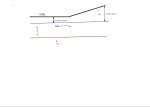
Does this represent the situation? X and Y represent the situation described by Duncan. The actual npr depends on just where the ball is along the path
 

Attachments

  • nprstance.jpg
    nprstance.jpg
    68.3 KB · Views: 27
Does this represent the situation? X and Y represent the situation described by Duncan. The actual npr depends on just where the ball is along the path

That's how I pictured it from the words....hole to the left of the page, tee back to the right.

The more complicated version already posted earlier applying to the mirror situation with the track and boundary on the left (for a right hander)
 
Does this represent the situation? X and Y represent the situation described by Duncan. The actual npr depends on just where the ball is along the path

Yes.

Duncan has clarified things for me. However...(sorry) one further clarification.

From what I now understand - the nearest place off the track that I can stand is in itself irrelevant in the context of the NPR?

If the nearest point off the track that I can stand does not enable me to find a NPR in bounds - then that stance position has no further relevance in identified my NPR? So I need not continue to stand at that point and rotate until I find point in-bounds - as that point would have me not taking a normal address position to play toward the green - as I would have been doing were the track not there.

And so - in my scenario (as illustrated by @rulefan) I simply go back (down the track) towards the tee until I am at a place where I have a point that I can BOTH drop my ball in bounds and take a stance to address it normally to take the shot I would have been playing had the track not been there.

Then having found a NPR, how close to the fence is that NPR? Is it in fact literally just inside the boundary fence? And so when I drop my ball it might sit right against the boundary fence but in bounds - and that would just be tough. If I can take a stance, address and hit the ball, then it is up to me whether I want to play my ball sitting so close to the boundary fence.

Note that standing OoB is not something I had raised - though I was asked. But as asked - in general can I stand OoB to play a shot. I've never had to ask myself that question when playing - eiter in respect of myself or a playing companion.

Sorry for being so picky and pedantic.
 
Last edited:
Yes.

Duncan has clarified things for me. However...(sorry) one further clarification.

From what I now understand - the nearest place off the track that I can stand is in itself irrelevant in the context of the NPR?

If the nearest point off the track that I can stand does not enable me to find a NPR in bounds - then that stance position has no further relevance in identified my NPR? So I need not continue to stand at that point and rotate until I find point in-bounds - as that point would have me not taking a normal address position to play toward the green - as I would have been doing were the track not there.

And so - in my scenario (as illustrated by @rulefan) I simply go back (down the track) towards the tee until I am at a place where I have a point that I can BOTH drop my ball in bounds and take a stance to address it normally to take the shot I would have been playing had the track not been there.

Then having found a NPR, how close to the fence is that NPR? Is it in fact literally just inside the boundary fence? And so when I drop my ball it might sit right against the boundary fence but in bounds - and that would just be tough. If I can take a stance, address and hit the ball, then it is up to me whether I want to play my ball sitting so close to the boundary fence.

Note that standing OoB is not something I had raised - though I was asked. But as asked - in general can I stand OoB to play a shot. I've never had to ask myself that question when playing - eiter in respect of myself or a playing companion.

Sorry for being so picky and pedantic.

Don't be sorry - I can see why there is confusion despite my earlier observation that it's simple.

No, the ability to take your stance clear of the obstruction (track here) is integral to the establishment of the NPR....which is why you have to go back (in this instance) to find a valid point on that side of the track.
Yes, the NPR will be exactly where you can stand clear of the track and drop the ball in bounds - but you then have a 1 club distance from that point (as I think I referenced earlier in this context) to create some wriggle room.
Obviously if the valid relief point on the other side of the track is nearer to the original position of the ball things are better!

Situations like this are classic examples of why you shouldn't pick up your ball from the track until you are sure you have a better option!
 
Don't be sorry - I can see why there is confusion despite my earlier observation that it's simple.

No, the ability to take your stance clear of the obstruction (track here) is integral to the establishment of the NPR....which is why you have to go back (in this instance) to find a valid point on that side of the track.
Yes, the NPR will be exactly where you can stand clear of the track and drop the ball in bounds - but you then have a 1 club distance from that point (as I think I referenced earlier in this context) to create some wriggle room.
Obviously if the valid relief point on the other side of the track is nearer to the original position of the ball things are better!

Situations like this are classic examples of why you shouldn't pick up your ball from the track until you are sure you have a better option!

I understand that stance and NPR are integral.

My point about the position of the stance I can take, clear of the track, and at the closest point to my ball - is that in itself it does matter - because if I cannot drop the ball in bounds taking a normal address for the shot I would have played had the track not been there - then that stance position is redundant as it does not help me identify me NPR. It is NOT the de facto 'stance point' for defining the NPR.

And I proceed as you indicate.

But what if I cannot have 1 club length beyond the NPR as that takes my OoB. Clearly in my scenario I could have 1 club length in a direction back towards the tee and I might still be able to take a normal stance taking full relief from the track. Is the 1 club length beyond the NPR something the rules give us - and so something that we can use to define our NPR - I go back down the track until I have a NPR one club length from the boudary fence?

Sorry again - still not quite got it nailed it in my head...
 
Last edited:
Top