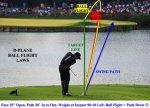
Old ball flight laws used by world no 1

Have enjoyed reading this thread, been very interesting and the "new" way certainly makes sense.

However, I'm a bit confused by some of the clock measurements for slice and hook. The dran and fade make perfect sense, basically an hour between club face and swing path. But:

Want to slice a ball to the 2 o'clock postion?
aim the clubface at 12.30 and swingpath to 12 OR clubface at 12 and swingpath to 10.30

Want to hook a ball to the 10 o'clock position?
aim the clubface at 11.30 and swing to 12 OR clubface at 12 and swingpath to 1.30

On the 2 in bold there is only half hour difference between club face and swing path, surely to "slice" or "hook" as opposed to fade or draw, you would have to increase the difference in angles, not decrease? The second part of hook and slice seem right ie. 90 minutes difference!
 
Have enjoyed reading this thread, been very interesting and the "new" way certainly makes sense.

However, I'm a bit confused by some of the clock measurements for slice and hook. The dran and fade make perfect sense, basically an hour between club face and swing path. But:

Want to slice a ball to the 2 o'clock postion?
aim the clubface at 12.30 and swingpath to 12 OR clubface at 12 and swingpath to 10.30

Want to hook a ball to the 10 o'clock position?
aim the clubface at 11.30 and swing to 12 OR clubface at 12 and swingpath to 1.30

On the 2 in bold there is only half hour difference between club face and swing path, surely to "slice" or "hook" as opposed to fade or draw, you would have to increase the difference in angles, not decrease? The second part of hook and slice seem right ie. 90 minutes difference!

In the slice example you don't need much cutting across if you've already got the face open... it's already started to the right

The reverse is true for the hook in the examples I gave, the face is closed so it's already going left.


Many people that hook do so with an OPEN face (aimed at 12.30 and swingpath to 2) and many slicers do so with a CLOSED face (clubface at 11.30 and path at 10) Square the face on either of these shots and you're going to get even MORE CURVE (greater angle of difference between clubface and path).
 
I think why most people find these laws hard to grasp is that they are a little unsure as to what the definition of target means......
I know most people know the exact definition but your not trying to get your ball to a target per say.......You want it to arrive at the destination which is where the flag is or a point in the fairway that you want the ball to land....This is NOT the target...It is the Destination......
Your target should be a point where you want the ball to start at NOT finish at....
So in effect you want your clubface to aim where you want the ball to start not where you want your ball to arrive....


Am i right with the above statement James?.......
It seems that a lot of people on this thread are really confusing a simple situation.
 
Kid2 above has described it spot on. Another post above says " so the face is closed". No the face is still open to the swing path but facing to the left of the bloody great tree in front at impact.
 
Here's the best explanation - with pictures and links - that I can find to how it really works.

http://johngrahamgolf.com/blog/new-ball-flight-laws/

Just as Cochran and Stobbs wrote in 1968!

Hehe... I was wondering.............. :thup:

what is interesting about that post is that it shows 13 ball flights (3 straight, 6 curve towards target, 4 curve away) there's actually 2 he didn't show in the drawings which which are push-slice and pull-hook, which makes 15

Not bad from 9 (supposed) ballflight laws :whistle:
 
Am i right with the above statement James?.......
It seems that a lot of people on this thread are really confusing a simple situation.

You are right because wherever you want the ball to start is where the clubface needs to be AT IMPACT.

It is confusing though because people aim differently and also hit the ball from different positions which is why you need to use the flight of the ball to diagnose your impact conditions... not the other way round.

If the ball curves to the right then your swingpath was LEFT of the ball, no matter how you hit it or lined up. If it also starts to the right then your clubface was open. That's how simple it is.

Fixing it is a totally different kettle of fish though ;)
 
Yes it can destroy your game.... for a while... until those new things bed in and become natural. We all think about things when we make a change, even simple little things, eg: try weakening someone grip just a little and see if they can actually hit a ball t feel' that they are using on the day.

I did this last night on the range with spectacularly bad results. Although I did hit the ball, along the ground..... :confused:
 
I like this picture from John Graham's site...

it shows that to push-draw the ball the clubface is open to the target and the path is more to the right than the face...

d-plane-ball-flight.jpg
 
To me i make it as simple as this....Which i think everyone should......

Now before i go on I'm not very strong at shaping the ball right to left.....Tried it for 12 months and it messed me right up.

I have a natural fade.......so when i aim everything parallel left of my destination.......Only by a few yards mind.....Clubface gets set first....At the target not my destination...And then i set my posture parallel to this

If your tendency is to hook/draw the ball aim everything right of your destination....Simple :) :)
 
^
^
^
The problem with your definition Kid2 is that you're assuming a pull-fade (hit with an out-to-in path at impact). So it doesn't necessarily stand up for everyone. However where the ball starts DOES stand up as that's physics and how it curves also stands up as that's physics too, path/ball position/angle of descent etc are dynamic so you can't just give a description of how YOU do it and have it work for everyone... unless you also describe the impact factors.

I would prefer to describe a push-fade than a pull-fade as a pull-fade is a risky shot that you need to pick cleaner off the turf and leads to fat/thin shots.
 
^
^
^
The problem with your definition Kid2 is that you're assuming a pull-fade (hit with an out-to-in path at impact). So it doesn't necessarily stand up for everyone. However where the ball starts DOES stand up as that's physics and how it curves also stands up as that's physics too, path/ball position/angle of descent etc are dynamic so you can't just give a description of how YOU do it and have it work for everyone... unless you also describe the impact factors.

I would prefer to describe a push-fade than a pull-fade as a pull-fade is a risky shot that you need to pick cleaner off the turf and leads to fat/thin shots.


Ah right......I suppose its horses for courses so to speak.......Works for me though :) I'm probably so used to it now that it comes natural......One thing i do know is that its definitely not a slice ;)......I'm confident of aiming just a few yards left of where i want the ball to finish...Not 25 yards left :)
 
One thing i do know is that its definitely not a slice ;)...

Actually reading back the way you describe it........... it IS a slice :mad:

Clubface and everything parallel then swing across it... slice.

If it helps any some people call it a straight-fade :D
 
That sounds a bit more less weekend hacker and more "I know what im doing" :) :) :)

Ha! just pulling your leg :D.... it could be one of 3 different shots depending on what you're doing through impact. A pull-fade, a slice or a push-fade

See how tricky it is to describe a shot without knowing what is going on? Ball position etc can make a big difference and there's no way to tell without seeing as you also need to know the exact direction the ball starts... even then you sometimes need trackman stats to see the small detail.

What I can tell you though is the clubface would be a little left of the target and the swingpath a little bit more left than that. Hence the ball starts a little left of target and curves to the right a bit :thup:
 
I think Luke Donald knows how to shape the ball but not necessarily how to build a club.

Your comparison is not the same.

I think it is you know. Like you say, Luke KNOWS how to shape the ball, he does not understand why he shapes the ball though. Like Hamilton KNOWS how to drive an F1 car but does not maybe understand how it works.

It took me some time to get my head around this, but justone did a great job of getting me to change my opinion and I am one stubborn git so it does take some doing.....:mmm:
 
Top