• We'd like to take this opportunity to wish you a Happy Holidays and a very Merry Christmas from all at Golf Monthly. Thank you for sharing your 2025 with us!

My Study of OBFL versus NBFL

Gary / James - yes i think you are not far off there.
The vid clip of james is interesting
I will look to see if i can find on t'interweb a clip of a 6 iron (say) or a club with a downward path at impact - the lob wedge clip is horizontal (possibly even rising) at impact.

Today, back in experiemental mode in teh hall again but using stripey sponge balls off the hardwood floor. i slid my U wedge along the floor (to ensure a horizontal attack) and observed quite noticeable backspin and launch. I then slid the club down a tray at about circa 5-10 degrees, placed to try and ensure that the club hit under the equator.
I definitely observed a much lower laucnh angle, and for what it's worth, felt more resistance on impact.

havent worked that all out yet - when i've had enough wine i'll have a think about it :)
I guess that when you are sliding the UW down the tray the shaft is more forward and you have taken loft of the clubface. This will launch it lower as it is making an oblique contact with the ball.
 
Last edited:
A question for Sev!

The ball is lying in one of those watery bunkers at Lythym/St.Annes.

Assume the golfer has struck the sand/water using 11° bounce and the ball rolls over the grooves of a 56° face. With the exterior effects, at what angle would the ball launch and can we expect the ball be kicked off to the right or left, presuming a square face and a 10° out to in path.
 
A question for Sev!

The ball is lying in one of those watery bunkers at Lythym/St.Annes.

Assume the golfer has struck the sand/water using 11° bounce and the ball rolls over the grooves of a 56° face. With the exterior effects, at what angle would the ball launch and can we expect the ball be kicked off to the right or left, presuming a square face and a 10° out to in path.

whats the point of this?
 
This whole thread was interesting to start with, now its run its course and going off at silly tangents.

Can you guys hit a 4 iron like a wedge?
Can you hit it high, low, left and right?

You probably can using .......instinct
 
i'll have a think about Patrick's question


Another angle - what is the reason for a divot ?

Tiger Woods hits a lot of divots. He is the most accomplished technical golfer of recent years. There must be a reason he (and other pros) hits a divot. A divot can only be generated with a downward blow (at impact) - i.e. the clubhead is still moving downwards when it hits the ball.

If there is no need to "compress" the ball (which i reasonably accept after discussions on here), why does he and others hit the
ball with a downward point of impact ? I am sure the best golfer (possibly bar one) ever, has a reason why he does this.

On another thread, it is postulated that "steeper" impacts generate higher amounts of backspin than "rounded" impacts.

This perhaps suggests that different ball flights are generated by a swing that hits with a descending blow, and swings that are steep and swings that are round ...

before nayone picks on me, i DON'T know the answer to this one ! :)(at the moment anyway)
 
i'll have a think about Patrick's question


Another angle - what is the reason for a divot ?

Tiger Woods hits a lot of divots. He is the most accomplished technical golfer of recent years. There must be a reason he (and other pros) hits a divot. A divot can only be generated with a downward blow (at impact) - i.e. the clubhead is still moving downwards when it hits the ball.

If there is no need to "compress" the ball (which i reasonably accept after discussions on here), why does he and others hit the
ball with a downward point of impact ? I am sure the best golfer (possibly bar one) ever, has a reason why he does this.

On another thread, it is postulated that "steeper" impacts generate higher amounts of backspin than "rounded" impacts.

This perhaps suggests that different ball flights are generated by a swing that hits with a descending blow, and swings that are steep and swings that are round ...

before nayone picks on me, i DON'T know the answer to this one ! :)(at the moment anyway)

The hands lead the clubface and impact should follow this condition. It's hard to lead with the hands on an upward motion.
 
That sounds like a nicety rather than a necessity ? i.e. is that teh case with a driver set up on a high tee off the left toe, when you hit up on it ? Not certani the hands have to lead in that case. Hnce nicety rather than necessity perhaps.
 
The reason you want to hit the ball with a descending blow using irons is so that you can contact the sweetspot thus getting optimum results for the given hit.

Sev, Take a golfball and place it on a table, then place the leading edge of a wedge behind it with the shaft vertical you will notice the point of impact will be low down on the clubface. If you now lean the shaft forward you will notice the point of impact gets higher up the face towards the sweetspot. The shaft is designed to be forward leaning at impact with irons for this reason.

Striking the ball in the sweetspot will create better compression of the ball against the clubface, this will result in a slightly lower ballflight with greater spin and more distance.
 
That sounds like a nicety rather than a necessity ? i.e. is that teh case with a driver set up on a high tee off the left toe, when you hit up on it ? Not certani the hands have to lead in that case. Hnce nicety rather than necessity perhaps.

We were talking about irons and divots.
 
The reason you want to hit the ball with a descending blow using irons is so that you can contact the sweetspot thus getting optimum results for the given hit.

Sev, Take a golfball and place it on a table, then place the leading edge of a wedge behind it with the shaft vertical you will notice the point of impact will be low down on the clubface. If you now lean the shaft forward you will notice the point of impact gets higher up the face towards the sweetspot. The shaft is designed to be forward leaning at impact with irons for this reason.

Striking the ball in the sweetspot will create better compression of the ball against the clubface, this will result in a slightly lower ballflight with greater spin and more distance.

SR, that's just what I said but your reply is by far the most eloquent.
 
Very interesting and useful guys, thanks

This suggests therefore that golfers do in fact hit down on the ball deliberately, in order to get more of the sweetpot that you mention above, that the flight will be different .

Which appears to diagree with the guys above who say you dont need to hit down on a ball, and that it is a mistaken philosophy

i am confused :(

Good debate this :)
 
Sev,

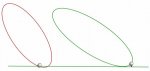
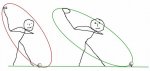
The swingplane for a 7-iron (in red) is steeper and the club enters the ground... so we hit the ball on the way down (as we can't hit it after we've buried the club in the ground!!).

The swingplane for driver (in green) is flatter so we can avoid hitting the ground.. and hit the ball on the way up.

[... click to enlarge]

swingplane.jpg

That's how simple it is.
 
sorry Tone, i just can't work out what teh 2 ellipses are ??

irrespective, i get the 7 iron vs driver issue but how does that help explain the earlier argument that people should not need to hit down on a ball to get it to lift/fly ?
 
With an iron: You don't need to hit down to get a ball to fly... but you can't hit UP < so what choice does that leave you? :whistle:


With a driver the ball is tee'd up so you can hit it on the way down OR the way up. Research has shown that the ball flies furthest when hit up so that's what most of us TRY to do.
 
With an iron: You don't need to hit down to get a ball to fly... but you can't hit UP < so what choice does that leave you? :whistle:

There are two different types of player with irons...

The sweeper - who doesn't take a divot

The digger - who does.

Both are effective.
 
How can you hit the ball out of the sweet-spot with mid and short irons without hitting on a downward path?

It depends on the course layout. On a parkland course, the grass tends to be between 1/2 - 3/4" long and a sweeper can easily hit the sweetspot without hitting into the ground. On a links, he better learn very quickly that digging is the most effective technique. A sweeeper does however still strike the ball with a downward action.
 
Last edited:
Here's a link showing Tiger's 8-iron striking.

http://thesandtrap.com/t/45647/sweetspot-on-irons-where-the-good-players-hit-it

It would indeed be possible, specially in longish fairways, to sweep and strike at bottom of tho swing and still hit the sweet-spot. The ball is 1.68", so if the sweet spot is 0.84" from bottom of iron (or less), then perfectly feasible, even on tight links courses.

Yes, interesting. My other iron sets, TaylorMade, Mizuno and Titleist had marks like this on my nine iron after about 10,000 shots but my Fusions have a titanium face and I played at least that amount with very little wear.
 
Top