Is forgiveness for humans and not golf irons?

Thanks for the replies fellas.Very interesting views.
I agree you can hit further with a forgiving club than a blade if it isn’t a good strike, but that was the point I was trying to make. If your green approach is 120 yds and your bad strike, intending to fly 120, flys 80% as far then you are liable to be in a bunker, water etc. More trouble than if a blade strike is bad and goes 50%.
Posts 5,7 and 10 agree that a bad strike doesn’t produce the required distance.

I agree it’s different re drivers. They weren’t in my thinking.
I follow where you are coming from and it likely comes down to how the course is laid out / designed.

I was at a course a bit back where a lot of bunkers were at the sides of the greens & long was often not good.
MP60s (so not full blades) and misses were often short, and I generally scrambled well from there.

A course with water carries, big front bunkers, then the cavities maintaining carry likely comes out better.

But probably over thinking, and just recalling certain outcomes!
 
I follow where you are coming from and it likely comes down to how the course is laid out / designed.

I was at a course a bit back where a lot of bunkers were at the sides of the greens & long was often not good.
MP60s (so not full blades) and misses were often short, and I generally scrambled well from there.

A course with water carries, big front bunkers, then the cavities maintaining carry likely comes out better.

But probably over thinking, and just recalling certain outcomes!
That’s interesting that you see it that way, whereas I see it opposite 😁
I envisage a shot to fly the green, and the right distance club ( CB or blade) will get you there if struck well.
If badly struck, I’m thinking it’s more likely neither club would get you to the green, whereas you think the CB bad strike will still get you there. Just not in the good part of the green.
That’s interesting, that tells me that your standard of play is pretty high.
If you saw our seniors ( including me) good and bad strikes, then you’d probably see it my way😂😂
Yes, I can see where playing standards can make the difference
 
There’s so many great looking forgiving irons these days. Back in the day they were ugly with loads of offset and huge soles.
Yes there were many ugly sets.
But also fairly traditional looking, minimal offset, but incorporating perimeter weighting or cavity back design.
Titleist DCI were popular. I chose Ram Laser Fx and my brother got some Powerbilt Oversize.

Many viewed the Ping Eye2 as ugly, including me, when it came out mid 1980s. This was the biggest selling iron in history.
At the time it was fairly expensive and was taken up by many pros.
Therefore many amateurs viewed them as being for more serious and accomplished players. Mid and high handicappers stuck to their cheaper blades in the 1980s.

Other manufacturers started to make things similar to the Eye2s. A race was on to produce the cheapest/biggest selling to higher handicap market. Hence some pretty poor stuff was around back then.
 
How many of the greens on your course are guarded by places you don’t want to be?…..water, bunkers, mini hills etc. .Most of them, I think.
So, miss the green with your iron , you are better off missing shorter ( still fairway, next shot a chip?) than missing ‘almost there’……water bunker etc., No?

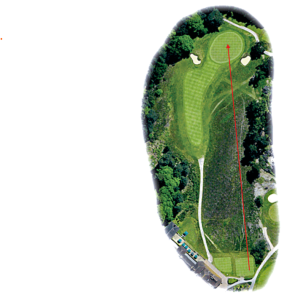
So you are saying a mis-hit that is so bad it doesn't reach the greenside hazards is better than a slight mis-hit that find a greenside bunker, because the punishment is less severe? Surely this depends on the difficulty of your golf course and the trouble in front of the hole.

For example, standing on the tee on this par 3, anything less than 90% is dead. I'd be happy to finish in the greenside bunker.

1770388137333.png
 
If your green approach is 120 yds and your bad strike, intending to fly 120, flys 80% as far then you are liable to be in a bunker, water etc. More trouble than if a blade strike is bad and goes 50%.

This only applies if you have a nice fairway all the way up to the green. Not going to work if there is rough / water to cross like here:

1770388779979.png
 
This only applies if you have a nice fairway all the way up to the green. Not going to work if there is rough / water to cross like here:

View attachment 60889

Well, yes, it applies to where the fairway runs close to the green, not necessarily all the way up to. I’m thinking of bunkers across nd around, or water across front of ,green or just a very narrow run in.
Clearly, the ones where it’s ‘jungle’, water or big trouble all the way to the green, don’t apply. As Harpo says , some you have to play long or exact.
But I think that a lot of courses will have more approaches where there is fairway running to just short of the green, than holes shown above, thank goodness😁
 
Going back quite a few years ago when I tried new irons I would deliberately hit balls off the toe and heel and the club. I very quickly learnt what clubs were truly forgiving.
I once played with Nicklaus N1 irons which had muscle bars on the back at the sides of the middle rather than the edge unlike a cavity back club and I got more distance if the ball was hit where one of these bars were rather than the middle.
 
Yes there were many ugly sets.
But also fairly traditional looking, minimal offset, but incorporating perimeter weighting or cavity back design.
Titleist DCI were popular. I chose Ram Laser Fx and my brother got some Powerbilt Oversize.

Many viewed the Ping Eye2 as ugly, including me, when it came out mid 1980s. This was the biggest selling iron in history.
At the time it was fairly expensive and was taken up by many pros.
Therefore many amateurs viewed them as being for more serious and accomplished players. Mid and high handicappers stuck to their cheaper blades in the 1980s.

Other manufacturers started to make things similar to the Eye2s. A race was on to produce the cheapest/biggest selling to higher handicap market. Hence some pretty poor stuff was around back then.


I remember back shortly after first starting that I would like a set of cavity back clubs but the prices compared to blades put them outside of my budget.
 
(…)

I suppose the question is…
Do forgiveness clubs mean you get further and straighter if you strike the ball other than properly?;
Or, forgiveness clubs allow your swing to hit the ball properly more than blades do?

I tend to think the former, so what are your thoughts?😁

IMVHO „forgiveness“ is very much a question of marketing, not facts.

When I started playing golf, I bought my first clubs based on two criteria exactly : appearance and price.

The result were blades that, unbeknownst to me at the time, I shouldn't have been able to play with. But it worked, and after a while I was even doing quite well for a beginner (consistently well under 100 strokes for a par 70 course).

This shows me that it's not the clubs that make the game, but the player. And if the player is comfortable with his clubs, it doesn't matter at all whether they are “forgiving” or not.

So, IMHO, play with the clubs that *you* feel most comfortable with! (y)
 
They were brilliant, and they were everywhere too it seemed, Scotland anyway, every pro shop.
I had a friend who worked in a mizuno factory in a place called Cumbernauld outside of Glasgow.
Managed to get a full set of mp33 blades on the fly for nothing.
So stupid as should not have been playing blades but they were beautiful. Looked the part anyway.
 
They were brilliant, and they were everywhere too it seemed, Scotland anyway, every pro shop.
I had a friend who worked in a mizuno factory in a place called Cumbernauld outside of Glasgow.
Managed to get a full set of mp33 blades on the fly for nothing.
So stupid as should not have been playing blades but they were beautiful. Looked the part anyway.

I have a set of MP32 - 3 - PW and use them when playing abroad, as they cost me just over £100 and a re-grip, so not as concerned with travel damage.

Basically 8 ish yards shorter than my current regular irons and little forgiveness, so a few poor shots, but the warmer weather does make up for the distance. If I played them here, I would have higher scores, so forgiveness does work, but I've found I play better without strong lofts, which many forgiving irons have, so sit somewhere in the middle with the T250/T150's I enjoy and have very few bad strikes.
 
Top