
So which shots are missing from the alternative diagram
To me it looks like a pre-flight diagram for the Red Arrows. All of those apply to me at one time or another in a round

So which shots are missing from the alternative diagram

So which shots are missing from the alternative diagram

So which shots are missing from the alternative diagram
The sandtrap diagram is the same as the one for the old ball flight laws. In theory the push-draw and pull-fade shouldn't be on there as the clubface needs to be manipulated to the swing path (a fraction closed or a fraction open accordingly). My issue is that they should be on there as so many people like to hit those shots.. there are probably a couple of others that could be added too so that it is more familiar to the 'average golfer'.
As it stands it almost has no real value to anyone whatsoever.
So which shots are missing from the alternative diagram
The sandtrap diagram is the same as the one for the old ball flight laws. In theory the push-draw and pull-fade shouldn't be on there as the clubface needs to be manipulated to the swing path (a fraction closed or a fraction open accordingly). My issue is that they should be on there as so many people like to hit those shots.. there are probably a couple of others that could be added too so that it is more familiar to the 'average golfer'.
As it stands it almost has no real value to anyone whatsoever.
I'm not quite sure where you're coming from.
The club can only point left, straight or right, and the swingpath can only be straight, in-out or out-in.
The ball can only start straight, left, or right, and can only stay straight, move left, or move right.
Whichever way you look at it there's 9 combinations. The only way you can add more is with varying amounts of sideways movement or varying how far left or right of target the ball starts.

I'm not quite sure where you're coming from.
The club can only point left, straight or right, and the swingpath can only be straight, in-out or out-in.
The ball can only start straight, left, or right, and can only stay straight, move left, or move right.
Whichever way you look at it there's 9 combinations. The only way you can add more is with varying amounts of sideways movement or varying how far left or right of target the ball starts.

I'm not quite sure where you're coming from.
The club can only point left, straight or right, and the swingpath can only be straight, in-out or out-in.
The ball can only start straight, left, or right, and can only stay straight, move left, or move right.
Whichever way you look at it there's 9 combinations. The only way you can add more is with varying amounts of sideways movement or varying how far left or right of target the ball starts.
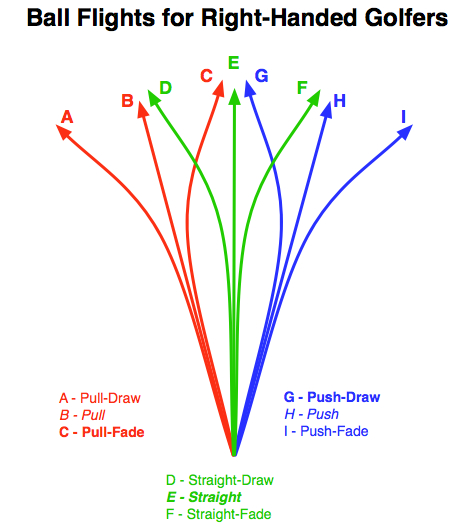
Gary, take a close look at the 3 shots on the right hand side in blue.... see shot G?
now find shot G on the pic below.....
Likewise do the same for shot C, can you see that ball flight on both pics
G is a ball that starts to the right and turns left.
Solid blue line in second diagram is a ball that starts right and turns left.......
G is a ball that starts to the right and turns left.
Solid blue line in second diagram is a ball that starts right and turns left.......
Solid blue line in second diagram is a ball that is hit with the clubface pointing at the target, is that your definition of a ball that starts right?


I've just seen why and how the 2 pictures are different, while both being right.
Both pictures show combinations of face left, at target, and right, and swingpath left, straight, and right.
How they differ is the first one's swingpath is in relation to the target, and the second one is in relation to face angle.
So where it looks like the first picture just repeats 2 shots, swingpath towards the target and the opposite side of target to face angle actually produce the same shot with different amounts of sideways movement.
Picture 1 doesn't show face left and swingpath further left, and the same on the right side of the target.
Picture 2 doesn't show face left of target and path right of target, and vice-versa.


