• We'd like to take this opportunity to wish you a Happy Holidays and a very Merry Christmas from all at Golf Monthly. Thank you for sharing your 2025 with us!

Local Rules for bridges over hazards

2blue

Journeyman Pro
Joined
Feb 4, 2012
Messages
4,595
Location
Leeds,
Visit site
We have many & would like relief granted from being on them & on the finishing surface that sometimes spills outside their boundaries i.e. Shingle, bark etc.
What's the easiest solution ... yellow line & post-wise bearing in mind maintenance of these etc
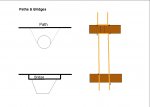
 
First, can you be clear that they are actually bridges over an open water course not simply a below ground concrete tube? Then we can look at solutions

See the diagram

Upper LH diagram - The area below the path and above the circular tube is earth

Lower LH diagram - the area below the path is open air
 

Attachments

  • path and bridge.jpg
    path and bridge.jpg
    52.8 KB · Views: 138
Last edited:
First, can you be clear that they are actually bridges over an open water course not simply a below ground concrete tube? Then we can look at solutions

See the diagram

Upper LH diagram - The area below the path and above the circular tube is earth

Lower LH diagram - the area below the path is open air
Yes its definitely the the area below the path is open air
 
Yes its definitely the the area below the path is open air

In that case, you cannot take or make a local rule that allows you to take relief if your ball lies on that part of the bridge which is within the margins of the water hazard. That is because you are are not allowed relief from an immovable obstruction in a water hazard. If you choose to play the ball as it lies, you may, however, ground your club on the obstruction.

If any part of the bridge is outside the margins of the water hazard, you may take relief if your ball is lying on that part.

Rule 24-2b applies.

The markings should show clearly where the margin of the hazard is when the bridge extends beyond it. Stakes immediately to either side with a line painted between them leave no doubt.
 
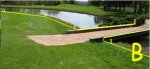
See example B
Seems very dangerous to encourage folk to play off the bridge especially as ours have knee-rails as well.....
Why is this not an acceptable solution?...... so the bridge becomes an immovable object & relief from its surface comes under 'paths' etc?
Bridge hazards.jpg
 
Last edited:
Seems very dangerous to encourage folk to play off the bridge especially as ours have knee-rails as well.....
Why is this not an acceptable solution?...... so the bridge becomes an immovable object & relief from its surface comes under 'paths' etc?
View attachment 21134


The rules tell you that you don't get relief within the margins of the hazard. If the bridge was not there you would be in the hazard so you should not expect free relief.
 
Seems very dangerous to encourage folk to play off the bridge especially as ours have knee-rails as well.....
Why is this not an acceptable solution?...... so the bridge becomes an immovable object & relief from its surface comes under 'paths' etc?
View attachment 21134

The rules tell you that you don't get relief within the margins of the hazard. If the bridge was not there you would be in the hazard so you should not expect free relief.
Oh yeah, I realise that you can't expect relief if in a hazard... fair enough..... but as the Club is in charge of defining the limits of the hazard why can it not be split as per my picture?? A far safer arrangement then having folk possibly playing off the bridges.
 
Oh yeah, I realise that you can't expect relief if in a hazard... fair enough..... but as the Club is in charge of defining the limits of the hazard why can it not be split as per my picture?? A far safer arrangement then having folk possibly playing off the bridges.

So what you class the ditch under the bridge as?
 
Seems very dangerous to encourage folk to play off the bridge especially as ours have knee-rails as well.....
Why is this not an acceptable solution?...... so the bridge becomes an immovable object & relief from its surface comes under 'paths' etc?
View attachment 21134

It's not a solution because the margins of a water hazard are in the first place established by its natural limits. The Committee cannot arbitrarily cut off a bit within those margins and make it other than a part of the water hazard.
 
So what you class the ditch under the bridge as?
It would become just part of the course..... balls that may finish under would just be treat as 'unplayable'...... a far safer solution really but I can see it won't wash.

It's not a solution because the margins of a water hazard are in the first place established by its natural limits. The Committee cannot arbitrarily cut off a bit within those margins and make it other than a part of the water hazard.
Yes, I can see where you're going with that, except the Committee do decide where that 'natural limit' extends to..... but, yes, cutting out a section is different all together. I can see we'll have to revise how all our bridges are treat & educate the members so.
Thanks for your contributions Louise & Colin :thup:
 
Taking picture B. The portion of the bridge between the parallel yellow lines cannot be marked as such. By definition the margins of a WH extend vertically upwards and downwards. So the portion of the bridge over the water must be in the hazard.
 
Oh yeah, I realise that you can't expect relief if in a hazard... fair enough..... but as the Club is in charge of defining the limits of the hazard why can it not be split as per my picture?? A far safer arrangement then having folk possibly playing off the bridges.
Because the Rules ie the definition says you can't.
 
First, can you be clear that they are actually bridges over an open water course not simply a below ground concrete tube? Then we can look at solutions

See the diagram

Upper LH diagram - The area below the path and above the circular tube is earth

Lower LH diagram - the area below the path is open air
Thanks Rf...... So whats the scenario in the case of 'Upper LH diagram - The area below the path and above the circular tube is earth'?
Think we may have one or two like it :thup:
 
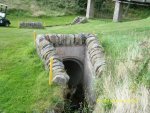
When a tube is used the area above the tube is often grassed so is marked as not in the hazard, if it is an artificial surface you can get free relief if it is outside the boundaries of the hazard as it is in the case of the "upper LH diagram"
 
Thanks Rf...... So whats the scenario in the case of 'Upper LH diagram - The area below the path and above the circular tube is earth'?
Think we may have one or two like it :thup:

It means that the ground above is not in the WH. ie it is not above an open water course.

See this as an example. The same would be true if it was gravel rather than grass
 

Attachments

  • SL271536.jpg
    SL271536.jpg
    96.9 KB · Views: 53
Last edited:
Top