
If you have your clubs and want to come to Libbaton give me a shout after 14th
If I can convince the good lady that she’s spent more than enough time with me these last twelve months, I may well take you up on that ?

If you have your clubs and want to come to Libbaton give me a shout after 14th

No botherIf I can convince the good lady that she’s spent more than enough time with me these last twelve months, I may well take you up on that ?


Or Deviant...It obvious! Her antibodies see you as a variant...

I've been following the various graphs trending in the right direction recently and taking the positives from those, whilst also being mindful that the most serious numbers are of course so sad & still feel (to me) too high. Which made me think what are the "acceptable numbers" that may be being scrutinised to trigger the relaxations.
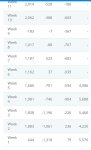
The constant bombardment of numbers do seem to be affecting some of the population, and we've chatted on here before about just how many deaths sadly occur in a "normal" year. I was looking for excess numbers and came across this. The 2nd column is 2018 when we had the bad flu season
View attachment 35087
Guess it shows just how variable things are, and how tricky it is to relate to the daily & weekly numbers constantly shared.
Without thinking about it too much, am maybe leaning towards 1400 a week tagged to covid19, so average of 200 per day.
Obviously with admissions and cases also feeding in. Could be way off though.
Sorry, I should have added the linkSorry don't understand the figures. Could you explain please.



Great news see attached although we must not forget what happened initially and he will be paralysed because of what happened initially during lockdown.This could easily have gone into random irritations but it is heartbreaking.
2 guys one from Liverpool the other from Leicester came to Kirkstone pass in The Lake District last week to camp overnight. They got into difficulties and Patterdale Mountain Rescue were called out. An experienced rescuer fell 500 feet whilst carrying out his rescue. The 2 guys were fined £200 each.
The rescuer has damaged his spinal cord and is unlikely to ever walk again. A fund has been set up to support him.
Words fail me
It’s absolutely fantastic, but as you say, something that should of never been needed and those responsible should be locked up imo.Great news see attached although we must not forget what happened initially and he will be paralysed because of what happened initially during lockdown.
£680,000 raised for Patterdale Mountain Rescue member injured in callout


The newer variants are much easier to catch, therefore more people will be infected so there will be more positive tests.Given we are in lockdown I am struggling a bit to understand why we still have such a significant numbers of new infections each day, yes falling dramatically from where it was as the lockdown has it's impact - but if we consider that a 'full' and 'fully enforced' lockdown should very quickly drive the number of new infections to a low number - why still the number we have daily.
Given that we are in lockdown the prospect of relaxing things does give me cause for concern. Maybe we have to accept that when relaxation comes, numbers of new infections will shoot up again but the vaccination programme will reduce the number requiring hospitalisation.
Of course those who will suffer the effects of 'long-covid' as a result of picking up the virus and contracting the disease will not show up as a short term concern in the context of hospitalisation - but will become apparent over the coming years.
But the current daily numbers...why? What are the infection contexts for the new cases? I'm sure someone is doing the analysis.
It's people not behaving themselves. We keep hearing about people saying they've had enough of lockdown and I still see groups of people not distancing. There have been recent parties broken up by the police with hundreds of people attending, how many are getting away with it.Given we are in lockdown I am struggling a bit to understand why we still have such a significant numbers of new infections each day, yes falling dramatically from where it was as the lockdown has it's impact - but if we consider that a 'full' and 'fully enforced' lockdown should very quickly drive the number of new infections to a low number - why still the number we have daily.
Given that we are in lockdown the prospect of relaxing things does give me cause for concern. Maybe we have to accept that when relaxation comes, numbers of new infections will shoot up again but the vaccination programme will reduce the number requiring hospitalisation.
Of course those who will suffer the effects of 'long-covid' as a result of picking up the virus and contracting the disease will not show up as a short term concern in the context of hospitalisation - but will become apparent over the coming years.
But the current daily numbers...why? What are the infection contexts for the new cases? I'm sure someone is doing the analysis.
Given we are in lockdown I am struggling a bit to understand why we still have such a significant numbers of new infections each day, yes falling dramatically from where it was as the lockdown has it's impact - but if we consider that a 'full' and 'fully enforced' lockdown should very quickly drive the number of new infections to a low number - why still the number we have daily.
Given that we are in lockdown the prospect of relaxing things does give me cause for concern. Maybe we have to accept that when relaxation comes, numbers of new infections will shoot up again but the vaccination programme will reduce the number requiring hospitalisation.
Of course those who will suffer the effects of 'long-covid' as a result of picking up the virus and contracting the disease will not show up as a short term concern in the context of hospitalisation - but will become apparent over the coming years.
But the current daily numbers...why? What are the infection contexts for the new cases? I'm sure someone is doing the analysis.
Ok - so my conclusion is that if we had had the same level of testing in the previous lockdown then the daily number of new infections would have been about the same. OK - I get that. But today with the level of testing we have, we clearly have a much better handle on the level of new infections daily - and if it is about the same as it was last time round (we just didn't know the true number back then) then we risk have repeated what happened last time we opened up (too soon or too quickly). problem that everyone has is that we don't know whether the 1000 a day last time is equivalent to 10,000 a day this time.Because we aren’t in a full lockdown
Many people are still going to work on a daily basis , people are still flying in , public transport still going strong , some schools still open
People are still interacting with each other
The numbers would have been the same during the previous lockdown if we did the same level of testing
No it’s not. Rule breaking will be the exception not the norm. LP has it right, people are still having to work, that will almost certainly be the cause of the majority of current infections. Not all of us can work from home, can’t/won’t it makes no difference.Ok - so my conclusion is that if we had had the same level of testing in the previous lockdown then the daily number of new infections would have been about the same. OK - I get that. But today with the level of testing we have, we clearly have a much better handle on the level of new infections daily - and if it is about the same as it was last time round (we just didn't know the true number back then) then we risk have repeated what happened last time we opened up (too soon or too quickly). problem that everyone has is that we don't know whether the 1000 a day last time is equivalent to 10,000 a day this time.
@SR has answered my 'Why?' question with the answer I fear is correct. I was rather hoping that there would be a systematic 'it's because of people meeting are up as permitted in a XXX context and in that context it's hard to not pass on the virus no matter how hard everyone tries' . If such could be identified then the risk associated with perpetuating the 10,000+ new infections a day could be mitigated. But if it's just reckless, careless or selfish behaviour of individuals...hmmm
Ok - so my conclusion is that if we had had the same level of testing in the previous lockdown then the daily number of new infections would have been about the same. OK - I get that. But today with the level of testing we have, we clearly have a much better handle on the level of new infections daily - and if it is about the same as it was last time round (we just didn't know the true number back then) then we risk have repeated what happened last time we opened up (too soon or too quickly). problem that everyone has is that we don't know whether the 1000 a day last time is equivalent to 10,000 a day this time.
@SR has answered my 'Why?' question with the answer I fear is correct. I was rather hoping that there would be a systematic 'it's because of people meeting are up as permitted in a XXX context and in that context it's hard to not pass on the virus no matter how hard everyone tries' . If such could be identified then the risk associated with perpetuating the 10,000+ new infections a day could be mitigated. But if it's just reckless, careless or selfish behaviour of individuals...hmmm


There is no doubt that during the first lockdown the cases if there was wide testing would be at the same level peak as we have seen this time around - the death rate is approximately the same.
There is a huge difference between the easing of lockdown this time - the vaccines.
There appears to be this thinking that when we eased out of lockdown in May it was rushed and caused issues ? Why when cases and deaths kept dropping. The issues restarted when the weather got worse and made it easier for viruses to spread - just like common cold and flu etc.
The vaccine is the big hitter right now , people will still catch Covid , it’s not just going to disappear- but the vaccine will protect people from the dangerous element of the virus

Ok - so my conclusion is that if we had had the same level of testing in the previous lockdown then the daily number of new infections would have been about the same. OK - I get that. But today with the level of testing we have, we clearly have a much better handle on the level of new infections daily - and if it is about the same as it was last time round (we just didn't know the true number back then) then we risk have repeated what happened last time we opened up (too soon or too quickly). problem that everyone has is that we don't know whether the 1000 a day last time is equivalent to 10,000 a day this time.