10 Golf Myths

I'm glad that two people already called out that utter codswallop so I didn't have to. šŸ˜‚


You might hole more putts, but you will also three-putt more as well, so in the grand scheme of things, not a great exchange.

Just to reiterate - if you missed the hole and went two feet past it did not 'have a chance' to go in, because it missed. It was on the wrong line. I could equally say to you that a putt that is short but on line for the hole is preferable over the one that missed two feet past - because at least it had a chance to go in - having been on the correct line. Where is the one that missed long was not. Equally justifiable with similar logic. Either way, all of these putts missed, and the only thing that matters then is getting the next one in - ergo, I'd rather be nearer the hole.

Not just you that thinks it the dude that dos all the Arcoss stats from PGAT does as well. Same dude that does the stats for Crossfields podcasts and same dude that coaches US Collegiate players, below is an exert I found on the ā€œgoogleā€.

ā€œModern golf statistics and analysis, such as that by Lou Stagner, often suggest that for very long putts (e.g., 30+ feet), the optimal strategy is actually to leave them slightly short on average to minimize the risk of a long second putt and a potential three-puttā€

Now it goes a lot further in depth and includes tours stats for leaving putts short but I couldn’t be bothered to quote it all because clearly golf forummers know better than trained people and top level players. After all ā€œNever up, Never inā€ šŸ˜‚
 
You cant with a putter. I tested it before.

Pro v and brick balls. Low lignting at home. Took my glasses off and putted on the putting mat. Played music on ear phones.

Could not tell the difference on feel.
How dare you disagree šŸ˜‚

I agree with you considering one of the things in reviews of tour level balls that’s often stated of the clicky sound ā€œ harder feelā€ of tour level balls off the putter. I’d be impressed if a club player could discern that ā€œfeelā€ with a top flight or premium ball in a blind test with no sound input either.
 
Yes sound is an important feedback element.

Have you never hit a top flite before? Maybe I should go and test this out on the range with some earplugs, I reckon I will be able to feel the difference, especially with the putter.
I once suggested on here that people would not be able to tell and got a load of replies saying it was stupid, you don't play golf with ear plugs in, etc. :ROFLMAO:
 
Not just you that thinks it the dude that dos all the Arcoss stats from PGAT does as well. Same dude that does the stats for Crossfields podcasts and same dude that coaches US Collegiate players, below is an exert I found on the ā€œgoogleā€.

ā€œModern golf statistics and analysis, such as that by Lou Stagner, often suggest that for very long putts (e.g., 30+ feet), the optimal strategy is actually to leave them slightly short on average to minimize the risk of a long second putt and a potential three-puttā€

Now it goes a lot further in depth and includes tours stats for leaving putts short but I couldn’t be bothered to quote it all because clearly golf forummers know better than trained people and top level players. After all ā€œNever up, Never inā€ šŸ˜‚
"Never up, never in" is true but so is "2 feet past, never in". And also "2 feet right, never in" :ROFLMAO:
 
Why? This is dumb. A miss is a miss, and closer is always better.

Why? Because this is playing the percentages. Sounds like you have a confidence issue with putting if you're looking to dribble it up to the hole on all your putts.

There are only 2 variables when putting: pace and line.

Sometimes, you can hit a putt with too much pace, but it catches the hole and still drops. If you don't hit it with enough pace, it will NEVER drop. You will hole much more putts if you consistently get the ball to the hole.

If you hit a putt with the pace to roll 2-3 feet past the hole, the ball holds its line better, you can choose a straighter line and that increases the margin for error. I should write a book about this. šŸ˜†
 
Why? Because this is playing the percentages. Sounds like you have a confidence issue with putting if you're looking to dribble it up to the hole on all your putts.

There are only 2 variables when putting: pace and line.

Sometimes, you can hit a putt with too much pace, but it catches the hole and still drops. If you don't hit it with enough pace, it will NEVER drop. You will hole much more putts if you consistently get the ball to the hole.

If you hit a putt with the pace to roll 2-3 feet past the hole, the ball holds its line better, you can choose a straighter line and that increases the margin for error. I should write a book about this. šŸ˜†
No, it's the opposite - I have the confidence to try and play the correct pace to the hole, not smash it past for fear of my ego taking a hit if I leave one short. :LOL:

Sometimes maybe yes - but I think the number of times you hit it too hard and dead on line so it drops is severely outweighed by the number of times it misses the hole and leaves you a six footer. You will three-putt many more times if you consistently hit it well past the hole.

You are talking as if we can all aim 2-3 feet past and leave it exactly 2.5 feet past the hole. Of course we don't. The whole key to understanding this, is about dispersion. If you aim for dead weight at the hole and hit ten putts, and you have a two-feet front and back dispersion, some of them will be two feet short, some two feet past, but likely all of them will be easily holeable. If you hit ten putts to a target of three feet beyond the hole though, with the same dispersion, it now means some of them are five-footers which are not tap-ins and very missable. The whole concept is around reducing wasted shots (i.e. three-putts) not draining the occasional wonder putt for birdie.
 
Why? Because this is playing the percentages. Sounds like you have a confidence issue with putting if you're looking to dribble it up to the hole on all your putts.

There are only 2 variables when putting: pace and line.

Sometimes, you can hit a putt with too much pace, but it catches the hole and still drops. If you don't hit it with enough pace, it will NEVER drop. You will hole much more putts if you consistently get the ball to the hole.

If you hit a putt with the pace to roll 2-3 feet past the hole, the ball holds its line better, you can choose a straighter line and that increases the margin for error. I should write a book about this. šŸ˜†

Whilst I get your point that’s overly simplistic and majority of club golfers will have far more variables than pace/line due ability and handicap.

Most don’t even start the ball on the line they’ve decided the putt should have so there’s another variable having that ability alone. Weather is another as winds can affect putts as can rain. So that’s 4 so far and that’s before you’ve even taken into account distance of the putt so there’s 5, then there is what do you want left if you do miss, left to right, right to left, uphill or downhill. My preference would be a short right to left uphill putt!

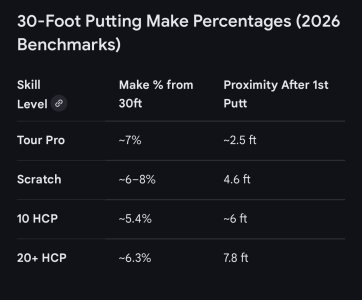
We’re not talking about short(ish) putts here. We’re talking proper lag putting, I’m a confident putter dare I say I believe personally I’m a good putter. But from 30feet the PGAT average of putts that length made is 7%, that same distance 38% of those world beating players still leave it short. So that’s going to be a big increase for club

So in my mind I go back to what I was taught as a kid, imagine a small dustbin lid size around the hole the aim is for any putt that length or longer to finish in that target area. Some will be long, some short, left or right but then I have a smaller area to work with than relying on exact pacing for a putt to finish exactly 2 feet past which is harder to judge unless everyone on here is a tour level putter which let’s be honest they are apparently šŸ‘€

The image attached is base on the latest data from Arcoss worldwide about miss range (proximity) at 30ft based on handicap. I’d say based on that my method and calling myself a decent putter is fair.

P.S remind me not to buy your book šŸ˜‰šŸ˜‚
 

Attachments

  • IMG_7196.jpeg
    IMG_7196.jpeg
    109.3 KB · Views: 4
No, it's the opposite - I have the confidence to try and play the correct pace to the hole, not smash it past for fear of my ego taking a hit if I leave one short. :LOL:

Sometimes maybe yes - but I think the number of times you hit it too hard and dead on line so it drops is severely outweighed by the number of times it misses the hole and leaves you a six footer. You will three-putt many more times if you consistently hit it well past the hole.

You are talking as if we can all aim 2-3 feet past and leave it exactly 2.5 feet past the hole. Of course we don't. The whole key to understanding this, is about dispersion. If you aim for dead weight at the hole and hit ten putts, and you have a two-feet front and back dispersion, some of them will be two feet short, some two feet past, but likely all of them will be easily holeable. If you hit ten putts to a target of three feet beyond the hole though, with the same dispersion, it now means some of them are five-footers which are not tap-ins and very missable. The whole concept is around reducing wasted shots (i.e. three-putts) not draining the occasional wonder putt for birdie.

I understand what your saying, but you're equating "never up never in" with smashing it past the hole. And yes we've all seen people do this in matchplay when they have a free putt.

Long range putting is all about distance control and leaving it close. 1 foot short is close.

But most of putting is short range: 2nd (or 3rd) putts, a putt to get up and down. That represents the majority of putting, and leaving those short is not a good outcome.

If you have a flat 4 foot putt and you knock it on the correct line but leave it a foot short, that is a poor strategy. If you roll it with 5 feet of pace it will drop, if you hit it with 6, 7 or even 8 feet of pace it will still drop. Just think of Tiger, smashing the ball into the back of the cup again and again. The best putters have never been golfers dribbling the ball into the hole.
 
Whilst I get your point that’s overly simplistic and majority of club golfers will have far more variables than pace/line due ability and handicap.

Most don’t even start the ball on the line they’ve decided the putt should have so there’s another variable having that ability alone. Weather is another as winds can affect putts as can rain. So that’s 4 so far and that’s before you’ve even taken into account distance of the putt so there’s 5, then there is what do you want left if you do miss, left to right, right to left, uphill or downhill. My preference would be a short right to left uphill putt!

We’re not talking about short(ish) putts here. We’re talking proper lag putting, I’m a confident putter dare I say I believe personally I’m a good putter. But from 30feet the PGAT average of putts that length made is 7%, that same distance 38% of those world beating players still leave it short. So that’s going to be a big increase for club

So in my mind I go back to what I was taught as a kid, imagine a small dustbin lid size around the hole the aim is for any putt that length or longer to finish in that target area. Some will be long, some short, left or right but then I have a smaller area to work with than relying on exact pacing for a putt to finish exactly 2 feet past which is harder to judge unless everyone on here is a tour level putter which let’s be honest they are apparently šŸ‘€

The image attached is base on the latest data from Arcoss worldwide about miss range (proximity) at 30ft based on handicap. I’d say based on that my method and calling myself a decent putter is fair.

P.S remind me not to buy your book šŸ˜‰šŸ˜‚

No. There's only 2 variables you can control: how hard you hit it and the starting line.

If you don't hit it hard enough to reach the hole you will never hole anything, regardless of the line. If you hit it hard enough you will start to hole some putts.
 
I understand what your saying, but you're equating "never up never in" with smashing it past the hole. And yes we've all seen people do this in matchplay when they have a free putt.

Long range putting is all about distance control and leaving it close. 1 foot short is close.

But most of putting is short range: 2nd (or 3rd) putts, a putt to get up and down. That represents the majority of putting, and leaving those short is not a good outcome.

If you have a flat 4 foot putt and you knock it on the correct line but leave it a foot short, that is a poor strategy. If you roll it with 5 feet of pace it will drop, if you hit it with 6, 7 or even 8 feet of pace it will still drop. Just think of Tiger, smashing the ball into the back of the cup again and again. The best putters have never been golfers dribbling the ball into the hole.
Knocking them 3 foot by is also not a good outcome. Ideally you want it to go in. šŸ˜‚ Nobody is saying try and leave it short. I'm saying I try and hit it at 'dropping in the hole' speed. If you try and play a speed that's two or three feet past the hole, you effectively reduce the size of the hole, because with more speed it is more likely lip out rather than catch the edge and drop. If you hit it hard so it "has a chance" then it has to be pretty much bang on line to go in.

We're not comparing ourselves to Tiger, how pointless is that? A man who probably hit 500 putts a day in practice and played on the fastest greens in the world. I can't relate to that. I just want to cut three-putts out of my game.
 
No. There's only 2 variables you can control: how hard you hit it and the starting line.

If you don't hit it hard enough to reach the hole you will never hole anything, regardless of the line. If you hit it hard enough you will start to hole some putts.
As I said simplistic and totally wrong! I hole plenty of putts but also know when reading it the best miss is one that leaves me the shortest and safest 2 putt from distance and very very rarely 3 putt .

Also if we’re talking short putts I’m certainly not hitting a 5-12ft putt with the speed to go 3 foot past. It’s makes the target smaller, the line less accurate and I prefer my putts to have less chance of lipping out. But you know best šŸ‘Œ
It's a best seller, comes with a free DVD :ROFLMAO:
I’d rather watch a Leadbetter video šŸ˜‚
 
What sort of nonsense pie in the sky talk is that? You'd rather be further away from the hole, because in some mythical parallel dimension it might have gone in? Both putts missed. One foot is a tap-in, two feet is maybe a tap-in, but maybe requires a bit more thought. I'd rather be putting from one foot than two feet, every single time, I do not care how it got there.
Taking 1 single putt in isolation I would agree with you....so if you need to 2 putt from 10-15ft to win a tournament....yes absolutely you are going to play so that the three putt doesnt come in to the equation and the "lag" is the correct option.

But over a longer term, and many dozens of putts over the course of a season, the player who hits his putts so they go past the hole by 20 inches (I think Dave Pelz said 17" past the hole was optimal pace) will hole more "first putts" than he will have 3 putts.

So whilst you will be level par with all your misses short to 1ft, someone else who takes the risk of hitting it long (within sensible reason of course) is likely to be under par over the course of many holes in this putting scenario.

From 20-30ft....yeah...us amateurs just need to get in inside the proverbial dustbin lid.
 
Yes sound is an important feedback element.

Have you never hit a top flite before? Maybe I should go and test this out on the range with some earplugs, I reckon I will be able to feel the difference, especially with the putter.
I did this once....put some Black Sabbath on the Walkman (that's how long ago it was!!) and played a knockout between various randomly selected balls with their logos sharpied out....softer ball going through to the next round. Did it three or four times and the ProV1 was in the final two balls every time and the Molitors never got past round 1.
 
Taking 1 single putt in isolation I would agree with you....so if you need to 2 putt from 10-15ft to win a tournament....yes absolutely you are going to play so that the three putt doesnt come in to the equation and the "lag" is the correct option.

But over a longer term, and many dozens of putts over the course of a season, the player who hits his putts so they go past the hole by 20 inches (I think Dave Pelz said 17" past the hole was optimal pace) will hole more "first putts" than he will have 3 putts.

So whilst you will be level par with all your misses short to 1ft, someone else who takes the risk of hitting it long (within sensible reason of course) is likely to be under par over the course of many holes in this putting scenario.

From 20-30ft....yeah...us amateurs just need to get in inside the proverbial dustbin lid.
Not convinced this is true. If you aim to hit it 2 feet past and hit it hard you’re giving yourself a 3 to 4 footer. You are also effectively making the hole smaller. The faster the ball hits the hole, the more chance there is of it lipping out.
 
Not convinced this is true. If you aim to hit it 2 feet past and hit it hard you’re giving yourself a 3 to 4 footer. You are also effectively making the hole smaller. The faster the ball hits the hole, the more chance there is of it lipping out.
But you wont hit it hard every time...a few you will hit weak (most of us do) and leave within 6 inches of the hole.

Yes the faster the ball hits the hole the more chance there is of it not dropping...but we're not (well...I'm certainly not :ROFLMAO: ) talking about balls that are consistently hit 5 or 6 ft past.


I just wish I could myself execute this "firm paced" putting....I watch one of the guys I regularly play with and he is draining the ball into the middle of the hole at pace (hitting the back of the cup) every time he putts....me I still dribble the ball softly at deadish weight!!!! :ROFLMAO:
 
Top