• We'd like to take this opportunity to wish you a Happy Holidays and a very Merry Christmas from all at Golf Monthly. Thank you for sharing your 2025 with us!

Local Rules for bridges over hazards

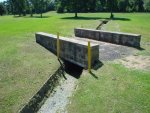
I have just thought about a couple of examples on my course where a stream runs under a graveled bridge through a conduit similar to the photo above, it has always been assumed that they are bridges over hazards and there are no hazard markings to say otherwise.

But if I now read things correctly free relief should be available from such a bridge. Is this correct.
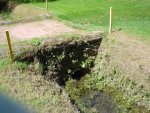
 
Yes but they are not bridges. The structure is a tunnel. Think of the difference between a railway tunnel and a railway bridge but it happens to conduct water.

Spot the difference. The first is a tunnel, the second is a bridge.
The second is in the WH but only to the extent of the margins unless a LR extends the margin to include the whole construction.
But the first isn't unless a local rule says it is.
 

Attachments

  • Bridge-0010.jpg
    Bridge-0010.jpg
    82.3 KB · Views: 65
  • Bridge-0016.jpg
    Bridge-0016.jpg
    70.6 KB · Views: 46
Last edited:
Yes but they are not bridges. The structure is a tunnel. Think of the difference between a railway tunnel and a railway bridge but it happens to conduct water.

Spot the difference. The first is a tunnel, the second is a bridge.
The second is in the WH but only to the extent of the margins unless a LR extends the margin to include the whole construction.
But the first isn't unless a local rule says it is.

Great that is good to know I will make enquires at the club. The photo on the left could have been taken on our 7th.
 
I am not wanting to be pedantic, but does it say anything in the rules about the tunnel type bridge, I raised this with one of the Lancashire rules ladies yesterday and she said she thought that type of bridge should still be part of the hazard?
 
I am not wanting to be pedantic, but does it say anything in the rules about the tunnel type bridge, I raised this with one of the Lancashire rules ladies yesterday and she said she thought that type of bridge should still be part of the hazard?

Direct the lady's attention to this part of the definition of a water hazard:

A "water hazard" is any sea, lake, pond, river, ditch, surface drainage ditch or other open water course


The key word is open. The section of a ditch which is channelled through a closed pipe is not open and is thus not a water hazard. Anything over that section is not in a water hazard.
 
Direct the lady's attention to this part of the definition of a water hazard:

A "water hazard" is any sea, lake, pond, river, ditch, surface drainage ditch or other open water course


The key word is open. The section of a ditch which is channelled through a closed pipe is not open and is thus not a water hazard. Anything over that section is not in a water hazard.

However, if the Committee decides to include it in the water hazard, it becomes part of the water hazard and must be played as marked.
Committees have some discretion in marking the course and should make it clear and easy for players to play within the Rules.
 
That is what I was saying to her, but as most of our bridges (and we have a lot) are tunnel type bridges I want to make sure I get it right before asking the club to mark them better, so even if the tunnel is only 3 feet long, it is still not classed as an open water course?
 
I checked our place yesterday & was a little surprised to find that in fact ALL our 'bridges' are over ditch conduits (pipes) so not in the hazard. As their surfaces are various, gravel, bark & bare soil..... would this local rule cover the situation even when sometimes the surface material spills out beyond the bridge limits?

OBSTRUCTIONS (Rule 24)
An "obstruction" is anything artificial.
Examples of an obstruction are Buggy paths, 150-yard marker posts, Knee & bridge rails, rubbish bins, the netting behind the 9th tee, paths over bridges & the gravelled flower bed next to the 13th tee and sprinklers. Relief is a free drop at the Nearest Point of Relief (Note 8) or if the obstruction is movable it can be moved and returned after playing.

Still seems to be a bit of a 'minefield'
 
That is what I was saying to her, but as most of our bridges (and we have a lot) are tunnel type bridges I want to make sure I get it right before asking the club to mark them better, so even if the tunnel is only 3 feet long, it is still not classed as an open water course?
.
Confirmed by the R&A some years ago. But they did suggest that short lengths between stretches of open water may be better included within the total WH margin.
 
That is what I was saying to her, but as most of our bridges (and we have a lot) are tunnel type bridges I want to make sure I get it right before asking the club to mark them better, so even if the tunnel is only 3 feet long, it is still not classed as an open water course?

The Committee should keep the markings simple - for both maintenance and players.
 
I checked our place yesterday & was a little surprised to find that in fact ALL our 'bridges' are over ditch conduits (pipes) so not in the hazard. As their surfaces are various, gravel, bark & bare soil..... would this local rule cover the situation even when sometimes the surface material spills out beyond the bridge limits?

OBSTRUCTIONS (Rule 24)
An "obstruction" is anything artificial.
Examples of an obstruction are Buggy paths, 150-yard marker posts, Knee & bridge rails, rubbish bins, the netting behind the 9th tee, paths over bridges & the gravelled flower bed next to the 13th tee and sprinklers. Relief is a free drop at the Nearest Point of Relief (Note 8) or if the obstruction is movable it can be moved and returned after playing.

Still seems to be a bit of a 'minefield'
.
If the paths over bridges are artificially surfaced and are not over open water courses the LR above is correct.

The spread of gravel outside the original limit of a path is a perennial problem which can only be determined on a case by case basis.
The individual pieces of gravel are of course loose impediments in their own right, whether on the path or not.
 
Last edited:
.
Confirmed by the R&A some years ago. But they did suggest that short lengths between stretches of open water may be better included within the total WH margin.

Coming back to this thread as I missed this reply.
It seems very ambiguous that they say may be better included.
 
Top