Drop Zone

Region3

Ryder Cup Winner
Joined
Aug 4, 2009
Messages
11,860
Location
Leicester
Visit site
Is it possible to have a drop zone that can be used for a lost ball as well as if a ball has finished in a water hazard?

I know it might sound like a stupid question, but you never know.

Thanks.
 
No. There is only one option for a lost ball. (If options can come in ones)

Thank you.

We have a lateral water hazard on our 18th which is almost impossible to know if a ball has remained in or not.

It would have been a much easier option than educating the majority of the members that they have to be almost certain their ball is in there to be able to take a drop.

Wishful thinking on my part. Thanks for the quick reply though :thup:
 
Thank you.

We have a lateral water hazard on our 18th which is almost impossible to know if a ball has remained in or not.

It would have been a much easier option than educating the majority of the members that they have to be almost certain their ball is in there to be able to take a drop.

Wishful thinking on my part. Thanks for the quick reply though :thup:
Is the lateral water hazard in play from the tee? Sounds like a good case for a local rule allowing you to play a second ball provisionally, even though the original ball may be in a water hazard. See specimen local rules in the rules book.
 
Is the lateral water hazard in play from the tee? Sounds like a good case for a local rule allowing you to play a second ball provisionally, even though the original ball may be in a water hazard. See specimen local rules in the rules book.

Not on my understanding of the situation Region 3 presents. He tells us that it is almost impossible to know whether or not a ball (not found) is in the water hazard. He was looking hopefully for a provision for a single procedure (a drop zone) for a ball lost maybe in the water hazard, maybe outside it.

The situation does not meet one of the criteria for the local rule you refer to. It has to be the case that if the original ball is not found, it is known or virtually certain that it is in the water hazard
 
Is there rough in front of the hazard? It might be sensible for the club to make the margin for the hazard to be on this side of the rough or to cut the rough down up to the edge of the hazard.
 
Thank you.

We have a lateral water hazard on our 18th which is almost impossible to know if a ball has remained in or not.

It would have been a much easier option than educating the majority of the members that they have to be almost certain their ball is in there to be able to take a drop.

Wishful thinking on my part. Thanks for the quick reply though :thup:

Educate them to take a provisional, at least they wouldn't have to walk back.
 
The issue is people clattering one into the trees and because the trees are in the hazard they assume the ball must be.
How on earth they think a ball travelling at 100+ mph hitting a tree can't ricochet more than 10 yards is beyond me, but it's not the first and won't be the last time that I'm surprised at some people's grasp on reality.

I'm off to fetch my crayons, back in a bit with a pic to explain.
 
Not on my understanding of the situation Region 3 presents. He tells us that it is almost impossible to know whether or not a ball (not found) is in the water hazard. He was looking hopefully for a provision for a single procedure (a drop zone) for a ball lost maybe in the water hazard, maybe outside it.

Spot on.
 
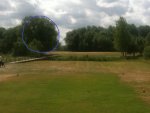
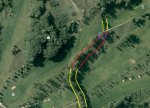
The overhead shows roughly were the hazard is marked, and the blue circle shows the same tree in both pics.

The direct line to the green is straight over the end of the bridge, so if you make it over/past/through the first tree I don't see how anyone can say with virtual certainty that the ball is in the hazard, unless they go to the right of the first tree with a draw/hook.

Even if you see the ball drop in the hazard off the first tree, between it and the bridge is junk so there's no useful place to drop anyway.

I used to think that people kept hitting from the tee until they got one that was definitely in play, but the last couple of weeks or so I've heard of people clattering into the trees (which you can't see behind the first one) and dropping over the bridge to the side of the first tree, because x told them they could.

Not that it's my responsibility as I have no part of any committee at the club, but I was trying to think of an alternative solution.

BLGC 18 TEE.jpgBLGC 18.jpg
 
My interpretation would be that even if a ball was known to be in the hazard in the area of the blue circle there is almost no way that the last point at which is crossed the hazard margin would enable them to drop anywhere other than behind the trees on the left ie even if it went into the lateral area the opposite margin not nearer the hole doesn't seem an option as marked on the map (arguably badly marked!).

The further left you hit it the more likely that the opposite margin (right of the tree) becomes but the less likely you have korvc it went in the hazard (from the tee).

Looks like a lost ball is the reality most of the time here as it's portrayed - tough one.
 
My interpretation would be that even if a ball was known to be in the hazard in the area of the blue circle there is almost no way that the last point at which is crossed the hazard margin would enable them to drop anywhere other than behind the trees on the left ie even if it went into the lateral area the opposite margin not nearer the hole doesn't seem an option as marked on the map (arguably badly marked!).

The further left you hit it the more likely that the opposite margin (right of the tree) becomes but the less likely you have korvc it went in the hazard (from the tee).

Looks like a lost ball is the reality most of the time here as it's portrayed - tough one.

I can't argue with badly marked (but the first red stake is next to the left corner of the bridge), but you are right in that the opposite margin is not a serious option. Neither is where it last crossed if it hit the first tree, or even went over the first tree. The only decent (legal) drop at the moment is if you enter the hazard from the right side of the first tree.

This is why I've been mentioning to them for the last couple of years that a drop zone behind the yellow line might be a better option, both for the player having a reasonable shot and also to prevent those who misunderstand the dropping procedure not getting an unfair advantage over those that do it properly.

It still wouldn't prevent people wrongly assuming their ball is in the hazard though. The only way I can see round that is to remove all rough from around the hazard and keep it that way, but I can't see that happening.

I'd love to hear any other suggestions anyone might have.
 
I can't argue with badly marked (but the first red stake is next to the left corner of the bridge), but you are right in that the opposite margin is not a serious option. Neither is where it last crossed if it hit the first tree, or even went over the first tree. The only decent (legal) drop at the moment is if you enter the hazard from the right side of the first tree.

This is why I've been mentioning to them for the last couple of years that a drop zone behind the yellow line might be a better option, both for the player having a reasonable shot and also to prevent those who misunderstand the dropping procedure not getting an unfair advantage over those that do it properly.

It still wouldn't prevent people wrongly assuming their ball is in the hazard though. The only way I can see round that is to remove all rough from around the hazard and keep it that way, but I can't see that happening.

I'd love to hear any other suggestions anyone might have.

I think you have summed it up pretty well.

1. Removing all the rough may not be enough - Far to many options for a ball hitting a tree to travel (as you already mentioned).
2. I think that the use of the lateral designation here is too broad and fundamentally leads people to believe they can drop out such that they have a shot to the green. Personally I would probably designate most of it as yellow - and definitely the early section left of the bridge on the tee side (it can still be red on the further side for second shots violently hooked into the stream...:))
 
This is the specimen local rule I was referring to:

1. Water Hazards; Ball Played Provisionally Under Rule 26-1

If a water hazard (including a lateral water hazard) is of such size and shape and/or located in such a position that:
(i) it would be impracticable to determine whether the ball is in the hazard or to do so would unduly delay play, and
(ii) if the original ball is not found, it is known or virtually certain that it is in the water hazard,
the Committee may introduce a Local Rule permitting the play of a ball provisionally under Rule 26-1. The ball is played provisionally under any of the applicable options under Rule 26-1 or any applicable Local Rule. In such a case, if a ball is played provisionally and the original ball is in a water hazard, the player may play the original ball as it lies or continue with the ball played provisionally, but he may not proceed under Rule 26-1 with regard to the original ball.
In these circumstances, the following Local Rule is recommended:

“If there is doubt whether a ball is in or is lost in the water hazard (specify location), the player may play another ball provisionally under any of the applicable options in Rule 26-1.
If the original ball is found outside the water hazard, the player must continue play with it.
If the original ball is found in the water hazard, the player may either play the original ball as it lies or continue with the ball played provisionally under Rule 26-1.
If the original ball is not found or identified within the five-minute search period, the player must continue with the ball played provisionally.
PENALTY FOR BREACH OF LOCAL RULE:
Match play – Loss of hole; Stroke play – Two strokes.

This would seem to help with the problem described, and we have it on one of our holes which has a water hazard hidden from the tee.

They seem to have marked penalty dropping zone in pro tournaments, but these only seem to be used when it is known or virtually certain that the ball is in the water hazard. Otherwise it's 3 off the tee!
 
That wouldn't help Del, as my argument is that if you don't find your ball you cannot assume it's in the hazard because there is so much other junk that isn't a part of the hazard.
 
Del. That LR is NOT APPRORIATE to the situation described in the OP!
We have a somewhat similar situation at our par-3 15th hole, where there is a hidden water hazard in a dip to the right of the green in among some trees, where this local rule applies. Basically you can play a provisional if your first ball is seen to be heading in the general direction of the water hazard. If you find the original ball outside the hazard you must continue with it. If the ball is found inside the hazard, you may either play it as it lies, or continue with the provisional ball. You do not have the normal water hazard dropping options. If the original ball is not found, it is lost and you continue with the provisional ball. Seems like a fairly sensible rule to me.
 
We have a somewhat similar situation at our par-3 15th hole, where there is a hidden water hazard in a dip to the right of the green in among some trees, where this local rule applies. Basically you can play a provisional if your first ball is seen to be heading in the general direction of the water hazard. If you find the original ball outside the hazard you must continue with it. If the ball is found inside the hazard, you may either play it as it lies, or continue with the provisional ball. You do not have the normal water hazard dropping options. If the original ball is not found, it is lost and you continue with the provisional ball. Seems like a fairly sensible rule to me.

Yes. It is a sensible rule. In the appropriate circumstances.
But the OP is not describing those appropriate circumstances. In OP the ball could be lost in a multitude of places.

(If I understand the local rule correctly, it is for circumstances where you can't see it go in the hazard, but if not found, it can't be anywhere else?)
 
Yes. It is a sensible rule. In the appropriate circumstances.
But the OP is not describing those appropriate circumstances. In OP the ball could be lost in a multitude of places.

(If I understand the local rule correctly, it is for circumstances where you can't see it go in the hazard, but if not found, it can't be anywhere else?)
I think the water hazard rules are fine if you can clearly see the ball go into the hazard. However I can think of quite a few course and holes where the water hazards are hidden or partly hidden and with deep rough or trees nearby. Then the rules are less satisfactory, as it may be impossible to know or be virtually certain that the ball has gone into the water.
 
Last edited:
This is the specimen local rule I was referring to:

1. Water Hazards; Ball Played Provisionally Under Rule 26-1

If a water hazard (including a lateral water hazard) is of such size and shape and/or located in such a position that:
(i) it would be impracticable to determine whether the ball is in the hazard or to do so would unduly delay play, and
(ii) if the original ball is not found, it is known or virtually certain that it is in the water hazard,.....!


Del,
I was well aware that you were referring to this local rule when I said in Post #5 that it could not be used in the situation described by the OP - and gave the reason why. I’m sorry if I wasn’t clear enough, but the clue was in this bit:

The situation does not meet one of the criteria for the local rule you refer to. It has to be the case that if the original ball is not found, it is known or virtually certain that it is in the water hazard.


I’ve highlighted that criterion above.
 
Top